Brookfield Epoxy Flooring has spent more than 20 years on epoxy flooring in West Allis and the rest of the Milwaukee area, and the floors we think hardest about here are the ones where somebody strikes an arc for a living. A fabrication shop asks a coating to do something no garage or showroom does: sit a few feet from molten metal, hot slag and freshly cut steel, every shift.
So before we price a shop floor, we ask where the welding and cutting actually happens. The answer decides which parts of the slab get resin, which parts stay bare concrete, and where the line between them falls. A floor laid out that way holds up, while a floor coated wall to wall usually ends up with scorched patches in the busiest bay.
We also do the ordinary work: garages, basements, kitchens and offices. On a working industrial floor, though, the coating plan and the hot-work plan are the same document, and we treat them that way from the first walk-through.
A Welding Shop Inside an Allis-Chalmers Building
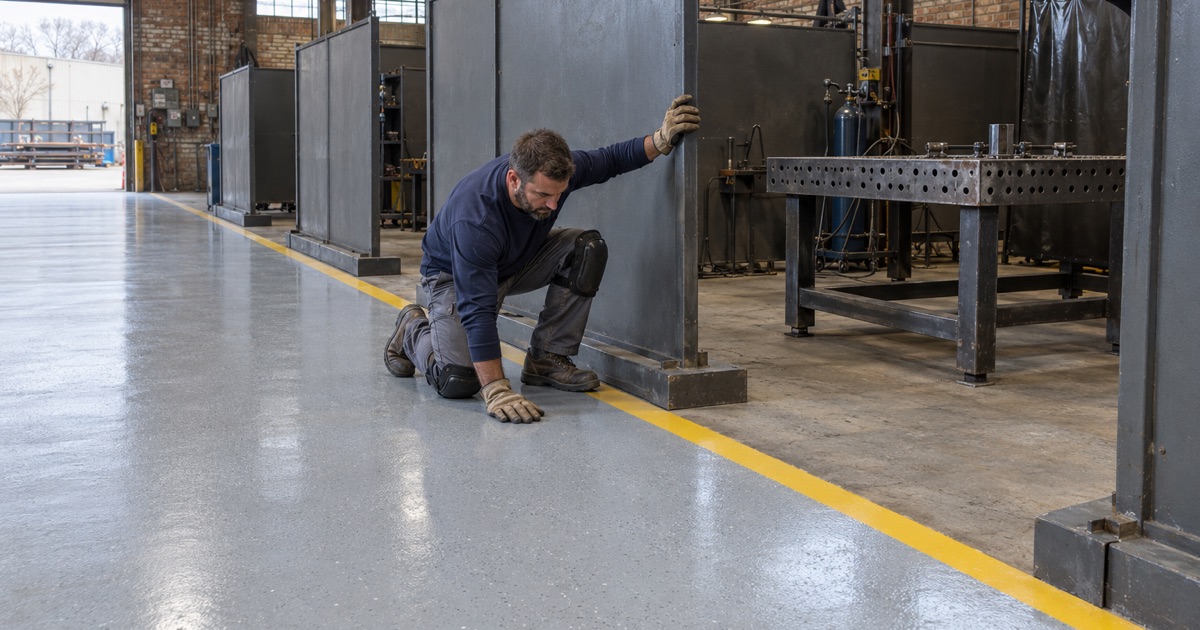
West Allis grew up around heavy manufacturing, and some of that work never left. Old Allis-Chalmers buildings still hold shops that cut, fit and weld steel, which is exactly the kind of floor where a resin system has to be planned around the work instead of the other way around.
Pressure vessels on W. Washington Street
At 6600 W. Washington St., inside West Allis city limits, Advance Boiler & Tank builds carbon-steel tanks and pressure vessels. A 2011 BizTimes profile described vessels made from carbon-steel plate, typically six or seven feet in diameter, with walls up to an inch thick and weights up to 110 tons. Those figures come from that dated profile, and we have not been inside the shop.
A trade directory lists the company as specializing in ASME Section VIII vessels. Whatever the current production mix, plate fabrication at that scale means long seams, repeated passes and a great deal of cutting, all of it throwing sparks toward the floor.
The Tank & Plate Shop and Welding Shop
The Wisconsin Historical Society record for 6600 W. Washington St. names the building the Allis Chalmers Mfg. Co. Tank & Plate Shop/Welding Shop, built by the company for exactly that work. It is a sprawling cream-brick, multi-block building, also recorded under the name Avalon Rail, with a modern two-story addition and a truck dock on the south side.
We mention it because it shows how long welding has shaped floors in this part of the city. A shop owner here is rarely starting from a clean slate; the slab carries decades of use, patches and old cracks, and we read all of that before quoting a coating.
Other working floors in the city
Unit Drop Forge on S. 62nd Street has made closed-die forged steel parts in West Allis since 1918. Smaller machine and fabrication shops along the old industrial corridors face the same basic question: which parts of the floor see hot metal, and which only see carts, people and forklifts?
Each of those shops has its own layout, so we never copy a zoning plan from one floor to the next. The weld stations, the cutting tables and the paths between them get measured where they actually sit.
Looking for epoxy-flooring closer to Pewaukee? See Pewaukee Epoxy-Flooring.
What OSHA’s Welding Rule Says About the Floor
Federal OSHA covers private employers in Wisconsin, and its welding and cutting standard, 29 CFR 1910.252, has several lines that land directly on the floor. None of them mention epoxy or any other coating. They describe fire prevention, and a shop has to fit its flooring choices inside them.
Sweeping, wetting, sanding and shielding
Under 1910.252(a)(2)(v), where combustible materials such as paper clippings, wood shavings or textile fibers are on the floor, the floor is swept clean for a radius of 35 feet. Combustible floors are to be kept wet, covered with damp sand, or protected by fire-resistant shields. Where floors have been wet down, people running arc welding or cutting equipment are to be protected from possible shock.
That language is about keeping fuel away from sparks. In practice it means the area around each weld station gets swept, shielded or wetted on a routine, and the floor finish has to tolerate that routine rather than complicate it.
Guards and the fire watch
Section (a)(1)(ii) calls for guards to confine heat, sparks and slag when the hazard itself cannot be moved. Section (a)(2)(iii) calls for a fire watch lasting at least a half hour after welding or cutting, where a fire watch is required.
Both rules assume the floor near the work will see sparks. Screens, curtains and blankets do most of the confining, but the floor at their base still catches whatever gets past them. During that half hour the floor around the station is part of what gets watched, which is one more reason to keep loose cardboard, rags and pallets off it.
What the rule leaves out
The standard does not endorse or rule out any floor coating, and we never present one as meeting it. Our job is narrower: lay out a floor system that leaves the shop’s hot-work program easy to run, and be honest about where resin does not belong.
Wetting down deserves a word of its own. A coated aisle that gets hosed or wet down near a weld station turns slick, so where a shop uses that method we broadcast quartz aggregate into the coating for grip and keep the smooth finish away from the wetted zone.
Spatter, Slag and a Thin Resin Film
Concrete does not burn. A resin coating is a thin organic film on top of that concrete, and molten spatter landing on it is a different event from spatter landing on a bare slab. The film is what gives a shop floor its color, its chemical resistance and its easy sweep, and it is also the part that reacts when hot metal lands.
What owners report
There is no coating maker’s written guidance on weld spatter that we can point to. What we have are owner reports from shops and garages: epoxy floors showing burn marks after years of MIG welding and torch cutting, burn marks appearing even with welding blankets down, and hot steel left on the floor after a cut melting a spot into the coating.
Those are reports, not lab results, and we treat them that way. They are consistent enough, though, that we plan a welding floor on the assumption that coated concrete inside the spatter range will mark.
Blankets, mats and backer board
The same owners describe welding blankets as most needed for torch cutting and MIG work. Some put cement backer board or rubber mats in front of benches so the drop zone takes the damage instead of the floor.
We are glad to plan around those habits. A coated floor with a bare or protected strip at each bench is far easier to keep looking right than one that relies on everyone remembering a blanket every time.
Choosing the system for the rest of the floor
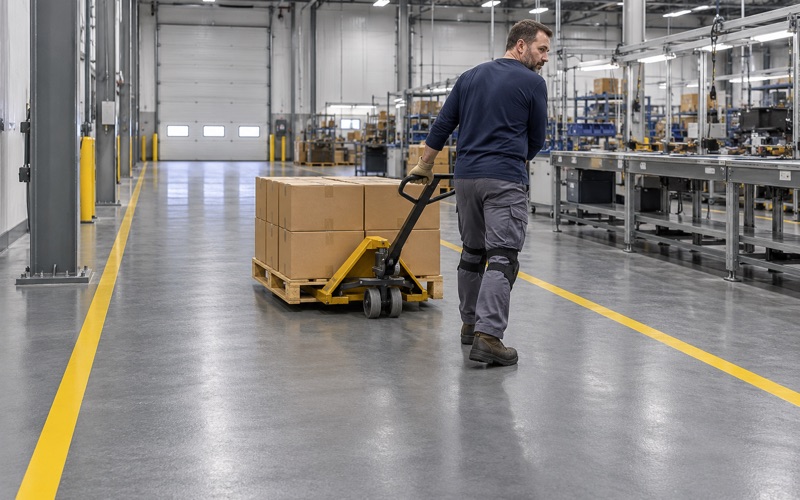
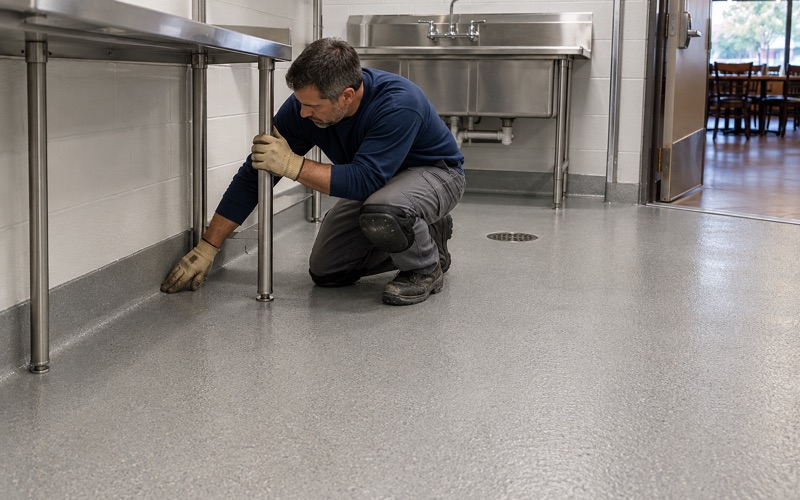
Outside the hot zone, the floor sees forklifts, pallet jacks, oil and solvents. That is where 100% solids epoxy, often with a quartz aggregate broadcast, or a polyaspartic topcoat earns its keep. We open every slab with a diamond grinder or shot blaster first, never acid, and the proposal names the product, the system build and the finished thickness so the shop can check what went down.
Where a shop expects the odd spark to reach a coated area anyway, we favor a system that can be sanded and recoated in sections. A scorched patch near a doorway is then a small repair over a weekend rather than a reason to strip the whole bay.
Bare Cells, Filled Cracks and Where the Coating Starts
The practical result is a zoned floor. We walk the shop with the person who runs it, mark each weld and cutting station, and draw the coating boundary on the plan before any grinding starts. That boundary goes into the written proposal along with the product and thickness for each zone, so the shop and our crew are working from the same drawing.
Weld and cutting cells
Inside each weld or cutting cell, the usual answer is bare concrete, sometimes treated with a lithium silicate densifier so it sheds less dust. Where a shop wants the cell coated anyway, we say plainly that shields and blankets become part of keeping that floor intact, and that marks are likely.
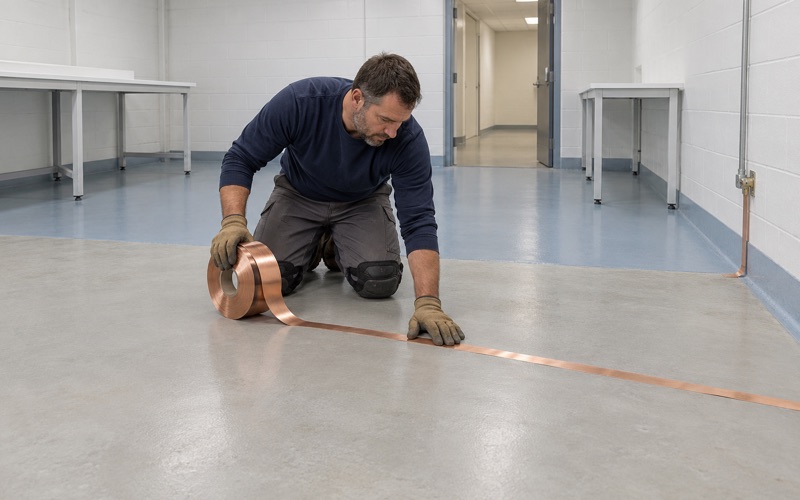
The coated assembly area and aisles start outside the spatter range. A clean edge there, ground and keyed into the slab, keeps the transition from lifting where carts and lift wheels cross it.
Filling cracks so sparks have nowhere to drop
Section 1910.252(a)(2)(i) says openings or cracks in floors are to be guarded so combustibles below are not exposed to sparks dropping through. In a shop with a basement, pits or a mezzanine, that matters well beyond appearance.
We read every crack and joint before quoting, and say so when a section of slab needs repair or replacement first. Control joints in working areas are filled with a semirigid joint filler before coating, which closes the gap and protects the joint edges from wheel traffic.
Testing an old slab before it is coated
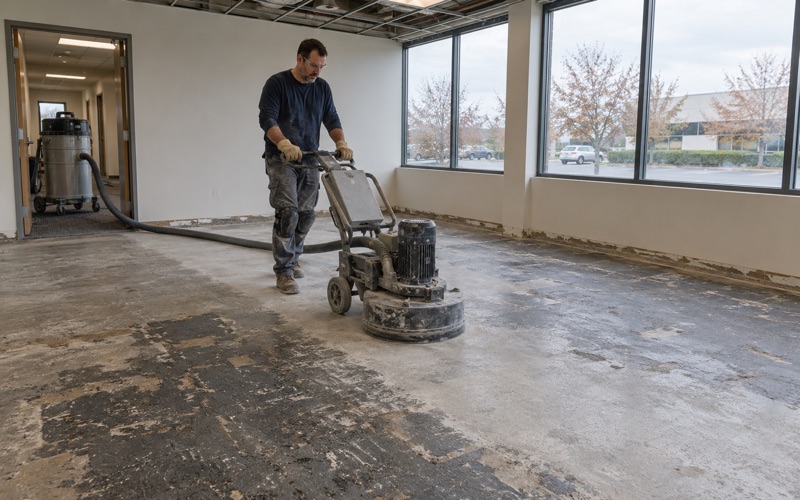
An older shop slab often carries patches or worn coatings from earlier tenants. We grind off what will not hold, then test moisture before anything goes down, using ASTM F2170 in-situ relative humidity probes or ASTM F1869 calcium chloride tests as a line item in the scope.
Before a shop signs, we also read the warranty exclusions aloud, with moisture coming up from below named first. Spatter and hot cut-offs are discussed in the same conversation, so nobody is surprised later by what the coating was never meant to take.
Permits and scheduling in West Allis
Commercial work that alters a building in West Allis goes through the city’s Plan Review Application with Building Inspection and Neighborhood Services. The 2026 fee resolution prices commercial alterations at $0.40 per square foot or $18 per $1,000 of value, at the director’s discretion, with a $150 minimum. We check whether a floor job needs that review before it goes on the calendar.
Shops rarely want to stop production for long, so we schedule zones in phases, including weekend and overnight windows. Curing runs on slab temperature and dew point rather than a calendar date, and we tell a shop in writing when a cold bay has to wait.
- 20+ Years Experience
- Moisture Testing in Every Scope
- Written Proposals and Contracts