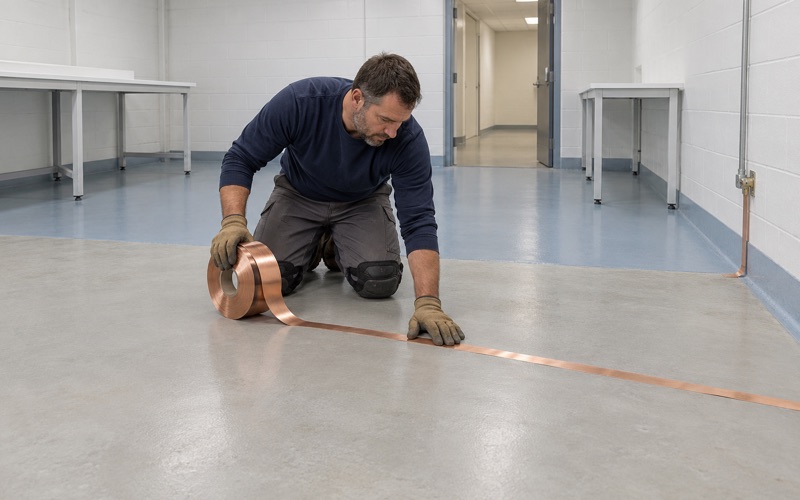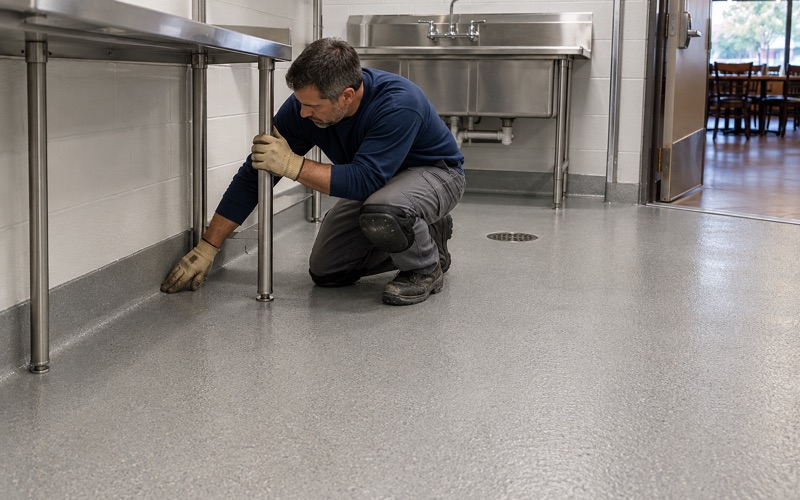
Brookfield Epoxy Flooring has spent more than 20 years on epoxy flooring in Wauwatosa and across the western Milwaukee suburbs, and the floors we are asked about here run from basements and garages to clinics and labs. What they share is a slab that has to be read, tested and prepared before anything goes on it.
Our proposals name the product, the system build and the finished thickness, so a facility manager or a homeowner can hold the quote up against what was actually installed. Before we price anything, we read the cracks, joints and any old coating, and we say so plainly when a slab needs repair or replacement first.
Some of the most demanding floors in this city are not in garages at all. They sit in rooms where animals are housed for research, and the standard those rooms answer to spells out what a floor has to do in unusually plain language. That standard is a useful yardstick for any floor that gets washed hard and often.
Animal Research on the Milwaukee Regional Medical Center Campus
Wauwatosa is a suburb immediately west of Milwaukee, named after the Potawatomi Chief Wauwataesie and the Potawatomi word for firefly. Its 2020 census population was 48,387, and the city is also home to a medical campus where research animals are housed under a written standard that few garage jobs ever have to meet.
The Biomedical Resource Center on Watertown Plank Road
The Medical College of Wisconsin’s Biomedical Resource Center sits on the Milwaukee Regional Medical Center campus at 8701 W. Watertown Plank Road, an address that geocodes inside Wauwatosa city limits. The college describes it as a centralized 95,000-square-foot facility that provides housing and care for the animals used in research throughout the college, supporting both terrestrial and aquatic species.
We have not worked in that building, and we have no knowledge of what is on its floors today. We bring it up because it shows how a floor is judged when the stakes are higher than appearance.
AAALAC Accreditation Since 1968
The college has remained continuously accredited by AAALAC since 1968. Accredited animal facilities are built and assessed against the Guide for the Care and Use of Laboratory Animals, an NIH-published reference that is guidance for accreditation rather than a statute.
That distinction matters when someone asks what a floor is required to be. In an accredited animal room, procedure room or cage-wash area, the floor would be specified against the Guide’s floor paragraph, and that paragraph is short enough to read line by line.
What That Means for a Floor Contractor
A floor in a room like that is not chosen from a color chart. It is chosen against written performance language, and a contractor who cannot explain how a system meets each line is guessing.
We approach any hard-washed floor the same way, whether it is a lab, an exam room or a grooming bay: the performance language comes first, and the product follows from it. That order keeps a coating from being sold on looks alone.
Looking for epoxy-flooring closer to West Allis? See Epoxy-Flooring Services in West Allis.
The Guide’s Floor Paragraph, Line by Line
The Guide’s section on floors, on pages 137 and 138 of the eighth edition, reads like a specification sheet. Each clause maps to something we can test, build or repair.
Moisture Resistant, Nonabsorbent, Impact Resistant
The Guide says floors should be moisture resistant, nonabsorbent, impact resistant and relatively smooth, although textured surfaces may be required in some high-moisture areas. Unsealed concrete is porous, which is why the materials the Guide lists include hard-surface sealed concrete rather than bare slab.
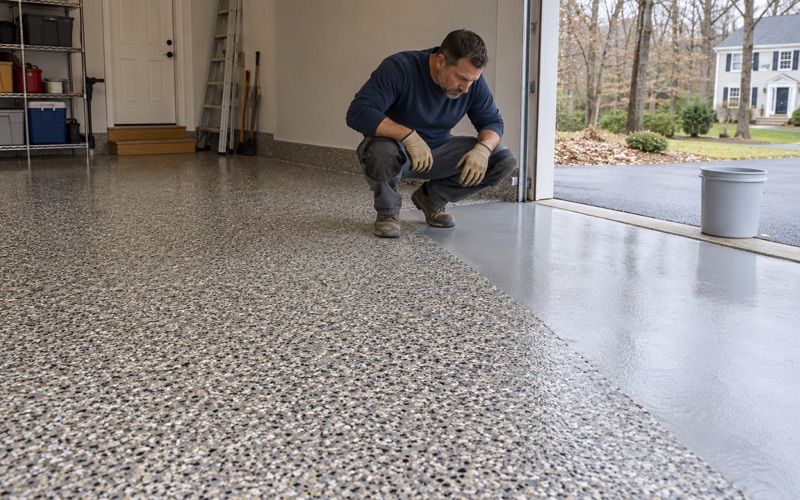
On a wet floor, that texture clause is where a quartz aggregate broadcast earns its place. We set the texture to the room’s use, because a profile coarse enough to grip under a hose can be harder to mop clean.
Easy to Repair
The Guide asks for floors that are easy to repair, and that line gets less attention than it deserves. A floor in a room that cannot sit empty for a week needs a system that can be cut out, patched and recoated in place, with the new section bonding to the old.
That is one reason we name the product in writing. A repair three years later goes faster and holds better when everyone knows exactly which resin and topcoat went down the first time.
The Materials the Guide Names
The Guide lists materials that have proved satisfactory: epoxy resins, hard-surface sealed concrete, methyl methacrylate, polyurethane and special hardened rubber-base aggregates. Epoxy is one entry on that list, not a requirement, and the right choice depends on the room.
For most washdown rooms we would build on 100% solids epoxy for its body, then weigh a polyurethane topcoat or a urethane cement system where cleaning chemicals are harsher. We explain that tradeoff in the proposal rather than defaulting to one answer.
Starting From an Open Slab
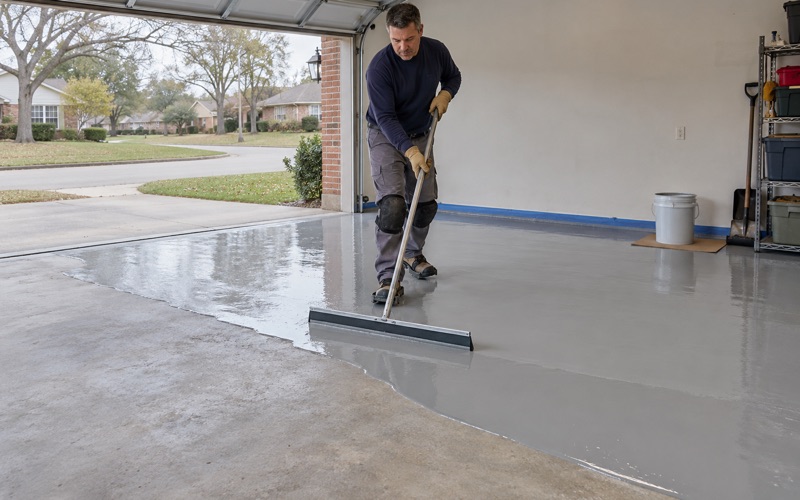
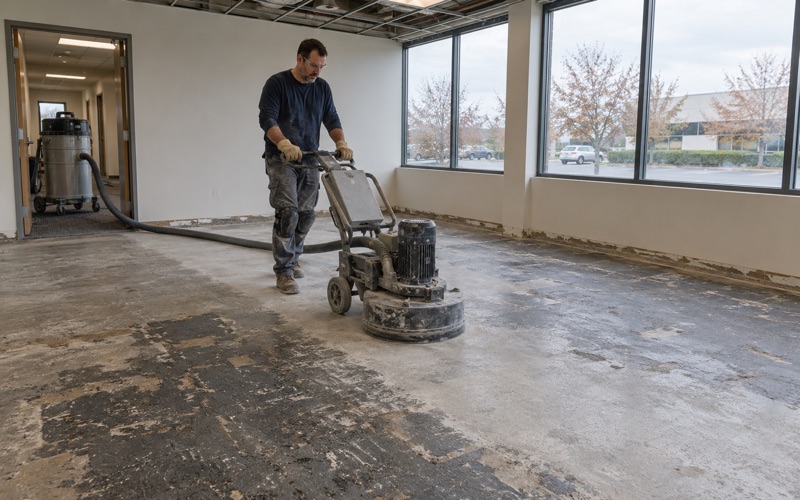
None of the Guide’s performance language holds if the coating does not bond. We open every slab mechanically with diamond grinding or shot blasting, never acid etching, to an ICRI CSP profile suited to the system, because a film sitting on a weak or contaminated surface will lift long before it wears through.
Older concrete brings its own problems. We watch for outgassing and pinholes during the primer coat on aged slabs, and we check for amine blush before recoating so each layer bonds to the last.
Monolithic Floors, Biologic Materials and Daily Disinfectant
Two clauses in the Guide do most of the work in an animal room. One is about seams; the other is about what the floor has to survive every day.
Why Seams Matter in an Animal Room
Depending on their use, the Guide says, floors should be monolithic or have a minimal number of joints. A joint is a place where liquid, bedding and debris collect, and a gap that cannot be cleaned is a gap that undermines everything else about the room.
A poured resin system answers that line better than tile or sheet goods, because it goes down as one continuous film. Where a slab has control joints that must stay, we fill them with a semirigid filler and carry the coating over them so the surface stays closed.
Floor-Wall Junctions
The Guide’s corridor guidance adds that floor-wall junctions should be designed to facilitate cleaning. In practice that means a coved base, where the floor resin turns up the wall in a smooth radius instead of meeting it at a hard corner.
A cove is built in the same pour sequence as the floor so there is no seam at the transition. Getting that radius smooth takes hand troweling, and it is the detail most worth inspecting when the job is done.
Urine, Biologic Materials and Cleaning Agents
The Guide asks for floors resistant to the action of urine and other biologic materials and to the adverse effects of hot water and cleaning agents. Disinfectants are chosen to kill organisms, not to be kind to a floor finish, and a coating that softens or stains under them will not stay nonabsorbent for long.
We ask for the actual cleaning products in use before recommending a topcoat. Chemical resistance varies by product and by chemical, so the honest answer comes from matching the two rather than from a brochure claim.
Rodent Rooms, Wet Mopping and Floors Across Wauwatosa
The Guide’s drainage section changes how a floor in some rooms is judged, and the same thinking carries into ordinary rooms here. A floor that gets mopped hard every day is a floor that has to be built for it.
Rodent Rooms Without Floor Drains
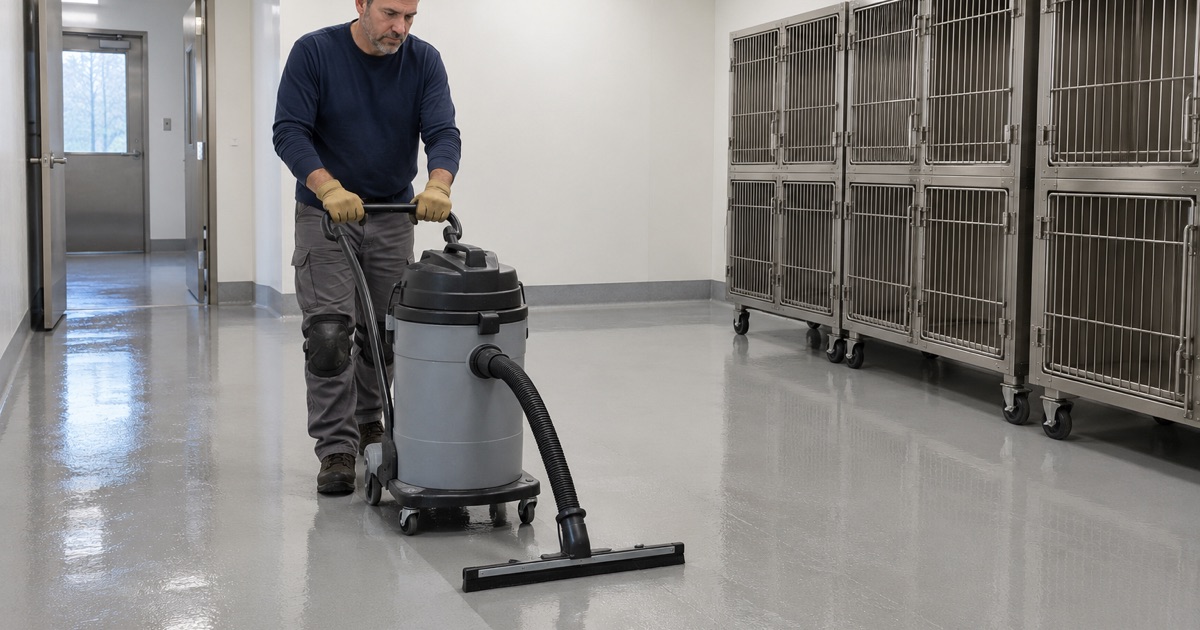
According to the Guide, floor drains are not essential in all animal rooms, particularly rodent rooms, which can be sanitized satisfactorily by wet vacuuming or mopping with appropriate cleaning compounds or disinfectants. With no drain, the only way water leaves the room is through the vacuum or the mop bucket.
That puts the weight on the surface itself. A rodent-room floor is judged by how it holds up to daily disinfectant mopping, so we favor a smooth, tight topcoat that a wet vacuum can clear completely over a heavy texture that holds water.
The cove matters even more here, since water pushed to the wall by a mop has nowhere else to go. A sealed, radiused edge lets the vacuum pick it back up instead of leaving it at the base of the wall.
Labs, Clinics and Exam Rooms
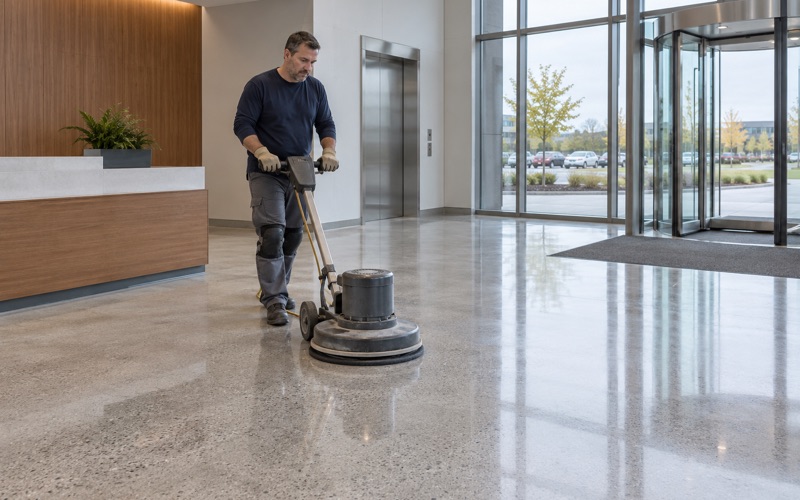
Most clinic and lab floors are far smaller than a research facility, but the same questions apply. A veterinary exam room, a dental operatory or a small lab benefits from a seamless floor, a coved base and a topcoat matched to its disinfectant.
These buildings usually have to stay open, so we schedule the work around their hours, including overnight and weekend windows. Grinding dust and slurry are collected on site and never washed into a floor drain or a storm sewer.
Coatings and Milwaukee County Air Quality
Milwaukee County sits whole in the Milwaukee 2015 ozone nonattainment area, designated in 2021 and classified Serious from January 2025. Wisconsin has no state architectural-coating VOC rule, so the national rule in 40 CFR 59 Subpart D sets the VOC limits for coatings sold here.
For an occupied clinic or lab, 100% solids epoxy has a practical advantage beyond the rule: there is little solvent to flash off into a building that has to stay in use. We ask about air handling and occupancy before choosing a primer and topcoat.
Garages and Basements
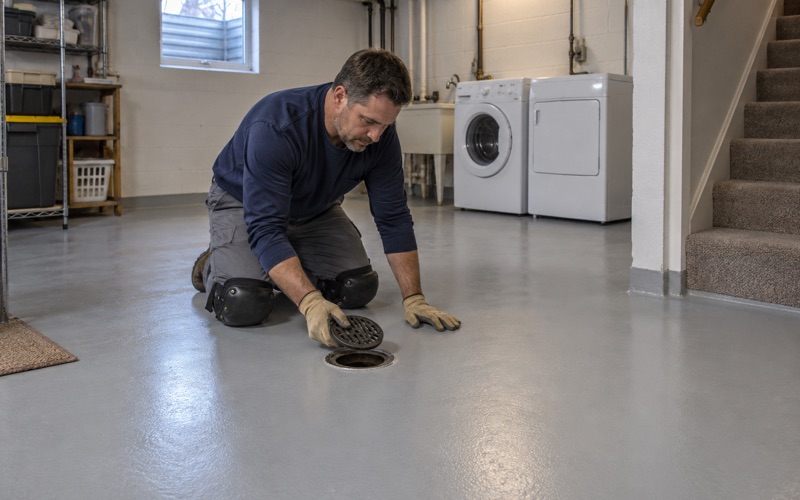
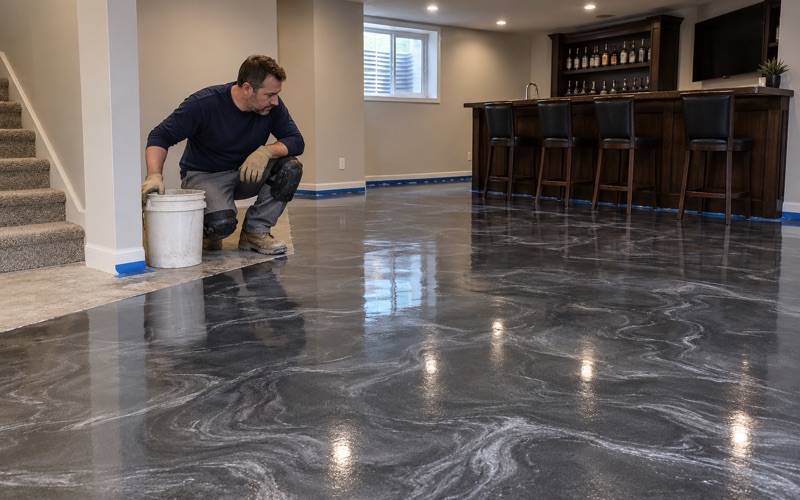
For homeowners, the usual floors are garages and basements. We moisture-test both as a line item in the scope, using methods such as ASTM F2170 relative humidity probes or ASTM F1869 calcium chloride tests, because Wisconsin does not require a vapor retarder under an unconditioned attached garage slab.
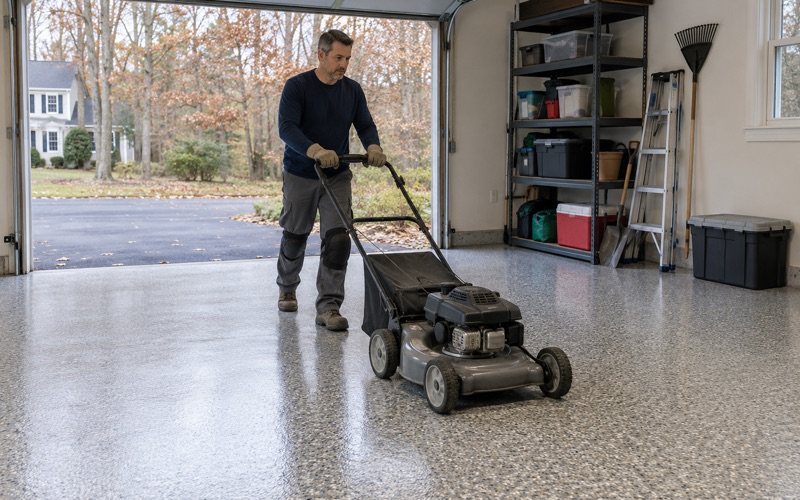
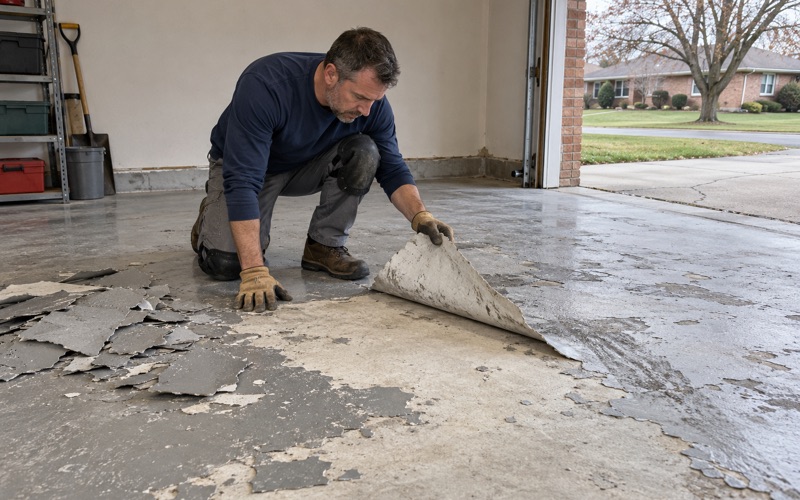
Garage systems are built for the road salt and calcium chloride brine that winter tracks in on tires, and curing is scheduled against slab temperature and dew point rather than the calendar. We will not sell a coating as a fix for water coming up through a slab, and we read the warranty exclusions aloud, moisture from below first.
Every home job gets a written contract before any deposit, with the products and any warranty written into it. If the work goes beyond coating, such as finishing a basement, we ask the City of Wauwatosa’s building department about permits before scheduling.
- 20+ Years Experience
- Moisture Testing in Every Scope
- Written Proposals and Contracts