Brookfield Epoxy Flooring has spent more than 20 years on epoxy-flooring in Waukesha and across the surrounding county, and much of that work comes down to one question: what happens to a floor when a vehicle sits on it and leaks. A car that rolls in and out every day spreads its drips around. A car that parks for months, or a display machine that cannot be moved at all, puts every drop on the same few square feet.
That is the floor this page is about. We coat garages, shops and showroom floors that hold parked vehicles, and we pick the system for how it handles fuel, motor oil and coolant, and for how cleanly a spill lifts off once somebody finally gets a rag under the car.
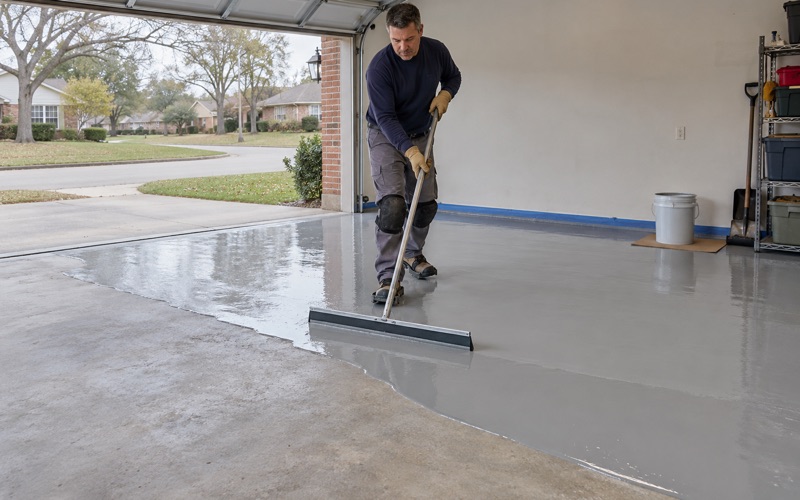
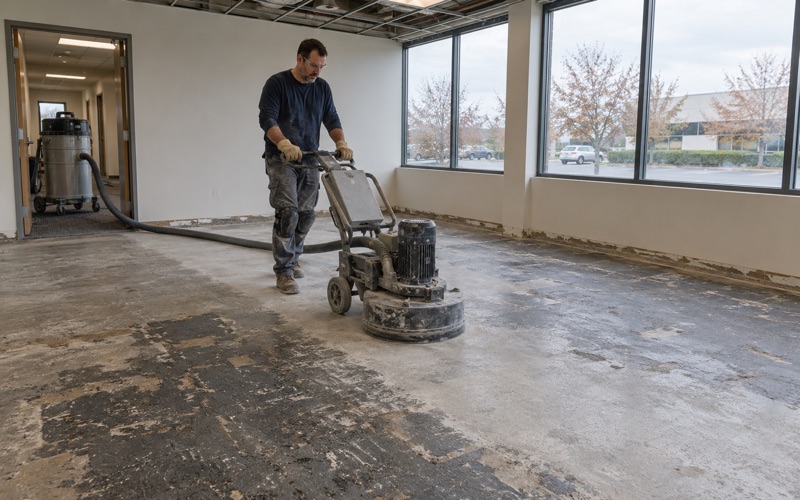
Before any of that, the slab gets opened with a diamond grinder or a shot blaster. We do not acid etch. The proposal then names the product, the build and the finished thickness, so the floor you get can be checked against the floor you were quoted.
Car Shows, Expo Halls and the Fire Code
The Forum halls on Northview Road
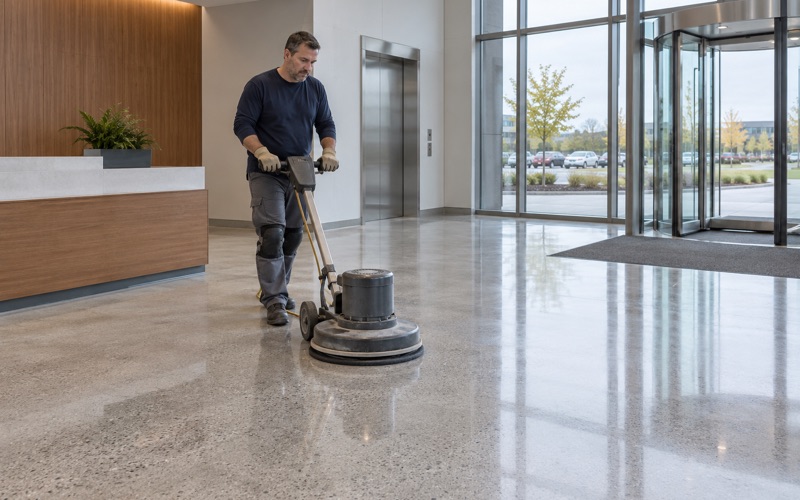
The Waukesha County Expo Center sits at 1000 Northview Road, inside the City of Waukesha. Its Forum Complex is three interconnected halls: the North Hall at 6,500 square feet and the South and East Halls at 6,900 square feet each. Each hall has a 10-by-12-foot overhead door, and the county describes the floors as high load-bearing concrete.
The county lists car shows among the events it books there, alongside tractor pulls, dog shows, trade shows and the county fair. That mix tells you what those halls are built for: heavy loads rolled in through a big door and parked on bare concrete for the length of an event.
We have not worked on that building. It is still a useful public example, because the same physics plays out in a Waukesha garage on a smaller scale.
What Wisconsin’s fire code asks of a display vehicle
Wisconsin’s fire code, SPS 314, adopts NFPA 1, and NFPA 1 points to NFPA 101 for exhibits in assembly buildings. The West Allis Fire Department summarizes that chain for State Fair Park, and the terms for a fuel-powered display vehicle are specific. The fuel tank can hold no more than one-quarter of its capacity or 5 gallons, whichever is less, and every fuel opening is locked and sealed.
At least one battery cable is removed and taped. Fueling and defueling inside the hall are prohibited, and the vehicle is not moved during exhibit hours. Batteries are charged outside the hall. The display needs a permit.
The rule is about fire, not floors
Nothing in that code chain mentions a floor coating, a drip pan or what the slab should be. The code limits fuel and movement to keep a crowded hall safe. What it does, as a side effect, is fix the vehicle in place with fuel still aboard for the whole show.
So the floor is left to whoever owns it. A hall that hosts car shows one weekend and a dog show the next has to recover from whatever the last event left behind, and a bare slab keeps a record of every drip.
Looking for epoxy-flooring closer to Milwaukee? See Epoxy-Flooring Services in Milwaukee.
One Parked Vehicle, One Wet Spot
Why a car that cannot move is hard on a floor
A daily driver drips a little in the driveway, a little at work and a little in the garage. A show car or tractor under those display rules drips in exactly one place from load-in to load-out. Any weep from a fuel line, an oil pan gasket or a radiator hose sits on the same patch of concrete the entire time.
On bare concrete that dwell is the problem. The slab is porous, and a puddle that sits for days has time to wick in and leave a dark stain that no degreaser fully pulls back out. A sealed or coated floor keeps the fluid on top, where it can be wiped.
The same pattern in a Waukesha garage
The home version of this is the project car that goes into the garage in the fall and does not come out until spring. It sits on one spot for months, often with a slow leak nobody has chased yet. By the time it rolls out there is a stain shaped like the oil pan.
We see this most in attached and detached garages that double as a workshop. A coated floor will not stop a car from leaking, but it changes a ruined patch of concrete into a cleanup job.
Waukesha has a large stock of these garages. Census figures count 14,790 owner-occupied detached homes in the city, and 3,605 housing units were built in 1939 or earlier, so many of the slabs under parked project cars are far from new.
Moisture comes before any of this
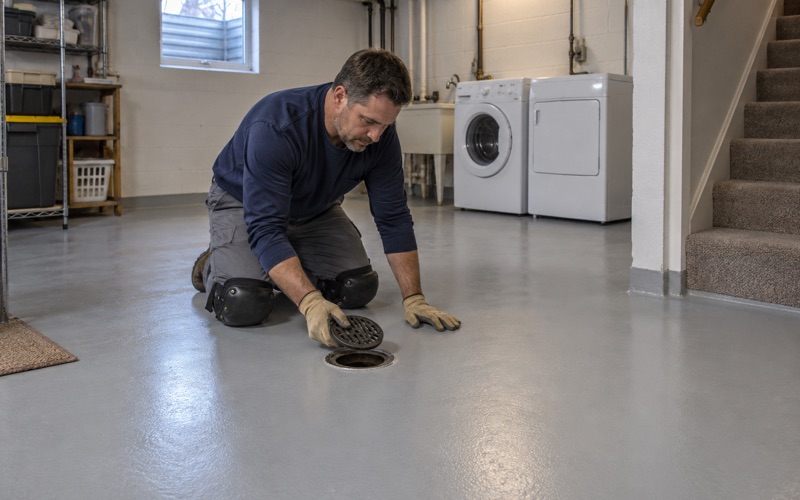
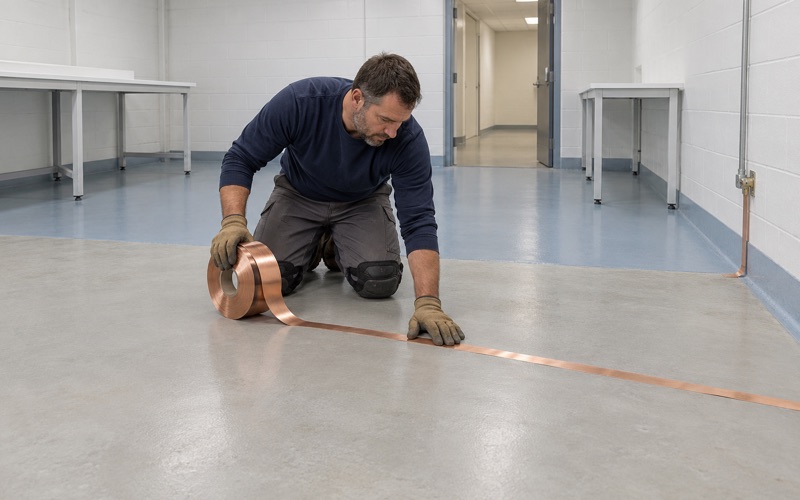
A floor that looks dry can still be pushing vapor up from below, and a coating over that vapor can blister. Moisture testing is a line item in our scope, garage slab or basement slab, using methods such as the ASTM F1869 calcium chloride test, ASTM F2170 in-situ relative humidity probes or the ASTM D4263 plastic sheet test. When the numbers say the slab needs a moisture-mitigation primer, the proposal says so before the job is sold.
The grinding step matters here too. Opening the slab to a measured ICRI CSP surface profile gives the primer something to grip, and it takes off the stained top layer a parked car leaves behind instead of coating over it.
How Coatings Handle Fuel, Oil and Coolant
Resistance is a system choice
Not every coating stands up to fuel the same way. A 100% solids epoxy base coat gives a dense, thick film, and a polyaspartic or polyurea topcoat over it adds a hard, chemical-resistant wear surface. Where a floor will see heavy fluid exposure, urethane cement is another option we put on the table.
We match the system to what will actually sit on the floor. A detailing bay, a project-car garage and a small shop that stores tractors over the winter each get a build chosen for that use, and the proposal names it.
Some owners only want bare concrete protected rather than a full color coat. A lithium silicate densifier hardens and tightens the surface, but it is not a film, so fluid that dwells on it for a whole winter can still stain. For a parked car, a coating is the stronger answer.
Cleanability matters as much as resistance
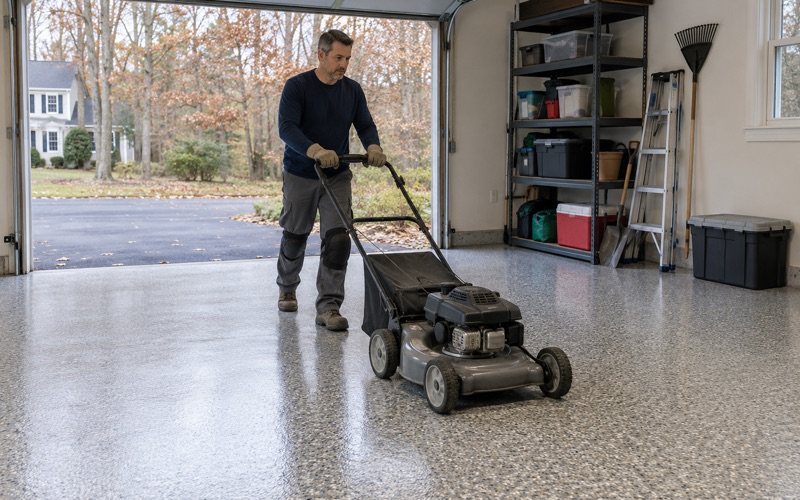
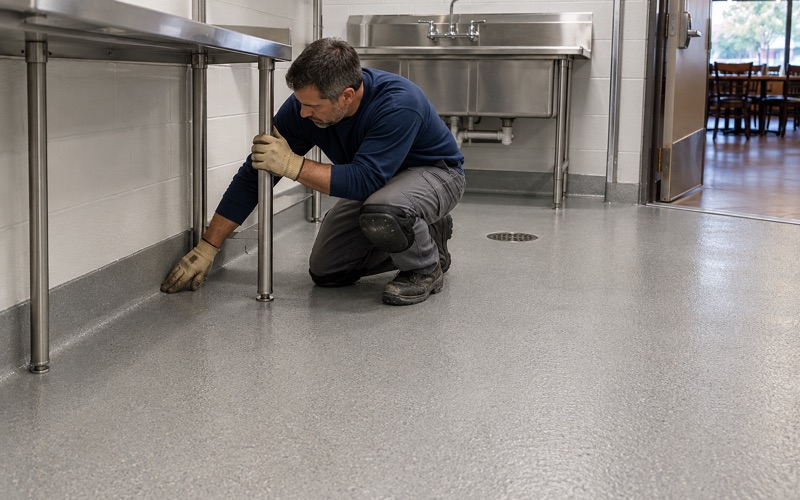
A floor that resists fuel but holds a stain in its texture is only half the job. A vinyl flake broadcast hides small marks and gives grip. A quartz aggregate broadcast gives more traction, and both are locked in under the topcoat so a spill wipes off the surface instead of settling into the texture.
The finish is a tradeoff between grip and how easily a rag clears it. We talk through that tradeoff on site, with the use of the floor in front of us.
Reading the slab before quoting
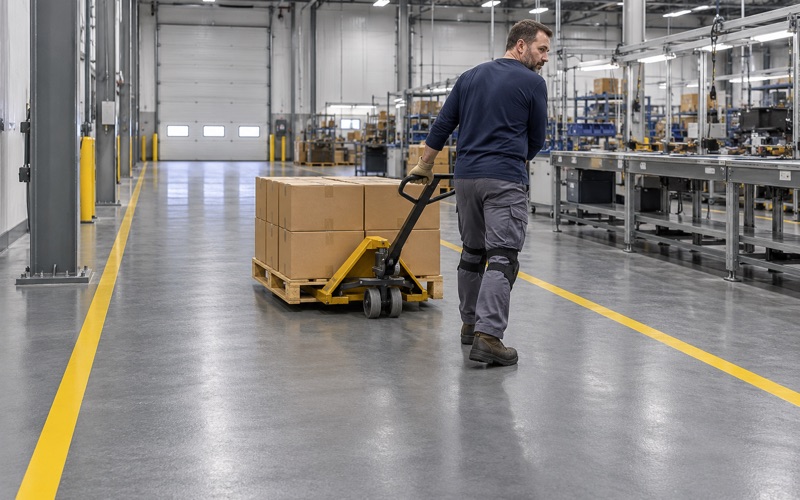
Cracks, control joints and any old coating tell us what a slab has been through. We read them before we quote, and we say plainly when a floor needs repair or replacement before it can be coated at all. In a shop or showroom, joints get a semirigid filler before the coating goes over them, so lift wheels and creepers do not break the edges.
Warranty exclusions are read out before the job is sold, with moisture from below named first. A coating is a surface, and we do not sell it as a fix for water coming up through a slab.
Trays, Mats and Waukesha Garage Floor Questions
Drip trays under any leaker
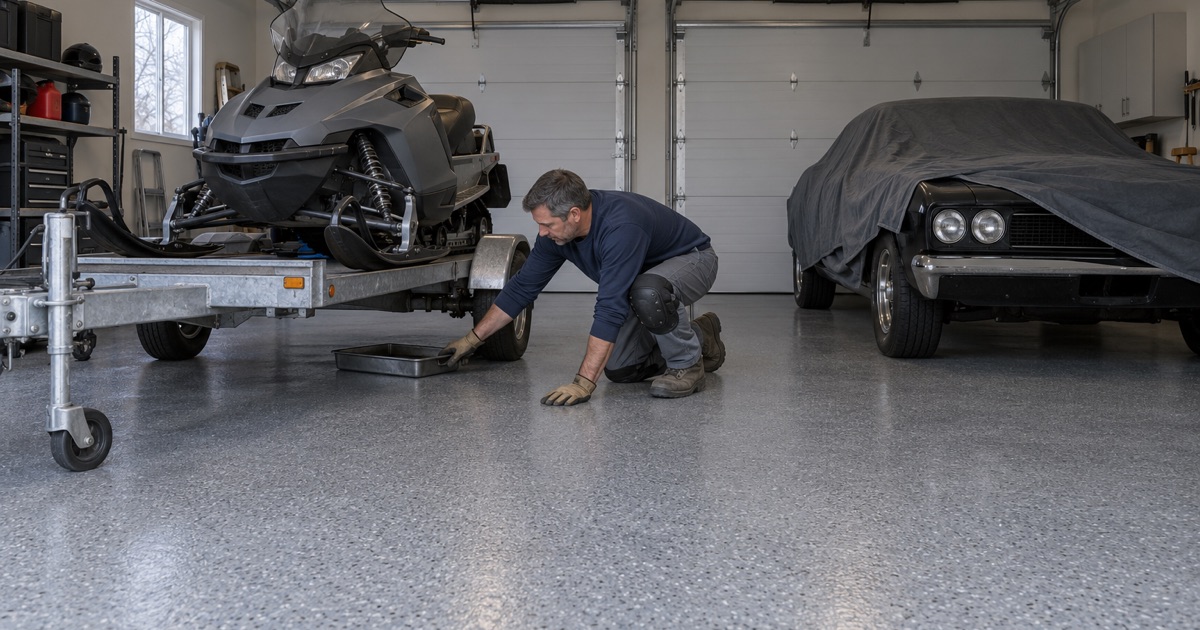
A coating does not replace a drip tray. Under a vehicle with a known leak, a tray or an absorbent pad catches what falls, and the coated floor around it handles the drops that miss. For a car going into winter storage, that is the simplest habit that keeps a floor looking new.
A tray needs emptying, too. A full tray left under a car for a season is a spill waiting to happen when someone slides it out, so we suggest checking it whenever you check the car.
At a show, the same thinking applies to any hall that holds parked, fueled vehicles. Whether a particular venue asks for trays is up to that venue, and we do not speak for the Expo Center’s rules.
Clean-up after the car rolls out
When a parked vehicle finally leaves, wipe the fluid up first, then clean the spot with a mild degreaser and water. On a coated floor that is usually the whole job. Coolant and fuel should not sit for weeks even on a good coating, because long dwell is what tests any surface.
During our own work, grinding dust and slurry are collected on site. None of it goes into a floor drain or a storm sewer.
Questions Waukesha owners ask us
Owners in Waukesha often ask whether a coated floor will hold up to a car that sits all winter. With the right base coat, topcoat and a tray under any leaker, it is built for exactly that. Others ask whether we can work around a shop or showroom that has to stay open, and we schedule commercial floors around open hours, including overnight and weekend windows.
Another common question is whether a coating can go down while a project car is still in the bay. It cannot; the floor has to be empty, ground and tested, so we plan the work for a window when the car can be stored elsewhere and the coating can cure fully before it rolls back in.
Every home job starts with a written contract before a deposit is taken, with the products and any warranty written into it. That way the system we described for your parked car is the one on paper and the one on your floor.
- 20+ Years Experience
- Moisture Testing in Every Scope
- Written Proposals and Contracts