Brookfield Epoxy Flooring has spent more than 20 years on epoxy flooring in Port Washington and across the region, and the first thing we look at on a garage job here is not color or flake size. It is the slab itself. A coating is only as good as the concrete under it, and some garage floors are past the point where a coating is the right answer.
So every visit starts with a plain assessment of the cracks, joints, surface wear and any old coating still clinging to the floor. If the slab is sound, we can prepare it and build a system on it. If it is not, we say so before a quote is written, because pretending a failed slab can be saved with a thick coat is how floors end up peeling in their second winter.
That call matters more than usual in this city. Whether a floor gets coated or torn out changes the scope, the schedule, and whether the city gets involved at all, which is what the rest of this page walks through.
Epoxy Garage Floors and the Coat-or-Replace Question
Most garage floors we see are candidates for coating. They have hairline cracks, some surface scaling from deicers, oil stains, and maybe a worn-out paint job from a previous owner. None of that rules out a durable epoxy floor, and most of it is exactly what proper preparation is designed to deal with.
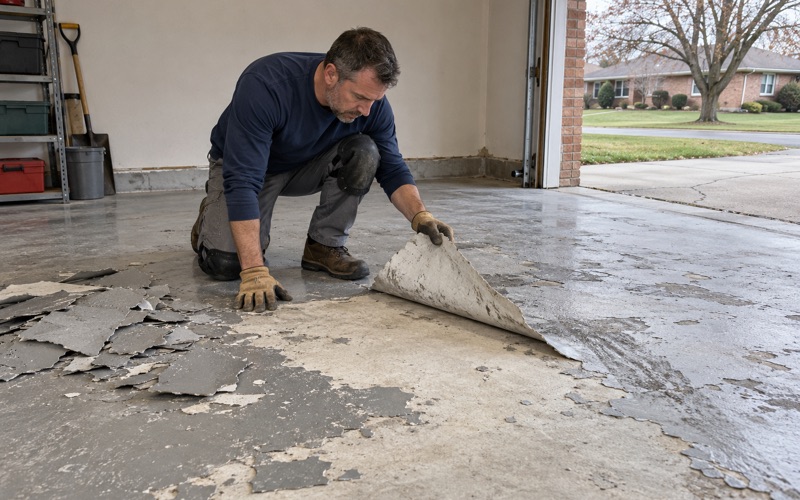
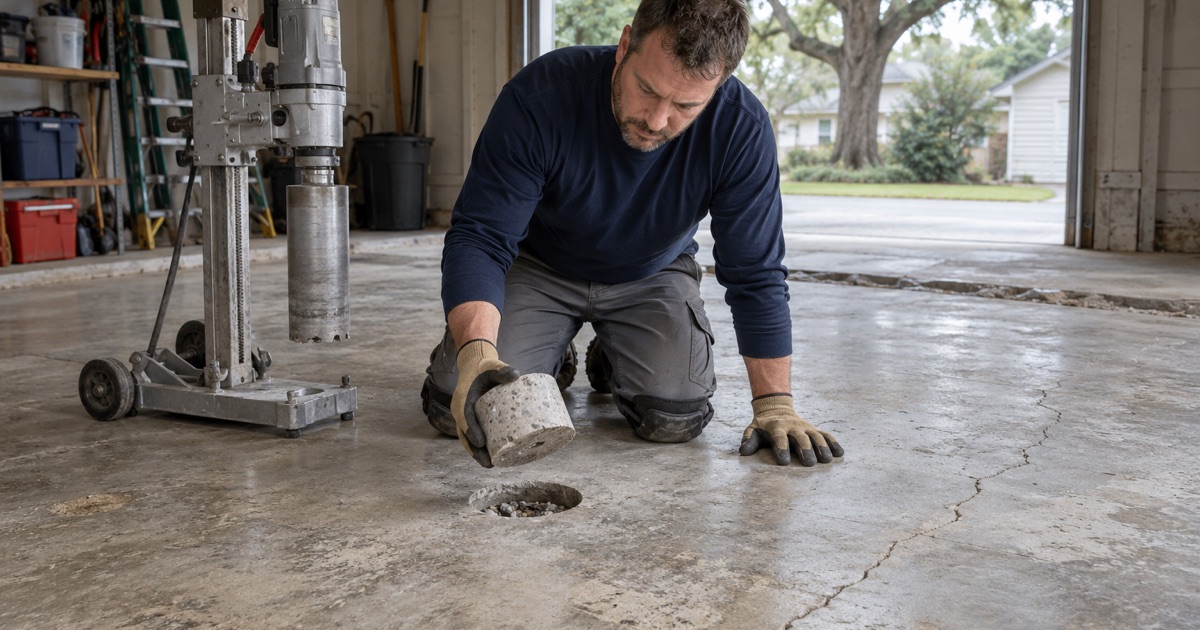
A smaller share of slabs are a different story. Heaved sections, wide displaced cracks, crumbling edges and hollow-sounding areas tell us the concrete itself has failed. Coating that kind of floor does not fix it; it just hides the problem under a finish that will crack along the same lines.
Why This Is the First Question
The repair or replace decision comes before product choice because it decides everything downstream. A repairable slab is a coating job measured in days. A failed slab is a concrete job first, and the coating becomes a second project that waits on the new pour.
We would rather have that conversation at the first walkthrough than discover it halfway through grinding. Telling a homeowner their slab needs replacement is not the answer anyone hopes for, but it is cheaper than paying for a coating twice.
What the City Sheet Says
The City of Port Washington publishes a ‘Do I Need A Permit?’ information sheet, dated December 2023, and it lists cement garage floor replacement as needing a permit. The same sheet says garage replacement must comply with current codes. That puts a full tear-out and repour in a different category from a surface finish.
Coating a sound existing slab is finish work on concrete that is already there. Tearing out a failed floor and pouring a new one is construction, and the city treats it that way. Before we schedule anything, we confirm with the building department which side of that line a job falls on rather than guessing.
Who Handles Permits and Inspections
Building inspection in Port Washington is administered under contract by SAFEbuilt, which handles permits and inspections for the city. Applications go through a Community Core online portal, and the inspection line is 262-268-4277.
Because the permit attaches to the concrete replacement and not to the coating, our role is to make the coat-or-replace call honestly up front. That way the homeowner knows whether a permit and inspections are coming before any work is booked.
Looking for epoxy-flooring closer to Burlington? See Epoxy-Flooring Services in Burlington.
When a Garage Slab Can Be Repaired and Coated
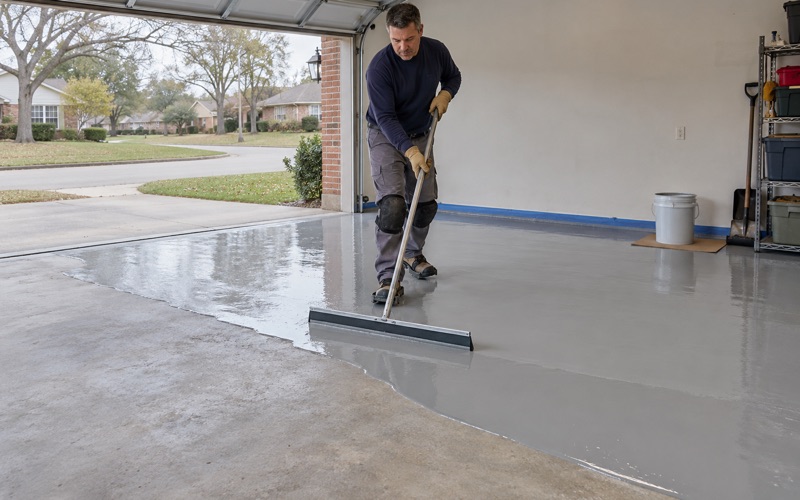
A repairable slab is one where the concrete is structurally sound but the surface has problems. That covers most of the floors we see: cracked but not displaced, scaled but not crumbling, stained but not soft. Those floors can take a high-performance coating once they are properly opened and repaired.
The repair work is part of the coating job, not a separate trade. Cracks are routed and filled, spalled spots are patched with repair material compatible with the system going on top, and joints are addressed so they do not telegraph through the finish.
Mechanical Preparation, Never Acid
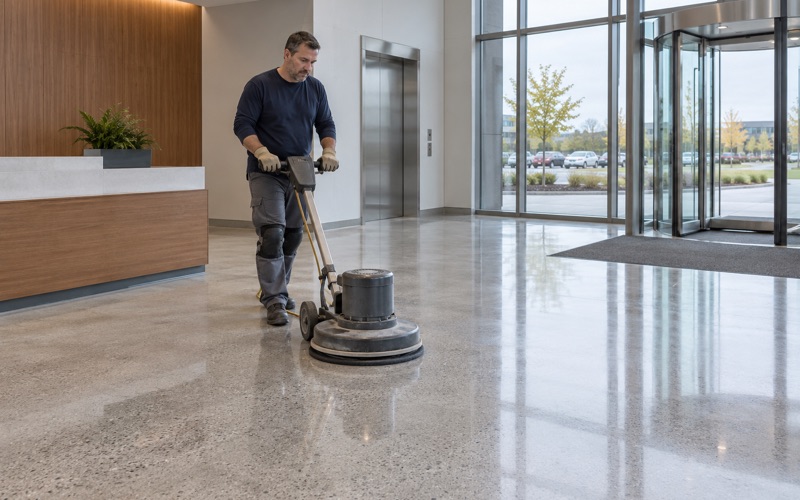
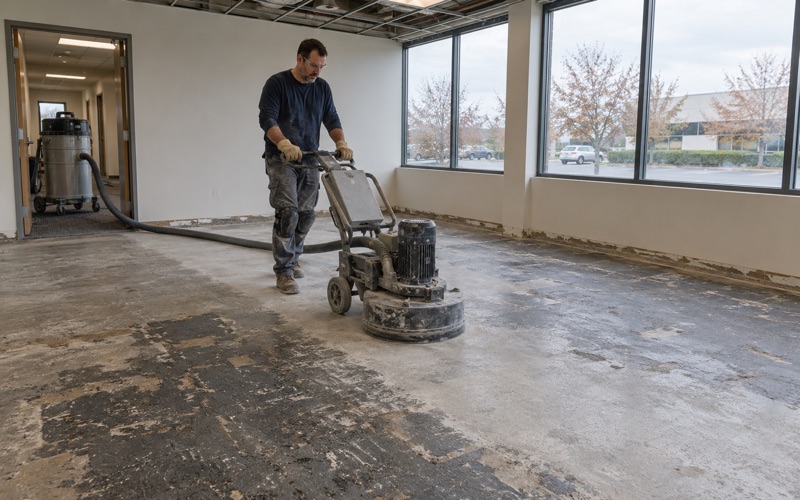
Every slab we coat is opened with a diamond grinder or a shot blaster. That cuts through laitance, old sealers and contamination and leaves a profile measured on the ICRI CSP scale, which is what gives a 100% solids epoxy something to bite into.
We do not acid etch. Acid leaves residue, cleans unevenly, and does nothing about the sealers and coatings that are usually the real bonding problem on an older garage floor. The grinding dust and any slurry are collected on site and kept out of floor drains and storm sewers.
Testing for Moisture Before We Commit
Wisconsin does not require a vapor retarder under an unconditioned attached garage slab, so a garage floor that looks dry can still be pushing moisture up from below. We put moisture testing into the scope as its own line item, using methods such as the ASTM D4263 plastic sheet test or ASTM F2170 in-situ relative humidity probes depending on the slab.
If readings come back high, a moisture-mitigation primer goes into the build or we hold off. We are also clear that a floor coating is not a fix for water coming up through a slab, and moisture from below is the first exclusion we read out when we go over the warranty.
Building the System for Winter Traffic
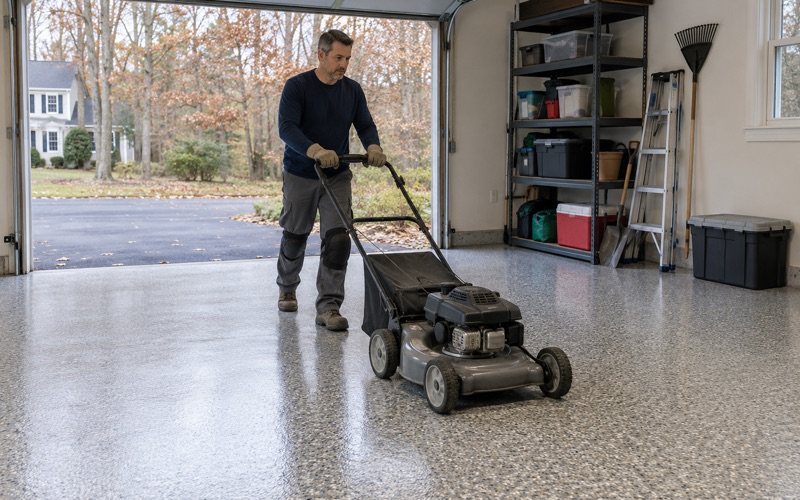
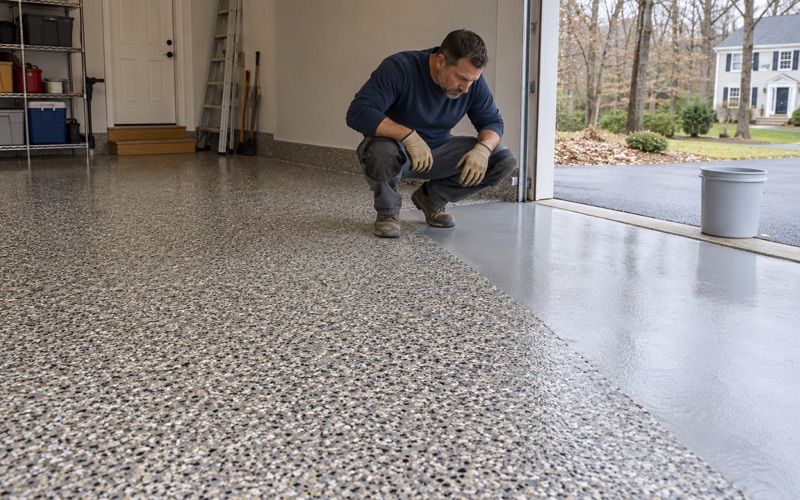
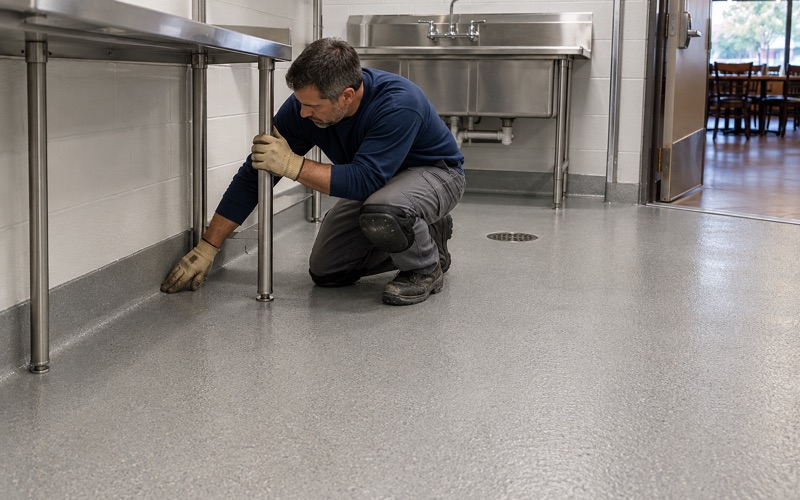
Once the slab is prepared and repaired, we build a system meant to handle the road salt and calcium chloride brine that come in on tires every winter. A common build is a 100% solids epoxy base, a vinyl flake broadcast, and a polyaspartic topcoat that resists hot tire pickup and cleans up easily.
The proposal names each product, the full system build and the finished thickness. That way a homeowner can check what was quoted against what actually went down, and the written contract carries the same details along with any warranty before a deposit is taken.
When Replacement Means a Permit and a Second Project
Some slabs cannot be saved. When a garage floor has heaved, settled in sections, broken into pieces that rock underfoot, or lost its surface to the point of exposing loose aggregate across large areas, replacement is the honest recommendation. We would rather lose a coating job than coat a floor we know will fail.
In Port Washington, that recommendation carries a practical consequence. Under the city’s permit sheet, the garage floor replacement becomes a permitted job that has to meet current codes, with inspections through the city’s contracted inspector.
Signs a Slab Is Past Repair
We look for cracks with vertical displacement, where one side sits higher than the other. We tap for hollow areas that suggest the base has washed out or settled. We check whether the slab still drains toward the door or whether low spots now hold water.
One of those signs on its own may be repairable. Several together, spread across the floor, usually mean the concrete is done. We explain what we found and why, so the decision rests on the floor in front of us rather than on a sales pitch.
Sequencing New Concrete and a Coating
A replaced slab is new concrete, and new concrete has to cure before any coating goes on. That makes a permitted replacement and a coating two separate jobs spaced weeks apart, not one visit. Trying to rush the second job onto a fresh pour is how coatings blister and lose bond.
When the new slab is ready, we test it the same way we test an old one, then prepare and coat it. Curing for the coating itself is scheduled against slab temperature and the dew point spread at the surface rather than the calendar, and when an unheated garage is too cold, we say plainly that the work should wait for spring.
What the Homeowner Coordinates
The replacement pour goes through the city’s permit and inspection process on its own track. We can talk with the concrete contractor about finish and surface texture on the new slab, since a smoother, cleaner pour is easier to prepare well later.
Our part picks up once the new floor has cured and passed whatever the city requires. Keeping the two jobs clearly separate avoids confusion over who owns which inspection and keeps the coating warranty tied to a slab that was ready for it.
Port Washington Homes and Commercial Floors
Port Washington is the Ozaukee County seat, a Lake Michigan city about 27 miles north of Milwaukee. Most owner-occupied housing here is detached: Census figures show 2,891 owner-occupied detached homes out of 3,665 owner-occupied units. That is a lot of private garages, and a lot of slabs of very different ages.
The housing stock runs from 939 units built in 1939 or earlier to 129 built since 2020, with large blocks from the 1960s and 1970s in between. A garage slab poured decades ago and one poured recently can look similar from the doorway and behave very differently once a grinder opens them up.
Older Slabs and Previous Coatings
Older garages often carry years of patching, paint or a failed roll-on coating. Those layers have to come off completely before a new system goes down, and removing them sometimes reveals damage the old finish was hiding. That is one more reason we treat the coat-or-replace call as a judgment made with the floor opened up, not from a photo.
When an older slab is sound underneath, it is often an excellent candidate for coating. Decades of curing mean the concrete has long since finished shrinking, and the main work is clearing what previous owners put on top.
Commercial and Industrial Work
Port Washington also has an active commercial base. Allen Edmonds operates on Seven Hills Road, and the Vantage Data Centers Lighthouse campus is under construction in the city, with completion expected in 2028. The data center’s first phase alone is listed at $8 billion, with about 5,000 workers expected on site at peak.
For shop, showroom and warehouse floors, we fill control joints with a semirigid joint filler before coating so cart and lift wheels do not chip the edges. Office, retail, clinic and dealership floors are scheduled around the hours a building has to stay open, including overnight and weekend windows, so the work does not shut down the business.
Air Quality and Product Choice
Ozaukee County sits entirely within the Milwaukee 2015 ozone nonattainment area. Wisconsin has no state architectural-coating VOC rule, so the national standard under 40 CFR 59 Subpart D is the one that applies to coating products.
We use low-odor, high-solids systems where they fit the job, which keeps fumes down in an attached garage or an occupied commercial space. As with everything else in the scope, the specific products are named in writing before work begins.
- 20+ Years Experience
- Moisture Testing in Every Scope
- Written Proposals and Contracts