Brookfield Epoxy Flooring installs polyaspartic floor coatings in Brookfield, WI, serving surrounding cities including Wauwatosa, West Allis, Pewaukee, New Berlin and Menomonee Falls. With 20+ years of coating concrete, we use polyaspartic where it outperforms epoxy: fast return to service, ultraviolet stability and a tough wear layer, always over a slab we have ground and tested ourselves.
Polyaspartic is often sold as the one-day garage floor, and on the right slab it can be. The speed is real, but so is the risk: a coating that cures in hours gives the installer very little time to fix mistakes, and it bonds only as well as the prep beneath it. We treat the fast cure as a scheduling advantage, not a reason to skip grinding or moisture testing.
Each proposal names the product, the full system build and the finished thickness. On a home job, the products and any warranty are written into the contract before a deposit is taken.
What Polyaspartic Coatings Are
A Fast-Cure Aliphatic Resin
Polyaspartic is a type of aliphatic polyurea. Compared with epoxy, it cures much faster, resists yellowing in sunlight and holds up well to abrasion and many chemicals. It is applied thin and hard, which makes it an excellent top layer, and some systems also use it as the base coat.
Because it is aliphatic, the color you choose stays that color. Most standard epoxies are aromatic and amber over time under daylight, which is why a garage floor near an open door can yellow in a few summers.
Polyaspartic and Polyurea Topcoats Over Epoxy
Many of our systems combine resins: a 100% solids epoxy base for build and bond, a vinyl flake or quartz broadcast, and a polyaspartic or polyurea topcoat. Epoxy gives the floor body at a good cost, while the polyaspartic top handles wear, UV and cleaning. The combination is often the best value for a garage or showroom.
The order matters. The epoxy base has to reach the right stage of cure before the polyaspartic goes over it, and any amine blush on the epoxy has to be washed off first. Topcoating too early or over a blushed surface is a common cause of layers separating, so we time and inspect each coat rather than rushing to finish in one visit.
Full Polyaspartic Systems
When speed matters most, the whole system can be polyaspartic, primer through topcoat. That lets a floor go from bare concrete to walkable in a day on a sound slab. It costs more per square foot in material, and it demands a crew that mixes in small batches and works quickly, since the pot life is short.
We use full polyaspartic systems mostly on commercial floors with tight closure windows and on residential garages where the owner needs the space back fast. Elsewhere, the combined epoxy and polyaspartic build is usually better value.
Polyaspartic Floors for Homes
Garage Floors Through a Brookfield Winter
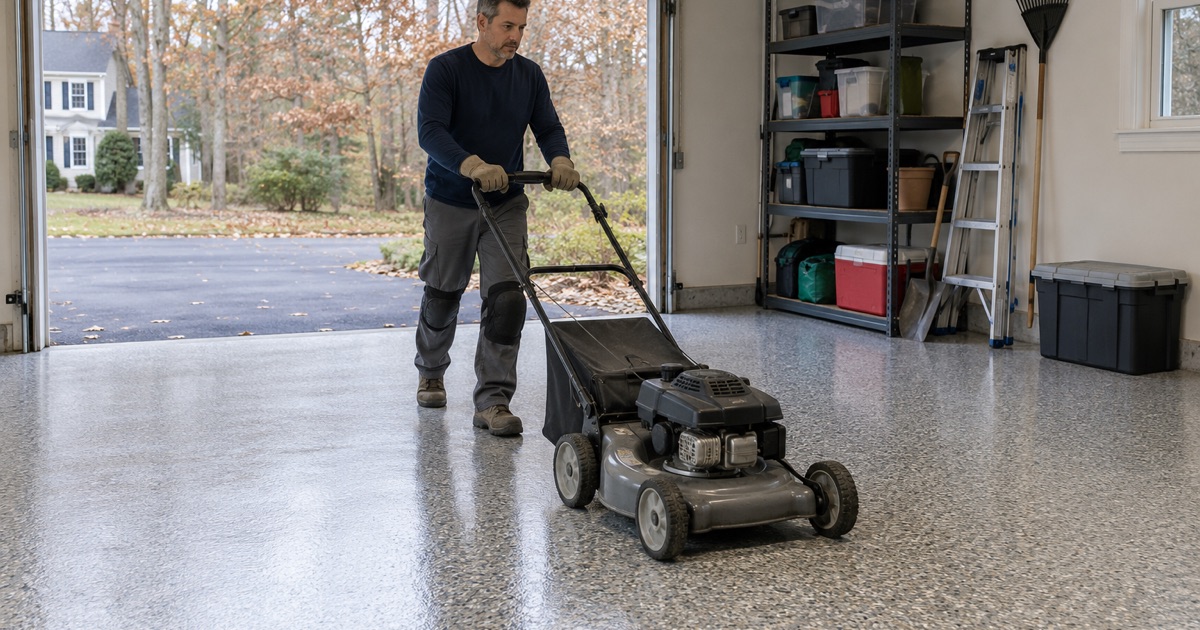
A garage in Brookfield takes rock salt and calcium chloride brine off every tire from late fall to spring. A polyaspartic topcoat resists that brine and cleans up with a squeegee and rinse. Over a flake broadcast, it gives a textured, slip-resistant surface that hides salt residue between washes.
The bond still comes from grinding. A polyaspartic topcoat over a slab that was only etched or cleaned will peel at the tire lanes just as an epoxy would, so the slab is diamond ground to profile first.
Basements, Workshops and Home Gyms
In a basement or workshop, polyaspartic’s low odor options and fast cure keep disruption short in an occupied house. It stands up to rolling tool chests and dropped tools, and it resists many of the oils and solvents used in a home shop. We still test basement slabs for moisture, since a topcoat does nothing to stop vapor from below.
If a basement is being finished into a rec room, the City of Brookfield requires a building permit for that work. We ask City of Brookfield Inspection Services, or the village inspector in a neighboring community, how the floor fits into the permit and its inspections before we schedule anything.
Hot Tire Pickup and Film Build
Hot tire pickup is driven mostly by product choice, film build, prep and cure. A polyaspartic topcoat at full thickness, over a fully cured base on ground concrete, resists the softening and grabbing that lifts a thin coating. We state the finished thickness in the proposal, so you can see the film build you are paying for.
Thickness is also where two quotes for the same garage most often differ without saying so. A single thin coat of polyaspartic can look identical to a full system on the day it goes down, and the difference only shows a winter or two later where the tires sit. Naming the build in writing removes that guesswork.
Polyaspartic Floors for Businesses
Overnight and Weekend Turnarounds
Offices, retail spaces, clinics and dealership service drives cannot close for days. A polyaspartic system lets us grind and coat overnight or over a weekend and have the floor in service the next morning. We plan each phase around the hours the building must stay open.
For a dealership service lane that opens early six days a week, that can mean grinding on Saturday night and coating on Sunday, with the floor ready for write-up Monday morning.
Showrooms and Customer-Facing Floors
In showrooms and lobbies, UV stability matters because large windows put sunlight on the floor all day. A polyaspartic topcoat keeps a gray, white or brand-colored floor from ambering, and a satin or gloss finish can be chosen to suit the lighting.
Showroom floors also carry display vehicles, fixtures and furniture that get moved around. A hard polyaspartic topcoat resists the scuffing those moves cause, and a worn area can be lightly sanded and recoated without closing the whole floor.
Light Industrial and Shop Floors
In light industrial spaces, polyaspartic topcoats add abrasion resistance over a thicker epoxy base. Before coating, joints are filled with a semirigid joint filler, so cart and lift wheels do not break the edges. Where heavy impact or hot washdown is part of the work, we may recommend urethane cement instead.
Installing Polyaspartic the Right Way
Grinding to a Measured Profile
Polyaspartic is thin and fast, so it relies heavily on the profile it is bonding to. We grind or shot blast to an ICRI CSP profile suited to the primer, which removes sealers, paint and laitance. Acid etching is never used, since it leaves residue and an uneven surface.
Moisture Testing and Mitigation
Moisture testing is a line item on every scope. An ASTM D4263 plastic sheet test, a calcium chloride test or in-situ relative humidity probes tell us whether vapor is moving. If readings exceed what the system can handle, a moisture-mitigation primer goes down before any polyaspartic layer.
This matters more for polyaspartic than many owners expect. A fast, hard film sealed over a damp slab traps the vapor right at the bond line, and blisters can appear within weeks. Most coating warranties exclude moisture from below, and we read that exclusion to you before the job is sold.
Temperature, Dew Point and Short Pot Life
Polyaspartic cures at cooler slab temperatures than many epoxies, but its cure is still affected by temperature and humidity. We check slab temperature and the dew point spread before mixing, and we mix in measured batches to stay inside the product’s pot life. Rolling it on a slab near the dew point invites adhesion problems no matter how fast the product is.
Low-VOC Choices and Ventilation
Wisconsin has no state VOC rule for architectural coatings, so the federal 40 CFR 59 Subpart D limits apply to the product as sold. Because Brookfield is in the Milwaukee 2015 ozone nonattainment area, and because homes and businesses stay occupied, we favor low-VOC and lower-odor formulations and ventilate the work area.
- 20+ Years Experience
- Moisture Testing in Every Scope
- Written Proposals and Contracts