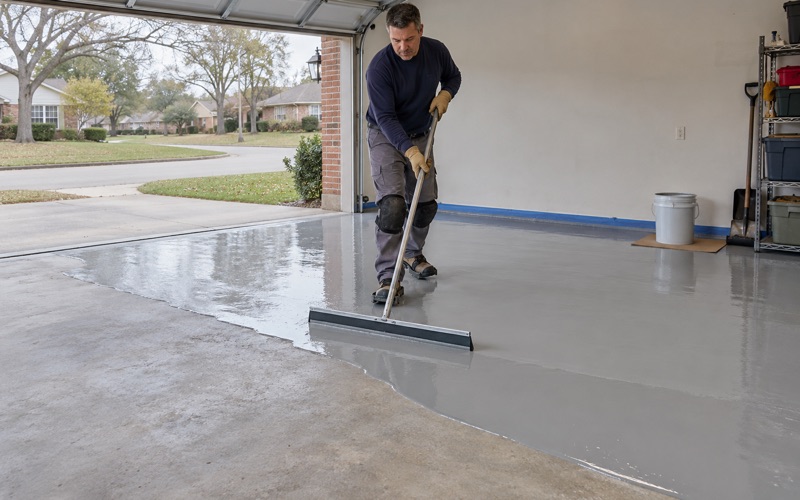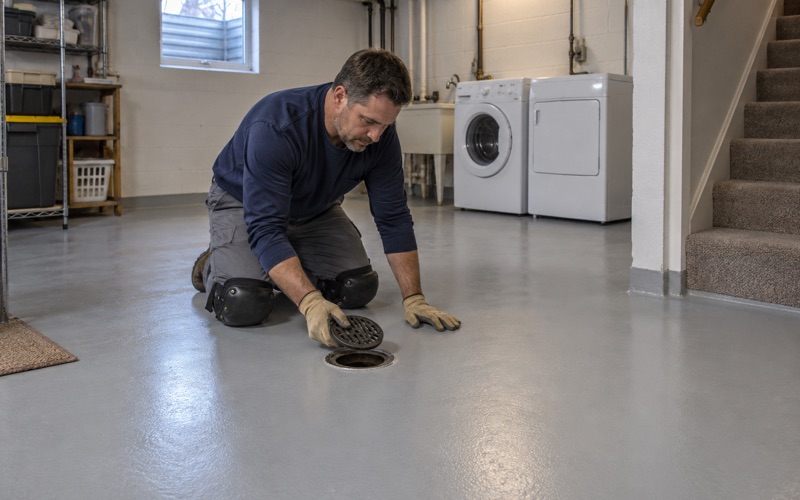
Brookfield Epoxy Flooring handles epoxy flooring in New Berlin for shops, warehouses, garages and the battery charging areas that lift-truck fleets depend on, with more than 20 years in the trade behind each job. Our work starts at the slab: every floor is opened with a diamond grinder or a shot blaster, and we never acid etch. The proposal you sign names the product, the system build and the finished thickness, so the floor that goes down can be checked against the one that was quoted.
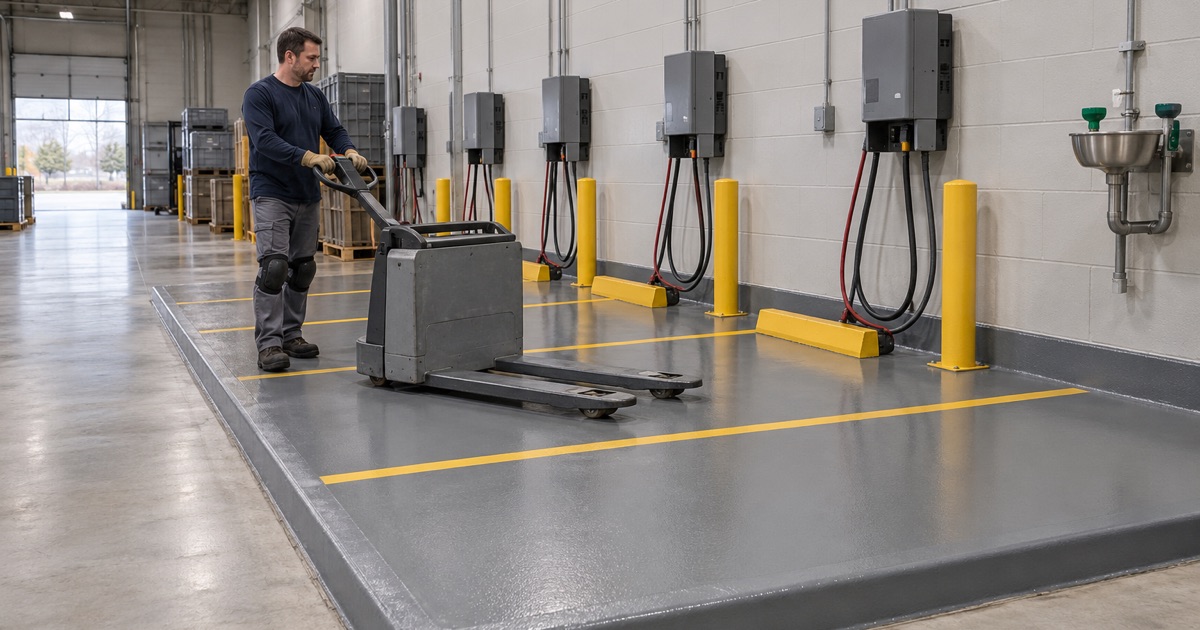
A charging area is a different job from the rest of a shop floor. It is the one spot in a building where sulfuric-acid electrolyte can land on the concrete, get flushed with water and then get neutralized. We plan that zone as its own floor, with its own layout and its own system, instead of extending whatever coating covers the shop around it.
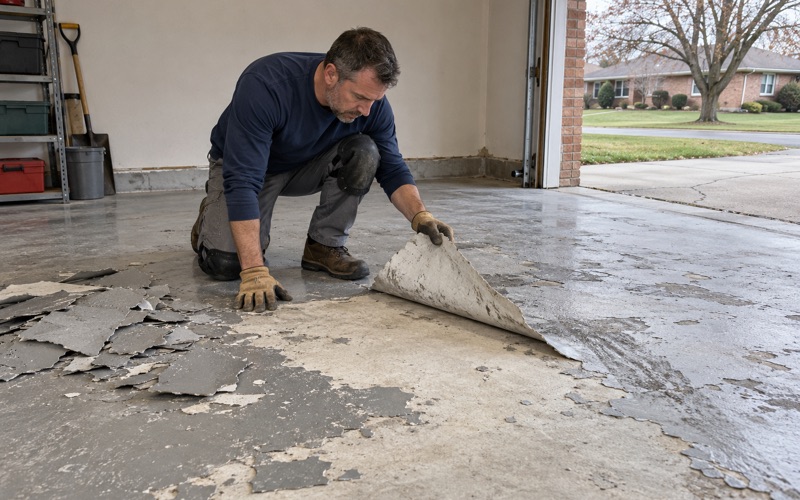
Before we quote, we read the cracks, the joints and any old coating, and we tell you plainly if the slab needs repair or replacement first. Warranty exclusions are read out before anything is sold, with moisture from below named at the top of the list.
A Forklift Service Branch on S. Towne Drive
New Berlin is a city in eastern Waukesha County and part of the Milwaukee metropolitan area, with a population of 40,451 at the 2020 census. New Berlin’s industrial side is large. The city counts three business parks totaling 1,126 acres: Moorland Road, the New Berlin Industrial Park and MSI/Lincoln Avenue. The city began buying land for the New Berlin Industrial Park in 1964, eventually 620 acres, and by 1967, 47 businesses had bought land there.
Crown Equipment’s Battery and Charger Service
Crown Equipment runs a sales and service location at 5150 S. Towne Drive. When it opened in December 2016, the new facility was three times larger than the previous location, and it offers Crown forklifts, warehouse equipment, design services and a parts and service system.
The branch has posted for a Battery and Charger Lead Tech, a role that troubleshoots, diagnoses and repairs industrial batteries and chargers and performs planned maintenance on customers’ units. A branch that staffs that work is a reminder that lift-truck batteries get charged on floors throughout the city’s business parks.
Crown is a neighbor, not a customer of ours, and we make no claim about its own floors. Badger ToyotaLift on W. Victor Road and Atlas Badger Toyotalift on S. Commerce Drive are also listed in New Berlin, so more than one lift-truck dealer serves buildings here.
What 29 CFR 1910.178(g) Asks For
OSHA’s powered industrial truck standard covers changing and charging storage batteries in 29 CFR 1910.178(g). Paragraph (g)(1) is short: battery charging installations shall be located in areas designated for that purpose. Paragraph (g)(2) then lists what that area needs: facilities for flushing and neutralizing spilled electrolyte, for fire protection, for protecting charging apparatus from damage by trucks, and for adequate ventilation to disperse fumes from gassing batteries.
Wisconsin private-sector workplaces fall under federal OSHA, so this is the rule a New Berlin plant manager answers to. It names facilities and a designated area, and it names no floor coating. No coating carries OSHA approval, so we describe our part plainly: we build the floor that the flushing and neutralizing facilities work on, and the operator’s equipment and procedures answer to the rule.
Looking for epoxy-flooring closer to Menomonee Falls? See Epoxy-Flooring Services in Menomonee Falls.
Flushing and Neutralizing Spilled Electrolyte
Every charging area runs through the same cycle. Electrolyte reaches the concrete during watering, a battery change or a spill, and then it is flushed with water and neutralized. The floor takes acid, then water, then a neutralizing agent, and it has to come through each round without letting any of it into the slab.
What the Floor Has to Handle
We build charging-zone floors for repeated acid contact and wash-down. That usually means a 100% solids epoxy or a urethane cement system chosen for chemical exposure, with a texture that stays walkable when wet and a coved edge that keeps flush water from running under the coating at the walls. No coating is immune to acid, so the system is matched to the exposure and inspected as part of the area’s upkeep.
Slope and drainage matter as much as chemistry. Where flush water collects and how it is contained belongs to the operator’s safety plan; our job is to match the floor to that plan and to point out where the existing slab works against it.
Handling Electrolyte at the Source
The same section addresses how electrolyte and batteries are handled. Paragraph (g)(4) calls for a conveyor, overhead hoist or equivalent for handling batteries, (g)(6) calls for a carboy tilter or siphon for electrolyte, and (g)(7) requires acid to be poured into water, never water into acid.
Those steps cut down on splashing without ending it. We plan the coating so the spots where electrolyte is mixed and batteries are changed sit well inside the chemical-resistant system, not at its edge, where a seam between two floors would take the first hit.
Keeping Prep Waste Out of the Drains
Prepping a charging area makes dust and slurry like any other floor. We collect it on site and never wash it into a floor drain or a storm sewer, which matters more in a room built around flushing and drainage.
Grinding is also the one chance to remove what old spills left in the top of the slab, so we take the surface down to clean concrete before any primer goes on. A primer over residue is a bond to the residue, not the slab.
Laying Out the Charging Zone Before It Is Coated
The designated area comes first and the coating follows it. If the charging positions, charger walls and flushing equipment are not settled, a coated zone can end up the wrong size, and the fix is cutting into a new floor.
Setting the Boundary of the Zone
We work from the operator’s layout for where trucks park to charge, where chargers mount and where the flushing and neutralizing equipment stands. The chemical-resistant system runs past that footprint with margin, and the transition to the general shop floor goes where traffic crosses it least.
Joints inside the zone and along its edge are filled with a semirigid filler before any coating goes over them. Lift-truck wheels cross that line all shift, and an open joint edge is where a coating starts to break down.
Protecting Chargers From Trucks, and the Floor From Both
Paragraph (g)(2) calls for protecting charging apparatus from damage by trucks, and (g)(8) requires trucks to be properly positioned with the brake applied before batteries are charged or changed. Bollards, curbs or barriers that guard the chargers are anchored into the slab, so we want their positions fixed before we coat.
Anchoring after the floor is finished punctures the system exactly where acid and wash water are most likely to sit. When the protection goes in first, we can detail the coating around each base instead of patching holes drilled through it. Ventilation equipment for the zone gets the same treatment: anything that stands on the floor is placed before the coating, for the same reason the charger guards are.
No Smoking, Flames or Sparks
The rule bans smoking in the charging area, calls for precautions against open flames, sparks and electric arcs, and keeps tools and metal objects away from the tops of uncovered batteries. We schedule prep and coating with the operator so the charging area is out of service while we work in it.
Office, retail and dealership floors get scheduled around open hours, overnight or on weekends. A charging zone is planned the same way, around the shifts a fleet has to keep running.
New Berlin Charging-Area Floor Questions
Does the Slab Need Work Before Coating?
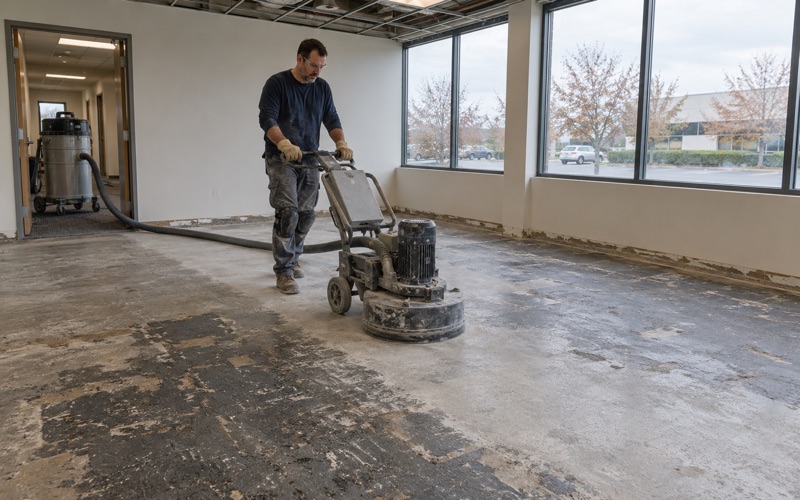
Every slab is opened mechanically to a surface profile on the ICRI CSP scale, by diamond grinding or shot blasting. Old coatings, oil and residue soaked into the concrete near the chargers come off before anything is applied.
A slab that has taken years of bare electrolyte spills can be contaminated below the surface, and we look for that during the walk-through rather than after a coating lets go. If it needs repair first, we say so.
Will Moisture Be Tested?
Yes, as a written line item on the proposal. We use ASTM F1869 calcium chloride testing or ASTM F2170 in-situ relative humidity probes, with an ASTM D4263 plastic sheet test as a quick screen. We do not sell a coating as a fix for water coming up through a slab.
Who Handles Permits in New Berlin?
The City of New Berlin Department of Community Development, on the second floor of City Hall at 3805 S. Casper Drive, issues building, electrical, plumbing and HVAC permits. Inspections are scheduled at least 24 hours ahead at 262-797-2445. We ask the city whether a job needs a permit before it is scheduled, since new chargers or ventilation can bring in other trades that the floor itself does not.
Do Air Quality Rules Change the Products?
Wisconsin DNR has no state architectural-coating VOC rule, so the national architectural coatings rule in 40 CFR 59 Subpart D is the one that governs what we bring on site. The Milwaukee 2015 ozone nonattainment area takes in only the part of Waukesha County north of I-94 and east of Highway 67, and New Berlin lies south of I-94.
What Goes in the Written Contract?
For the charging zone, the proposal lists that system separately from the general floor, with its own product, build and finished thickness. Warranty terms are written in alongside it, and the exclusions are walked through before anything is signed, so nobody learns about them after a spill.
How Soon Can Trucks Return?
Curing is scheduled against slab temperature and dew point, not a calendar date. We give the operator a return-to-service time based on the conditions we measure, and we say plainly when a cold building means the zone has to stay closed longer.
A fleet that cannot spare the charging area for long can sometimes split the zone into halves, coating one side while the other keeps running. Whether that works depends on the layout and on keeping work clear of active chargers, and we settle it with the operator before the schedule is set.
- 20+ Years Experience
- Moisture Testing in Every Scope
- Written Proposals and Contracts