Brookfield Epoxy Flooring has spent more than 20 years on epoxy-flooring in Mequon and the rest of our service area, and most of what decides a good result happens before any resin is mixed. We open every slab mechanically, test it for moisture, and read its cracks and joints before we put a number on paper. That order does not change between a two-car garage and a production hall.
What does change is the slab we are handed. A floor that has spent years under heavy equipment carries a record of everything that was bolted to it, and a coating applied over that record will show it. Our job on that kind of floor is to erase the old layout first, then build a system sized to whoever uses the building next.
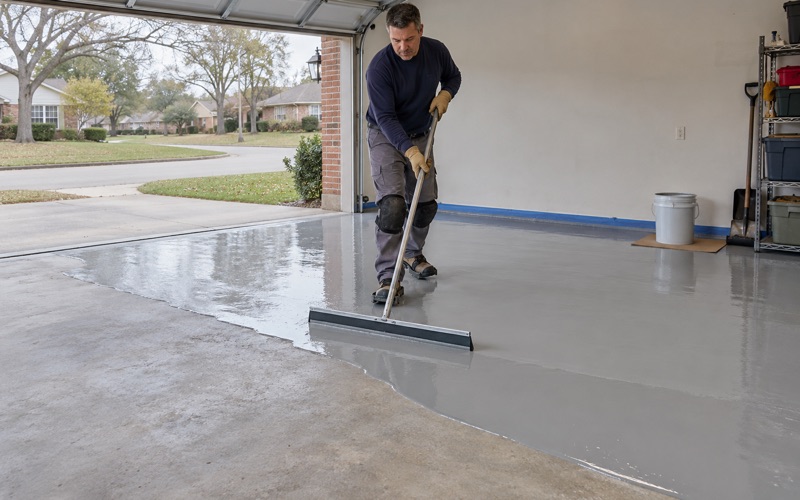
On the residential side the questions are simpler but no less specific: how old the slab is, whether it was ever sealed, and whether the garage stays cold all winter. Each of those answers shapes the system we propose and the week we can install it.
When a Plant Moves Out of the Donges Bay Road Corridor
Commercial floors in this city tend to be second-generation floors. A building gets put up, a manufacturer runs it for years, and then the equipment leaves and someone else takes the space with a different use in mind. Our work usually starts at that handoff.
A Real Example of the Pattern
BizTimes reported in November 2024 that Hultafors Group North America is ceasing manufacturing at 6333 W. Donges Bay Road, the Johnson Level & Tool plant. About 45 employees were to be laid off in two phases, the first on March 28, 2025 and the second no later than the fourth quarter of 2025. Product design, engineering and innovation stay at the company’s Mequon North America headquarters.
The future of that building has not been stated, and we make no claim about it or about having worked inside it. We cite it because it shows the sequence plainly: production stops, machinery is pulled, and a slab that was laid out for one process is left waiting for another.
A Business Park That Keeps Turning Over
The surrounding business park changes hands steadily. Kleen Test Products leased 30,000 square feet at 1000 W. Donges Bay in 2024, Kolberg-Pioneer, part of Astec, leased 8,353 square feet on N. Baldev Court in March 2026, and SPI Lighting holds a lease on a 128,028-square-foot building in the Mequon Business Park through August 2033.
Every one of those moves puts a used floor in front of a new occupant. That is why we treat the inherited slab, not a fresh pour, as the normal starting point for commercial coating work here.
What Machinery Leaves Behind
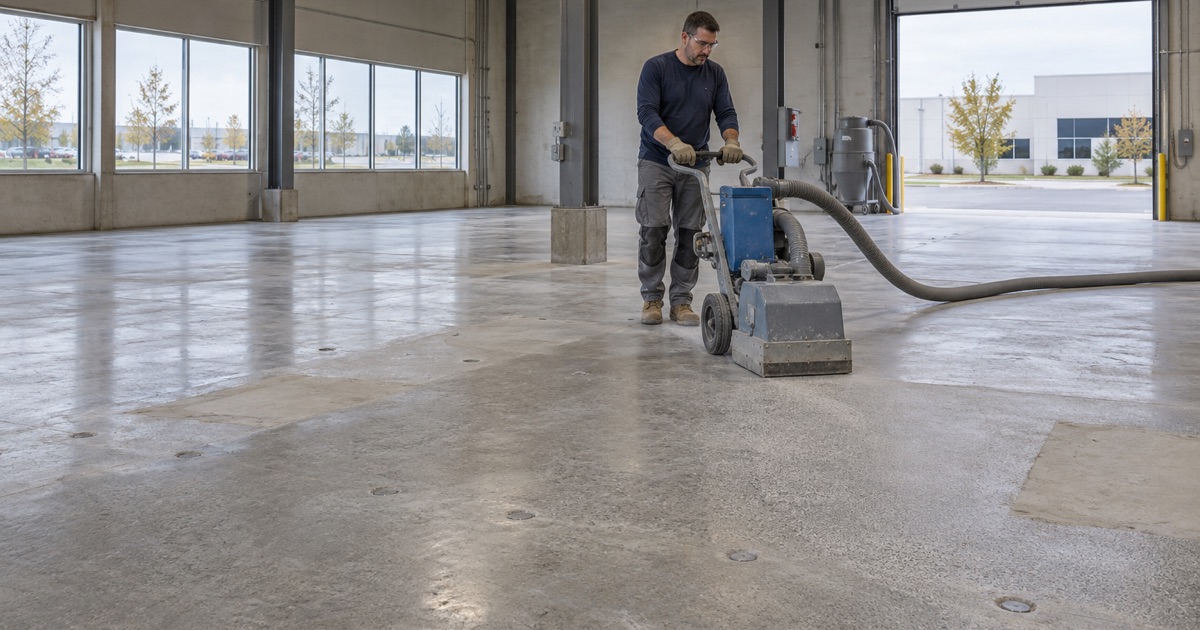
When production equipment is unbolted and hauled away, the slab keeps the evidence. Expect anchor bolts cut off at or above the surface, grouted machine bases standing proud of the floor, conduit sawn off where it once came up through the concrete, and patches of different ages and mixes.
None of that disappears under epoxy. A coating follows the surface it sits on, so a bolt stub prints through as a bump, a grout pad reads as a raised square, and a patch with a different texture absorbs primer differently from the slab around it. Left alone, the old machine layout shows through the new finish in a grid anyone can see.
Looking for epoxy-flooring closer to Whitefish Bay? See Whitefish Bay Epoxy-Flooring.
Grinding, Filling and Leveling Before the First Coat
Preparation on a vacated production floor is most of the job, and it is where we spend our walkthrough time. We read the cracks, joints and old coatings before quoting, and when a section of slab is too far gone to coat, we say so rather than bury it.
Taking Anchor Bolts and Bases Down Flush
We cut and grind anchor bolts below the finished surface rather than knocking them sideways, because a bent stub keeps rising under traffic. Grouted bases come down with diamond grinding until they sit level with the surrounding concrete. Abandoned conduit is cut back and its opening filled so nothing hollow remains under the coating.
The holes left by those bolts and sleeves are filled with a repair material compatible with the system going on top. A filler chosen for convenience can shrink or stay soft, and either one shows up later as a dimple or a crack line in the finish.
Matching Patches to the Slab Around Them
Old patches are the part most often skipped. Some were troweled smooth, some were left rough, and some were made with a mix that is denser or weaker than the original pour. We grind each patch and its border to the same ICRI CSP profile as the field of the floor so primer bites evenly across the whole surface.
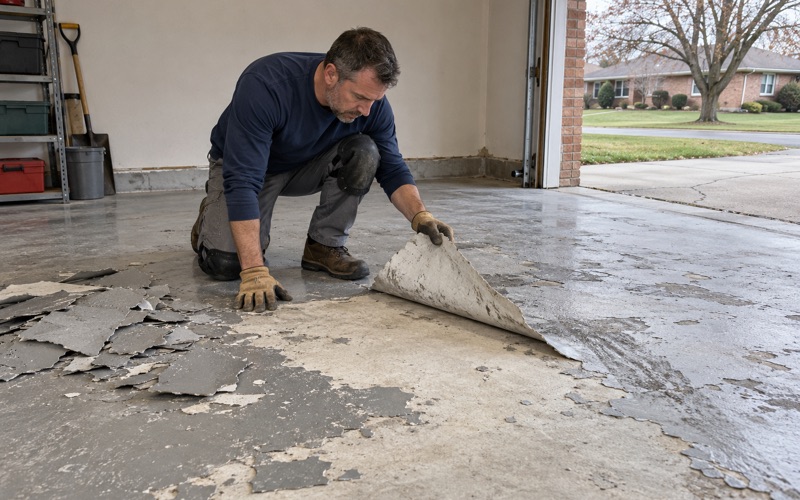
Where a patch is loose, hollow sounding or cracked at its edge, it comes out and is replaced rather than coated over. A coating bonded to a failing patch only lasts as long as the patch does.
Opening the Whole Slab and Testing It
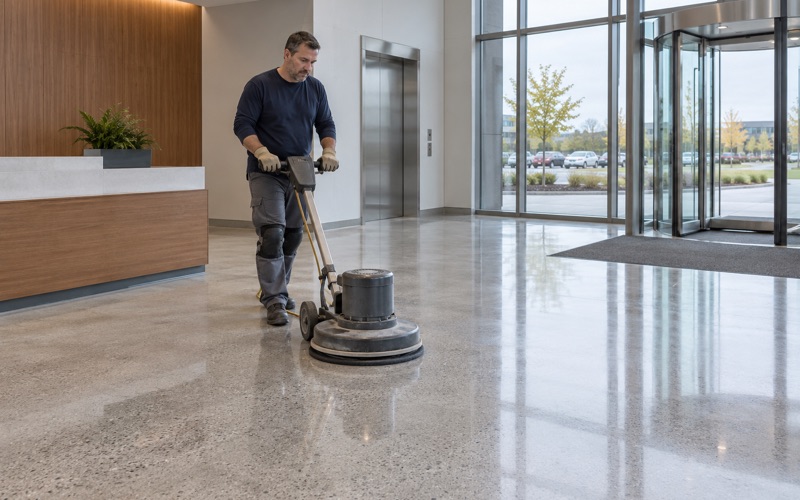
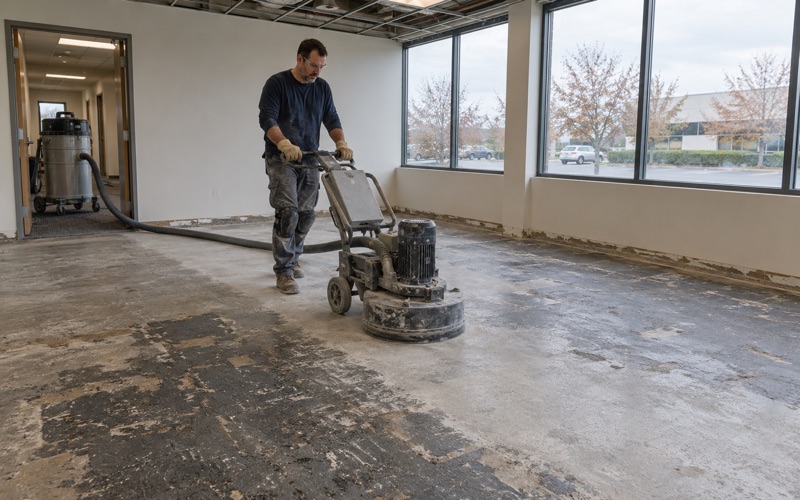
Every slab we coat is opened with a diamond grinder or a shot blaster, never with acid etching. Mechanical profiling removes the oil, sealers and weak surface paste that years of production leave in the concrete, and it gives us a profile we can measure instead of guess at.
Moisture testing is a written line item in our scope. We use ASTM F2170 in-situ relative humidity probes or ASTM F1869 calcium chloride testing depending on the floor, and we read the results against the product’s limits before committing to a system. If the readings call for a moisture-mitigation primer, the proposal says so up front.
Coating a Second-Generation Floor for Its Next Use
Once the old layout is gone, the system is chosen for the building’s new purpose, not its old one. A slab that once held stamping presses may now need to serve a warehouse, a showroom or an assembly area, and the coating should follow that use.
Building the System to the Work
For general industrial and storage space, a 100% solids epoxy build gives a hard, cleanable surface over the prepared slab. Where traction matters, we broadcast quartz aggregate into the body coat and lock it in with a topcoat. Shop and warehouse control joints are filled with a semirigid joint filler before coating so their edges hold up.
Our written proposal names the product, the system build and the finished thickness. That lets a building owner or a tenant’s facilities manager check what was quoted against what went down, which matters when the space may change hands again.
Scheduling Around the Building
A re-tenanted building often has offices or a showroom open while the floor in back is being prepared. We plan overnight and weekend windows where the occupant needs them, so grinding and coating do not stop the part of the business that is already running.
Grinding dust and slurry are collected on site with our equipment. None of it goes into a floor drain or a storm sewer, which matters in a building whose drains may be tied to a former process.
Code and Approvals for Commercial Space
Commercial and industrial buildings in Wisconsin fall under SPS 361-366, which adopted the 2021 International Building Code from September 1, 2025. Coating an existing slab is a different question from altering the building, so before we schedule the work we confirm with the City of Mequon Community Development Inspection Division whether anything in the project needs a permit.
That call takes a few minutes and keeps a floor job from turning into a stop-work order. If the tenant’s plans include walls, openings or other construction, those approvals sit with their builder, and we coordinate our dates around them.
Mequon Garages and Owner-Occupied Homes
Mequon sits on Lake Michigan’s western shore in Ozaukee County, and despite being the third-largest city in Wisconsin by land area, about half its land is undeveloped. The housing that is here is overwhelmingly owner-occupied, and that shapes the residential side of our work.
Detached Homes and Their Slabs
Census figures show 8,124 owner-occupied homes against 1,320 rentals, and 6,719 of those owner units are single-family detached houses. Most of the housing stock dates from 1970 through 2009, so we see a wide range of garage slab ages, from floors poured in the 1970s to ones barely twenty years old.
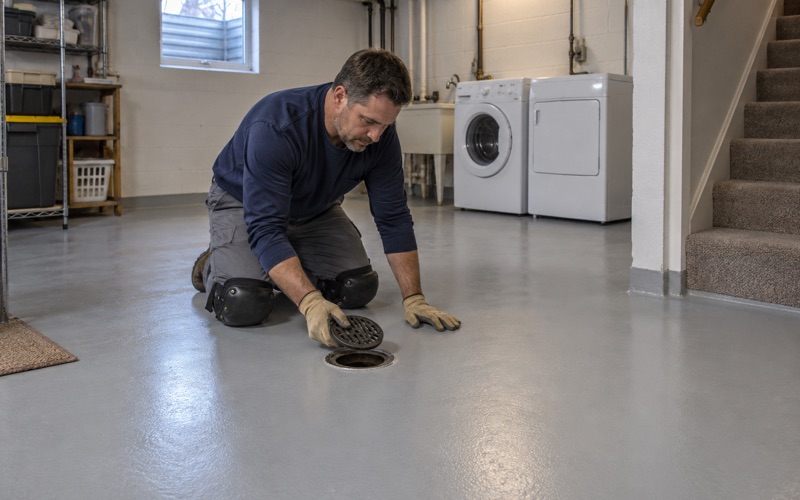
An older slab may carry a worn sealer, oil stains or a past coating that has started to lift. A newer one may look clean and still hold moisture. We test before coating because Wisconsin does not require a vapor retarder under an unconditioned attached garage slab, so a dry-looking floor is not proof of a dry one.
Building for Salt, Brine and Cold
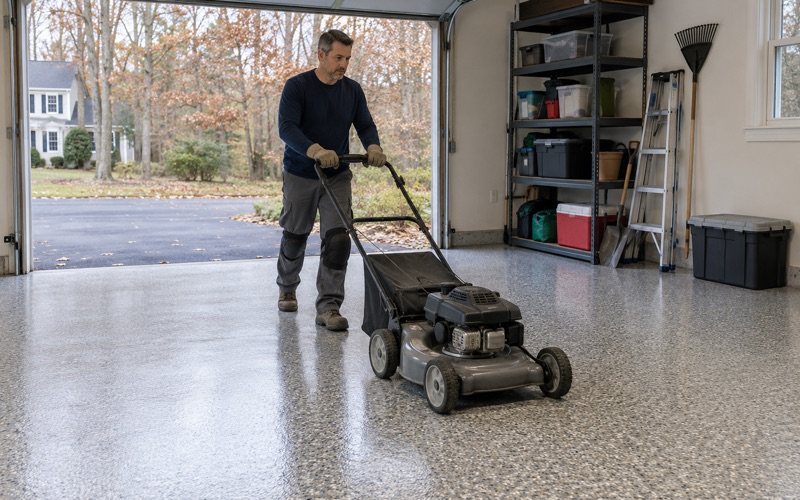
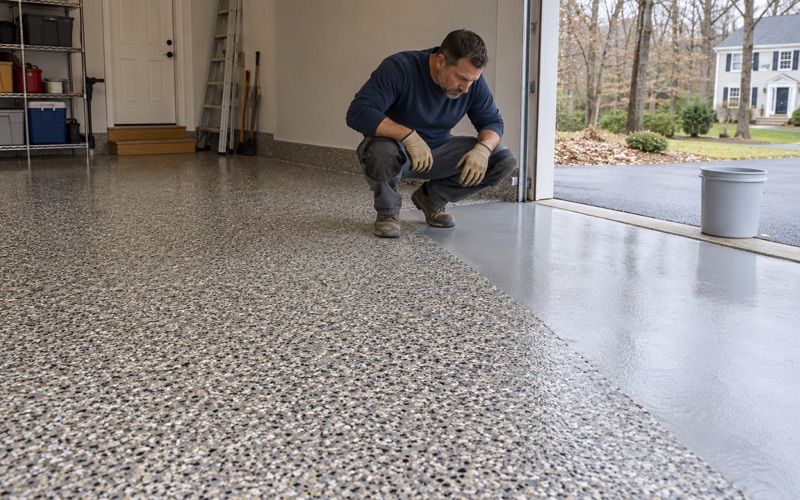
Garage floors here take the road salt and calcium chloride brine that winter tires track in. We build residential systems with a vinyl flake broadcast and a polyaspartic or polyurea topcoat chosen to stand up to those deicers and to clean off easily in spring.
Curing follows slab temperature and dew point, not the calendar. When an unheated garage is too cold for the system to cure properly, we tell the homeowner it has to wait for spring rather than install a floor that will not reach full strength.
New Detached Garages and the Architectural Board
Homeowners planning a new detached garage should know that Mequon’s Architectural Board approves new construction, additions, detached garages, pole barns and sheds over 300 square feet. It meets on the second Monday of each month at City Hall, and smaller sheds receive staff approval instead.
That approval belongs to the building project, not to us, and the coating comes after the slab is poured and cured. Every home job we take gets a written contract before any deposit, with the products and any warranty spelled out, and we read the warranty exclusions aloud beforehand, starting with moisture coming up from below.
- 20+ Years Experience
- Moisture Testing in Every Scope
- Written Proposals and Contracts