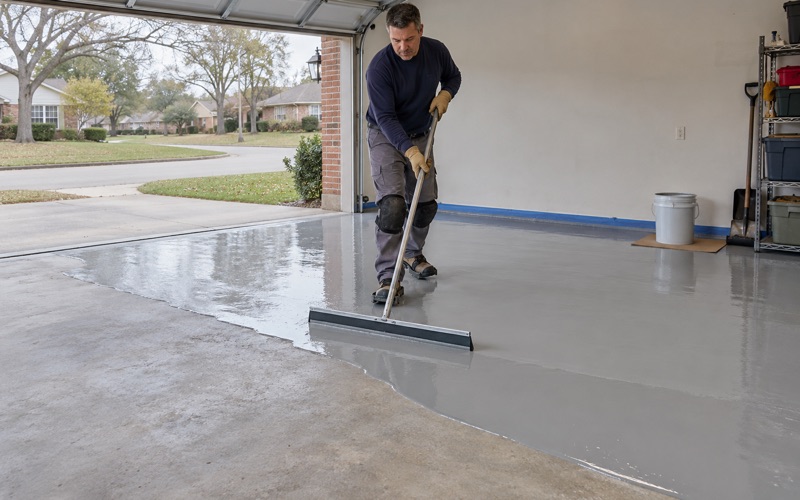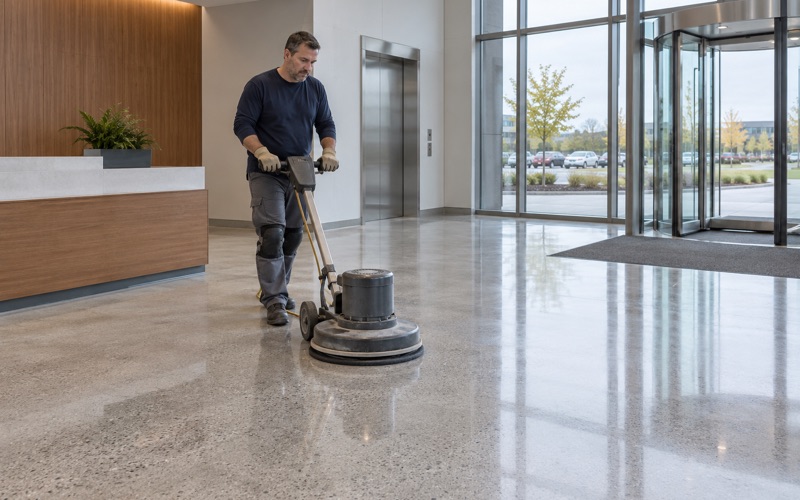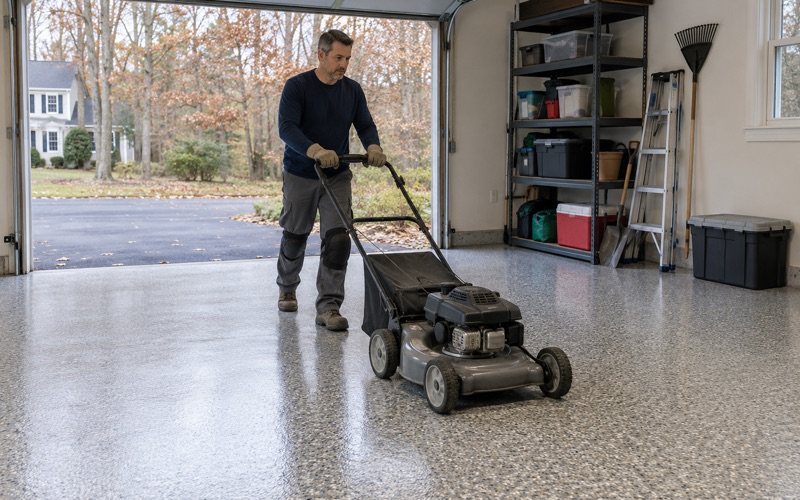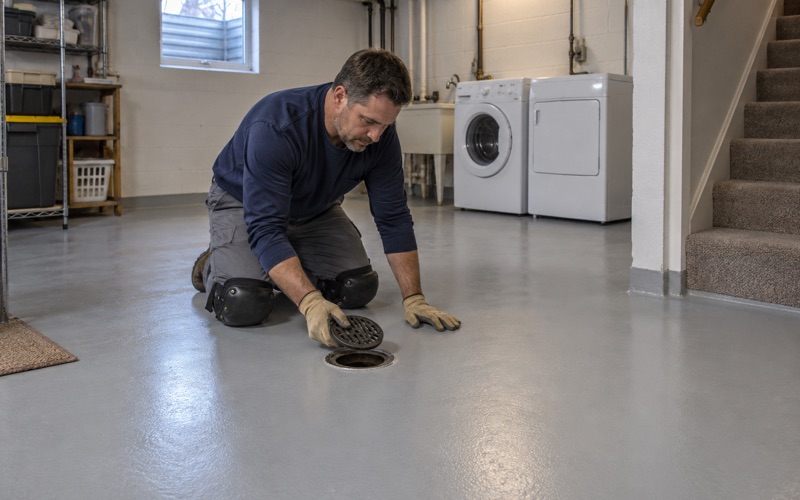
Brookfield Epoxy Flooring brings more than 20 years of work to epoxy flooring in Menomonee Falls, coating plant floors, machine shops, warehouses and garages. On a production floor we treat the coating as part of the room, which means its color and sheen get chosen alongside its chemical resistance, its thickness and how it cleans.
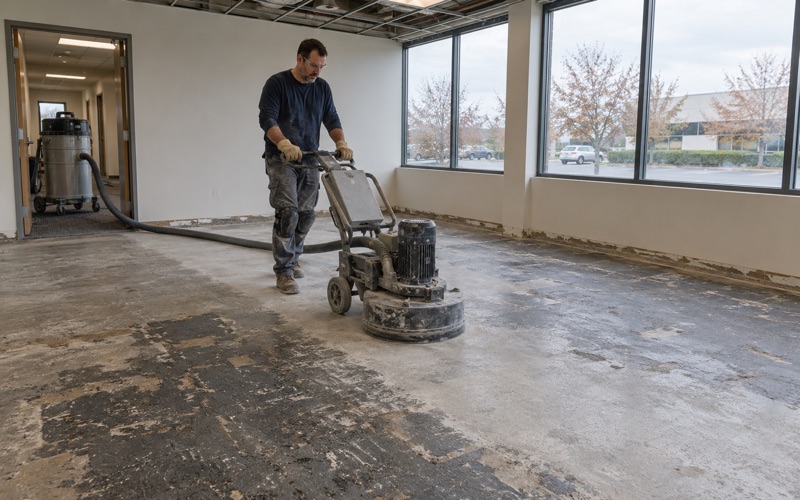
That starts with the concrete. We open every slab with a diamond grinder or a shot blaster, and we never acid etch. Moisture testing appears as its own line on the proposal, and the proposal also names the product, the system build and the finished thickness, so a plant engineer can hold the finished floor up against the quote.
We also read the slab before pricing it: the cracks, the joints and any coating already on it. When a floor needs repair or replacement before it can take a coating, we say so in plain terms, and we walk through the warranty exclusions before anything is signed, starting with moisture from below.
Engines and Transmissions on Pilgrim Road
Menomonee Falls is a village in Waukesha County and part of the Milwaukee metropolitan area. Its population was 38,527 at the 2020 census, which made it the most populous village in Wisconsin, and the Fortune 500 retailer Kohl’s is headquartered here.
Harley-Davidson Powertrain Operations
Harley-Davidson Powertrain Operations sits at W156 N9000 Pilgrim Road, inside the village. Harley calls it the home of the Big Twin, Milwaukee-Eight and Sportster powertrains, and the plant produces engines and transmissions for the final assembly plants in York, Pennsylvania and Kansas City, Missouri. Harley also runs public tours there, including the Classic Factory Tour, the Steel Toe Tour and an Engines 101 class.
Rider Magazine’s 2013 tour report described a 912,000-square-foot facility on 63 acres. The assembly line ran as two parallel loops at a 78-second cycle time, with a powertrain offloaded every 39 seconds and signs above most workstations. That account is dated, and the current layout is not something we have confirmed.
A Village That Builds Things
Harley is a landmark here, not a customer of ours, and we make no claim about its floors or its lighting. We bring it up because a line like that one shows what lighting in a plant has to do: put enough light on hands, parts and signs, station after station, all shift long.
The village’s industrial base runs well past Pilgrim Road. Milwaukee Tool has announced a campus expansion of three buildings totaling 499,500 square feet on 55 acres northwest of Flint Drive. Glenroy, a flexible-packaging printer and laminator, plans about 108,000 square feet of new space along I-41 to link its Megal Drive distribution facility with its Hillside Lane plant.
Looking for epoxy-flooring closer to Sussex? See Sussex Epoxy-Flooring.
Lighting Designs Count the Floor
A lighting designer does not just count fixtures. The calculation for how much light reaches a work surface includes the room itself, because light that leaves a fixture bounces off the ceiling, the walls and the floor before some of it lands where people work.
Ceiling 80, Walls 30, Floor 20
The ASHRAE/IES Advanced Energy Design Guides publish recommended surface reflectances for warehouse and self-storage space: ceiling 80 percent, walls 30 percent and product or floor 20 percent. Those are design-guide recommendations, not a code requirement and not a rule written for manufacturing space. They show that a designer assumes some value for the floor before a single fixture is placed.
The same guidance notes that lighter finishes can produce relatively higher light levels and perceptions of brightness. Reflectance feeds into what lighting designers call the coefficient of utilization, a measure of how efficiently a luminaire performs in a given room, and it rises as the room surfaces get lighter.
The Floor Is a Room Surface
In a plant, the floor is often the largest surface in the room, and it sits directly under the work. Light returned from the floor reaches the underside of a part on a fixture, the inside of an engine case on a stand and the lower half of a workstation that overhead light reaches poorly.
That is why we talk about floor color with the people who run the building, not only with whoever approves the purchase order. A floor that reflects what the lighting plan assumed lets the fixtures do the job they were selected for.
What We Will and Won’t Promise
We do not quote light levels and we do not promise an energy savings figure. The lighting design belongs to the building’s engineer, and the light a room delivers depends on its fixtures, its ceiling, its walls and its maintenance as much as on its floor.
What we can do is tell you which coating colors run lighter or darker and match the floor to the reflectance your lighting plan expects. If you have a lighting designer, we will work from their assumptions.
When an Oil-Darkened Slab Meets a Lighting Plan
A lighting plan carries its assumptions for decades, and the floor does not stay put. Years of oil, tire marks and wear can turn a slab several shades darker than it was the day the fixtures were specified.
Less Light Coming Back Up
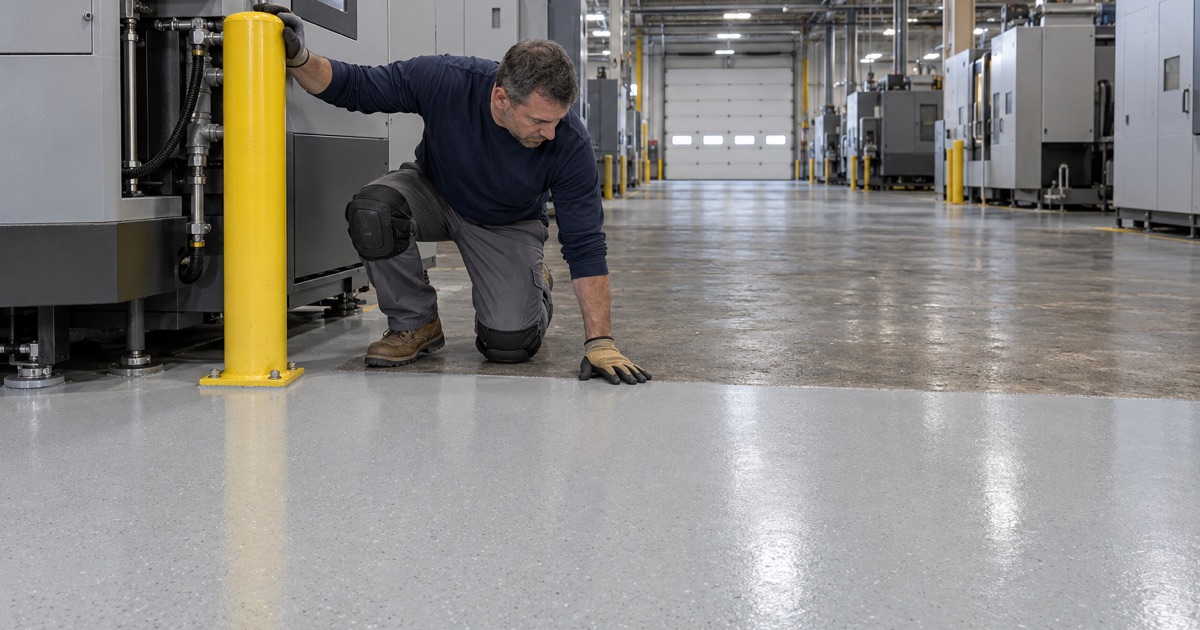
A worn, oil-darkened slab returns less light than the design assumed. The fixtures still deliver what they were built to deliver, but less of it bounces back to the work, so stations can read dimmer than they were designed to be. A light-gray coating does the opposite and returns more light to the underside of the work along the line.
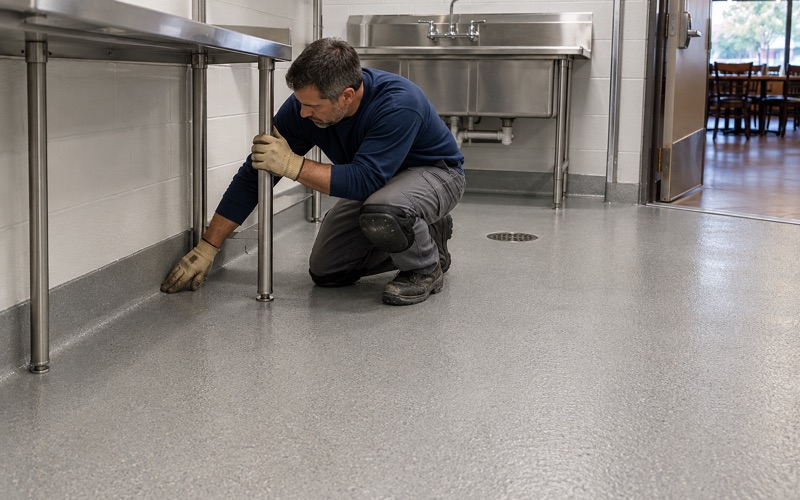
Cleaning only goes so far on a bare slab, because oil soaks into concrete rather than sitting on top of it. A sealed coating keeps spills on the surface, where a scrubber can take them off and the floor can hold its color longer.
Grinding Back to Clean Concrete
A coating cannot bond to oil. We grind or shot blast a contaminated slab to a measured profile on the ICRI CSP scale and take the surface down to clean concrete before any primer goes on, because a primer over residue only bonds to the residue.
Grinding dust and slurry are collected on site and never washed into a floor drain or a storm sewer. Where oil runs deep, we tell you during the walk-through whether the slab can be coated at all or needs repair first.
Choosing Color and Sheen for the Line
Color does most of the work. Light gray is a common choice for a production floor because it returns more light than a dark finish while still hiding everyday scuffing better than white. A 100% solids epoxy base with a polyaspartic or polyurea topcoat lets us set the color in the base and tune the sheen and wear layer on top.
Sheen changes how light leaves the floor. A satin topcoat spreads returned light more evenly, while a high gloss sends more of it off at a single angle and shows every scratch in a busy aisle. We help you weigh that against cleaning, since a smoother finish is easier to scrub and a textured one gives better footing where fluids land.
Joints Under Cart and Lift Traffic
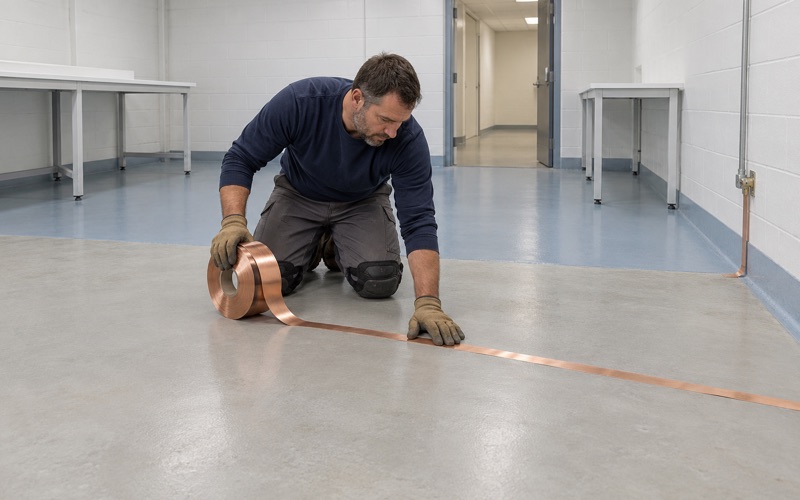
A plant floor carries carts, lifts and tuggers across its joints every shift. We fill those joints with a semirigid filler before any coating goes over them, so wheels do not break the edges and leave a dark line of chipped concrete that collects grime.
Open joints and cracks also break up the color of a floor. A filled, coated joint keeps the surface reading as one even field, which matters when the reason for a lighter finish is to return light consistently across the room.
Menomonee Falls Plant Floor Questions
Who Reviews Plans in the Village?
The Village of Menomonee Falls Building Inspection Division handles permits and inspections for residential and non-residential work, at 262-532-4400 for building applications and 262-532-4282 for inspections. The village holds DSPS Appointed Agent status for building and HVAC plan review, so some commercial plans are reviewed by the village and others must go to DSPS. We ask which applies before a job is scheduled.
A floor coating on its own is usually a different question from a renovation that adds walls, drains or equipment. When a coating project rides along with that kind of work, we coordinate with whoever holds the permit so the floor goes down in the right order.
Will Moisture Be Tested First?
Yes, and it is written into the scope. We use ASTM F1869 calcium chloride testing or ASTM F2170 in-situ relative humidity probes, with an ASTM D4263 plastic sheet test as a quick screen. A coating is not a fix for water coming up through a slab, and we do not sell it as one.
A slab that looks dry can still be pushing vapor, and a production floor is an expensive place to find that out. When readings come back high, a moisture-mitigation primer can go down under the system, and if the numbers are beyond what a primer can handle, we say so before you commit to a schedule.
Do Air Quality Rules Affect the Products?
Wisconsin DNR has no state architectural-coating VOC rule, so the national rule in 40 CFR 59 Subpart D governs what we bring on site. The village lies within the Milwaukee 2015 ozone nonattainment area, which takes in the part of Waukesha County north of I-94 and east of Highway 67, and we choose products with that in mind.
Can the Work Fit Around Production?
We schedule around the hours a building has to keep running, including overnight and weekend windows. A large floor can often be done in sections so part of the line stays open while another part is prepped and coated.
Curing follows slab temperature and dew point rather than the calendar. We give a return-to-service time based on what we measure, and we tell you plainly when a cold building needs longer before traffic goes back on.
Do You Coat Home Garages Here Too?
Yes. Most homes in Menomonee Falls are owner-occupied detached houses. Their garage floors get the same grinding and moisture testing, plus a system built for the road salt and calcium chloride brine that winter tracks in, and every home job gets a written contract before any deposit is taken.
- 20+ Years Experience
- Moisture Testing in Every Scope
- Written Proposals and Contracts