Brookfield Epoxy Flooring brings more than 20 years of epoxy flooring work to Lincoln Village, and the requests that teach us the most here come from rooms where a floor is judged by how well it can be cleaned. In a clinical space, a floor is part of the hygiene plan. A pretty coating that traps grime at a seam or lifts at a cabinet edge has failed, however good it looked on install day.
That changes the order of the questions we ask. Color and sheen come last. First we want to know which rooms see patient care, which rooms process instruments, what the staff mops with every night, and where the fixed equipment sits on the slab.
The answers usually sort a building into zones before we price a single square foot. Some rooms need a hard, seamless, nonporous floor that runs up the wall. Others can carry whatever finish makes visitors comfortable, and the proposal should say which is which.
A Six-Day Dental Office and the CDC Floor Guidance
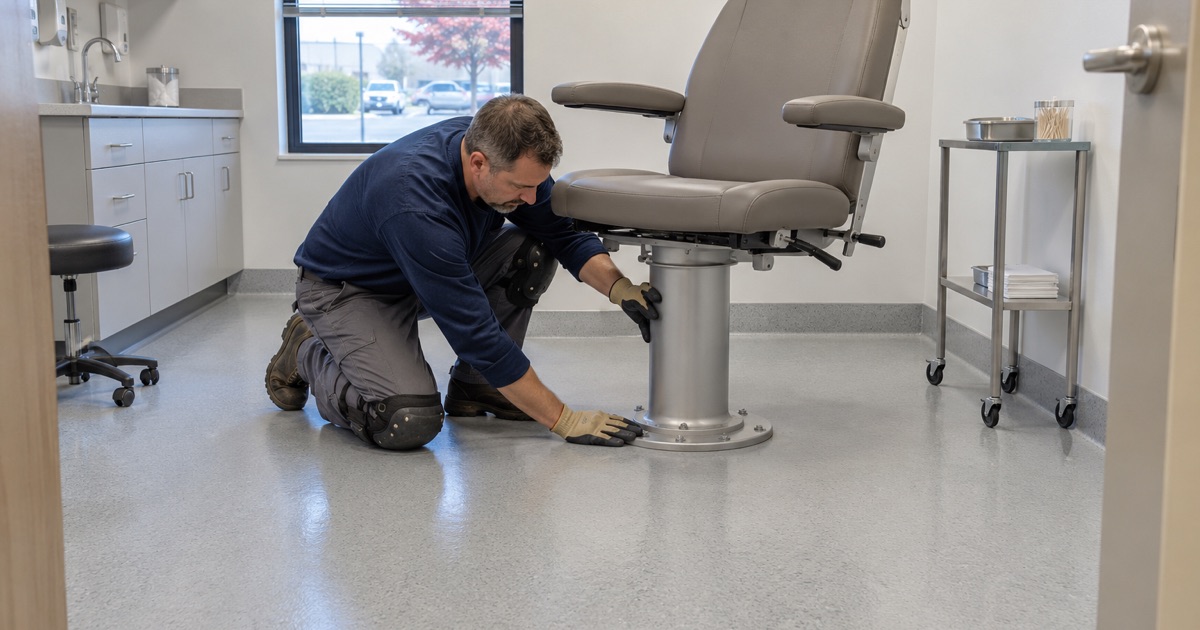
The clearest local example of that zoning problem sits on the commercial strip of Lincoln Avenue. It is worth walking through, because the same logic applies to any dental or medical suite in this south side Milwaukee neighborhood.
Bright Dental on W. Lincoln Avenue
Bright Dental at 1300 W. Lincoln Ave. sees patients Monday through Friday from 9 a.m. to 7 p.m. and Saturday from 9 a.m. to 3 p.m. The office welcomes dental emergency patients and walk-ins, and its service list runs from children’s dentistry and whitening to extractions, root canal treatment, implants and orthodontics.
We have not seen that office’s floors, and nothing on this page describes them. What its hours and services tell us is the kind of floor an office like it has to live with: long days, little downtime, and procedure rooms that turn over between patients many times a day.
What the CDC says about carpet
The CDC’s Guidelines for Infection Control in Dental Health-Care Settings, published in 2003, address flooring directly. The background text says carpeting is more difficult to clean than nonporous hard-surface flooring and that it cannot be reliably disinfected.
Recommendation VII.E.1 follows from that. It says to avoid carpeting and cloth-upholstered furnishings in dental operatories, laboratories and instrument processing areas. The same document adds that floors should be cleaned regularly and spills cleaned up promptly.
Guidance, not a state law
That recommendation carries the CDC’s Category II rating, and we describe it to clients as federal guidance rather than a Wisconsin rule. We have not confirmed whether Wisconsin’s dentistry regulations cite it, so we do not tell an office it is required by law.
What we do say is that the guidance makes the design decision easy. If a room is an operatory, a lab or an instrument-processing space, the floor in it should be hard, nonporous and something the staff can disinfect.
Looking for epoxy-flooring closer to Hartland? See Epoxy-Flooring in Hartland.
Operatories, Labs and the Sterilization Room
These are the rooms where a resin floor earns its place. Carpet is out by the guidance, and a floor full of joints and seams brings back the same cleaning problem in a different form.
A seamless floor with an integral base
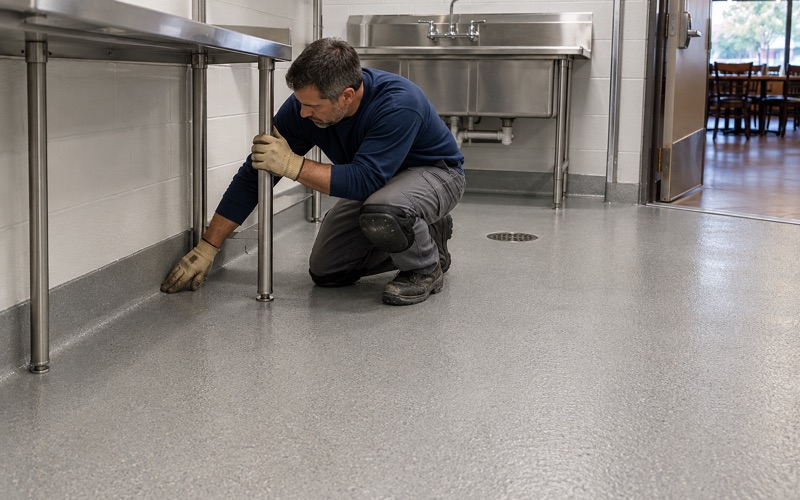
A formed-in-place epoxy floor has no tile joints for soil to settle into. Run the same material up the wall as an integral base and the corner where floor meets wall becomes a smooth curve a mop can reach, rather than a crack behind a vinyl strip.
For operatories we usually build a 100% solids epoxy body coat and finish it with a polyurethane or polyaspartic topcoat chosen for chemical resistance. A light quartz aggregate broadcast can add grip near the sink without opening up a texture that holds dirt, and the proposal names the product, the system build and the finished thickness so the office can check what went down.
Instrument processing and in-office labs
The sterilization room is the hardest-working floor in most dental suites. Instruments move from dirty to clean along a set path, carts roll back and forth, and the floor sees water and cleaning chemicals all day.
An in-office lab adds its own grit and spilled materials. In both rooms we keep the floor plain and continuous, carry the base up behind the counters, and avoid any decorative flake load that makes a dropped item harder to spot.
Thickness matters in these rooms as well. A thin roll-on coating wears through along the cart path first, so in a sterilization room we lean toward a heavier build than we would put down in an office corridor.
Preparing the slab underneath
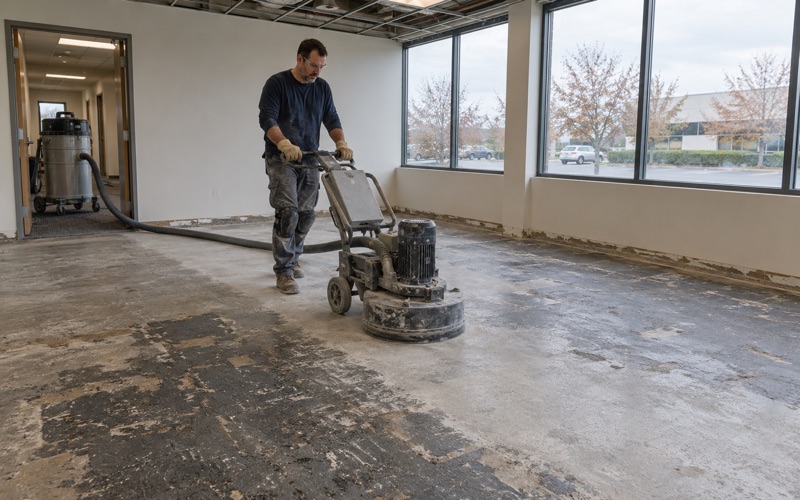
A clinical coating is only as good as its bond. We open every slab with a diamond grinder or shot blaster to a measured surface profile, and we never acid etch, because a chemical wash leaves residue the coating then has to bond through.
Moisture testing is in the scope from the start, using ASTM F2170 in-situ relative humidity probes or ASTM F1869 calcium chloride tests. Where readings call for it we quote a moisture-mitigation primer up front, and warranty exclusions for moisture from below are read out before the job is sold.
We also read the cracks, joints and any old coating before we quote. A clinic slab with failing tile adhesive or a wandering crack may need repair before it can be coated, and we say so plainly rather than coating over it. Moving joints get a semirigid filler so cart wheels do not break the edges.
Daily Cleaning Around Chairs and Cabinetry
In a dental office, the floor is cleaned every day around equipment that never moves. That is where coated floors fail first, so we plan those edges before anything else.
Sealing at chair bases and toe-kicks
A dental chair is bolted to the slab, and cabinetry sits on a toe-kick that meets the floor along every wall of the operatory. If the coating stops short at those lines, the gap collects cleaning water and debris where nobody can scrub.
We detail the coating tight to chair mounts and into the base of the cabinet runs, and where cabinets are being replaced we would rather coat first and set them afterward. Either way, the goal is a continuous seal with no open seam at the floor line.
Chemical resistance matters more than gloss
Operatory and sterilization-room floors take a nightly round of the office’s surface cleaners and disinfectants. A high-gloss finish that softens or dulls under those products is the wrong choice, however good it photographs.
We ask the office manager which products the staff use and pick the topcoat against that list. A satin finish that holds up to the chemistry will look better in five years than a mirror finish that has gone cloudy around every chair.
Amine blush is a related concern. Some epoxies curing in cool, humid air leave a waxy film on the surface, and if that film is not caught and cleaned before the topcoat goes on, the bond between coats suffers. Holding the room’s conditions during cure is part of how we avoid it.
Spills cleaned up promptly
The CDC’s housekeeping line is simple: clean floors regularly and clean spills promptly. A nonporous resin floor makes that practical because nothing soaks in during the minutes between a spill and a wipe.
Texture plays into this too. Heavy texture improves grip but holds soil in its low points, so in clinical rooms we keep any aggregate fine and lock it under the topcoat.
That said, a floor coating is not a substitute for the office’s own cleaning protocol. We build the surface so the protocol works, and we leave the protocol itself to the practice.
Zoning the Office, From Waiting Room to Clinic
Not every room in a dental suite needs the same floor, and pretending otherwise spends money in the wrong place. The guidance covers the clinical rooms; the front of the office is a different decision.
Where softer finishes belong
The waiting room is where carpet tile, wood-look plank or another warm finish still makes sense. Patients sit there, children play there, and nobody is processing instruments on it.
We mark the line on the plan where the clinical floor begins, usually at the corridor into the operatories, and make the transition flat so carts and wheelchairs roll across it. That keeps the hard, seamless floor where the CDC guidance points and the comfortable finish where people wait.
The doorway detail deserves attention of its own. A raised reducer strip is one more seam to clean and one more edge to catch a cart, so where we can, we carry the resin base right to the edge of the softer finish and keep the joint tight and low.
Working around six-day hours
An office open six days a week does not have a natural week off. Clinic and retail floors are scheduled around the hours the building must stay open, so we plan overnight and weekend windows, often one or two operatories at a time.
Curing is set by slab temperature and dew point rather than the calendar. We tell the practice how long each room must stay closed before chairs go back into service, and we put that in the written schedule.
Odor is a fair question in an occupied building. We talk through product choice with the practice ahead of time, including low-odor systems for rooms next to areas still seeing patients, so a Saturday evening install does not leave Monday’s first appointment in a room that smells of fresh coating.
Storefront and permit questions on Lincoln Avenue
Lincoln Village sits inside the City of Milwaukee, bounded by W. Becher St. on the north, the Kinnickinnic River on the south, S. 5th St. on the east and S. 20th St. on the west. Construction plan review for a tenant buildout here runs through the City of Milwaukee Department of Neighborhood Services and the Milwaukee Development Center.
Before we schedule a clinic or storefront job, we ask the city whether the work needs a permit, since replacing a floor finish and remodeling a suite are different questions. Grinding dust and slurry are collected on site, never washed into a floor drain, and the office gets a written contract naming every product before any deposit is taken.
- 20+ Years Experience
- Moisture Testing in Every Scope
- Written Proposals and Contracts