Brookfield Epoxy Flooring installs industrial epoxy flooring in Brookfield, WI, serving surrounding cities including Wauwatosa, West Allis, Pewaukee, New Berlin and Menomonee Falls. Our 20+ years in resinous floors include warehouse, shop and manufacturing slabs, where the floor is part of the production line and failure shows up as downtime.
Brookfield’s almost a dozen industrial and office parks, including the Brookfield Industrial Park, the Northeast Industrial Park and the 124th Commerce District, hold warehouses, assembly floors and shops that see forklifts, pallet jacks, carts and racking loads. Industrial floor systems are built for those loads first and appearance second.
Every proposal names the product, the system build and the finished thickness, so a plant manager can compare quotes on what will actually be installed. Thickness is the line most bids leave out.
Industrial Floor Systems
High-Build 100% Solids Epoxy
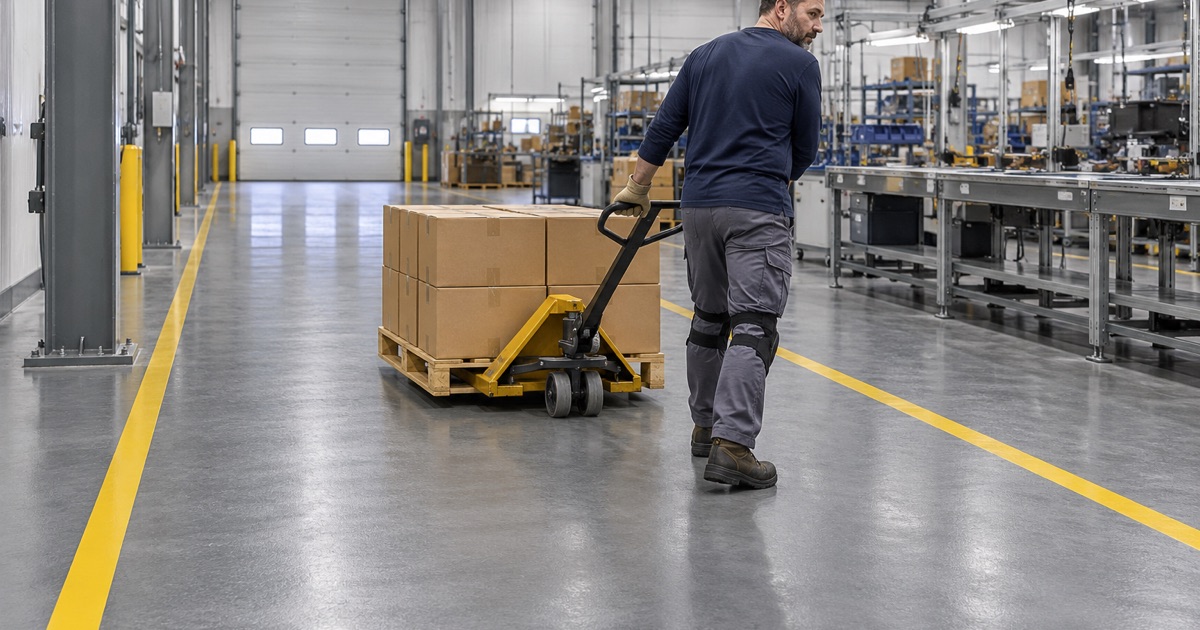
For warehouses and assembly areas, we install 100% solids epoxy at a stated build, often with a quartz or sand broadcast for texture and added thickness. These systems resist abrasion from forklifts and carts and many chemicals common to industrial work, and they leave a seamless, bright floor that is easy to sweep and scrub.
Thin, water-based coatings sold as industrial floors usually wear through in the forklift lanes within a short time. Film build is what separates a floor that lasts from one that needs recoating every year.
Epoxy Mortar and Trowel-Applied Systems
Where heavy impact, dropped parts and steel wheels are part of daily work, a trowel-applied epoxy mortar builds a much thicker, tougher surface. It can also be used to rebuild worn or damaged areas of a slab before a topcoat goes on. These systems are slower to install but much more resistant to impact damage.
Urethane Cement for Thermal Shock and Washdown
Urethane cement handles hot water washdown, steam cleaning, thermal shock and many acids that would crack or soften a standard epoxy. In food processing, breweries and wash bays, it is often the right choice. It is also more tolerant of moisture in the slab than most epoxy systems.
Food processing plants licensed by the state face ATCP 70 room finish rules, which call for floors in processing areas that are smooth, impervious and easily cleanable. Urethane cement with an integral cove base is a common way to meet that standard.
Preparing an Industrial Slab
Shot Blasting and Grinding
Industrial slabs are prepared by shot blasting or diamond grinding, never acid etching. Shot blasting moves quickly across large open areas and leaves a uniform ICRI profile, while grinding handles edges, tight spaces and coatings that shot blasting cannot remove. Both remove sealers, curing compounds, oil and weak surface paste.
Oil-soaked concrete around machines and in maintenance bays is degreased and ground out, and heavily contaminated areas may need to be cut out and patched. Coating over oil invites peeling exactly where the floor sees the most use.
Moisture Testing Older Slabs
Older industrial buildings may have slabs poured without an effective vapor retarder. Moisture moving up through the slab can blister or debond a coating. We test with ASTM F1869 calcium chloride or ASTM F2170 in-situ relative humidity methods and specify a moisture-mitigation primer or urethane cement where readings call for it.
Joint Filling and Repair
Control joints are where industrial floors break down first. Hard wheels chip open joints, and the damage grows with each crossing. We fill joints with a semirigid joint filler before coating and rebuild broken joint edges with epoxy mortar, so wheels roll smoothly and the coating is supported along every joint line.
Cracks and spalls get the same attention. We read the slab before quoting and say plainly when an area needs more than surface repair, such as a section that has settled or broken through.
Working Around Production
Phased Installation
Industrial floors rarely get a full shutdown. We divide the floor into phases and sequence them around production, racking moves and shipping schedules. Weekends, holidays and planned shutdowns are used where possible, and fast-cure products shorten the time each area is out of use.
Racking and Equipment
Racking and heavy equipment either stay in place and are coated around, or are moved in stages. We plan this with your team before starting, so the floor work does not interfere with picking, staging or maintenance access.
When a floor project is part of a larger tenant improvement or alteration, Wisconsin’s commercial building code applies statewide, with the 2021 International Building Code adopted through SPS 361 since September 2025. Commercial permits in the City of Brookfield are filed through Inspection Services, and we ask there before scheduling when a floor job is bundled with other work.
Dust, Slurry and Pretreatment Rules
Grinding and shot blasting dust is captured by industrial extractors. Slurry and wash water are collected on site, never sent down a floor drain or storm sewer. The western half of Brookfield sends its wastewater to the city’s Fox River Water Pollution Control Center, which runs an industrial pretreatment program to protect the plant and its collection system, and the east side flows to MMSD.
Safety, Traction and Markings
Slip Resistance
Industrial floors get wet, oily or dusty. Quartz or sand broadcast and textured topcoats give traction where it is needed, such as loading docks, wash areas and ramps. Texture is set to balance grip against how easily the floor can be cleaned.
Aisle Striping and Zones
Pedestrian walkways, forklift aisles, hazard zones and storage areas can be marked into the floor with colored coatings or durable line striping. Built-in markings last longer than tape or paint, and they can be laid out to match your safety plan.
Markings are easiest to plan before the topcoat goes on. Lines laid into the system are sealed under the same clear coat as the floor, so a forklift turning on them does not scrub the color off the way it does with surface paint or tape.
Chemical Exposure
We ask what chemicals are used, spilled or cleaned with in each area, then choose topcoats and systems with resistance to them. A battery charging area, a parts washer zone and a general warehouse aisle may each need a different system on the same floor.
Electronics assembly and test areas inside an industrial building can need static control as well as durability. In those zones we install static-dissipative or conductive ESD systems, specified to a resistance range and tested with a meter, alongside the standard industrial floor in the rest of the plant.
- 20+ Years Experience
- Moisture Testing in Every Scope
- Written Proposals and Contracts