Brookfield Epoxy Flooring brings more than 20 years of work to epoxy flooring in Greenfield, and on event rooms we start with a question most floor quotes skip: what will the furniture do to the coating once the room is in use? A garage floor answers to tires and road salt. A party room, a banquet floor or a basement bar answers to chairs, and those chairs get dragged across it hundreds of times a year.
That question changes how we scope the job without changing the basics. We still open every slab mechanically, test it for moisture, and name the product, the system build and the finished thickness on the proposal. On a room that hosts gatherings, we also ask what the seating stands on, how the floor gets cleaned and how often the room is reset.
The coating and the chair glides share the wear. Get the glides wrong and even a well-built system starts showing pale scratch paths along the routes the chairs travel most.
The Banquet Hall That Outlasts Spring Mall
What the city asked bidders to keep
Spring Mall, at 4200 S. 76th Street, is on its way out. When the City of Greenfield put the property out for proposals in 2023, its request described two single-story masonry buildings on about 23.85 acres. It also noted that the eastern 14,388 square feet of the South Building was leased to Meyer’s Family Restaurant, and that any proposed development should accommodate the placement or relocation of Meyer’s.
The Common Council selected Mandel Group in January 2024 after the request drew two responses. BizTimes reported in April 2025 that Mandel bought the roughly 24-acre site for $4 million and plans 257 market-rate apartments in two-story garden-style buildings, with the largely empty mall torn down.
One tenant stays
Meyer’s Restaurant Bar & Banquet Hall is the exception. BizTimes called it the mall’s only remaining commercial tenant, and Mandel’s plan keeps part of the existing retail space it uses. When the rest of the property turns residential, a banquet hall will still be operating on that stretch of S. 76th Street.
Greenfield is one of many bedroom communities in the Milwaukee metropolitan area, and the apartments will add to that character. The banquet room is the part of the old mall that keeps a working floor.
Why we point to it
We mention Meyer’s because it is a clear example of a floor type Greenfield already has and will keep having: a room built for events, where furniture moves more than people do. We have not seen that floor, its finish or its chairs, and nothing on this page describes them. It is a reference point for a kind of room, not a job of ours.
Greenfield’s retail centers are being re-tenanted in other ways too. At Greenfield Place, 5070 S. 74th St., the former Smart Buy Furniture store is planned as NRG Adventure Park, a 49,000-square-foot indoor amusement park. Entertainment and event use keeps replacing straight retail on the city’s commercial corridors.
Looking for epoxy-flooring closer to Hales Corners? See Epoxy-Flooring Services in Hales Corners.
A Banquet Floor Is a Furniture Floor
Chairs move every time the room changes
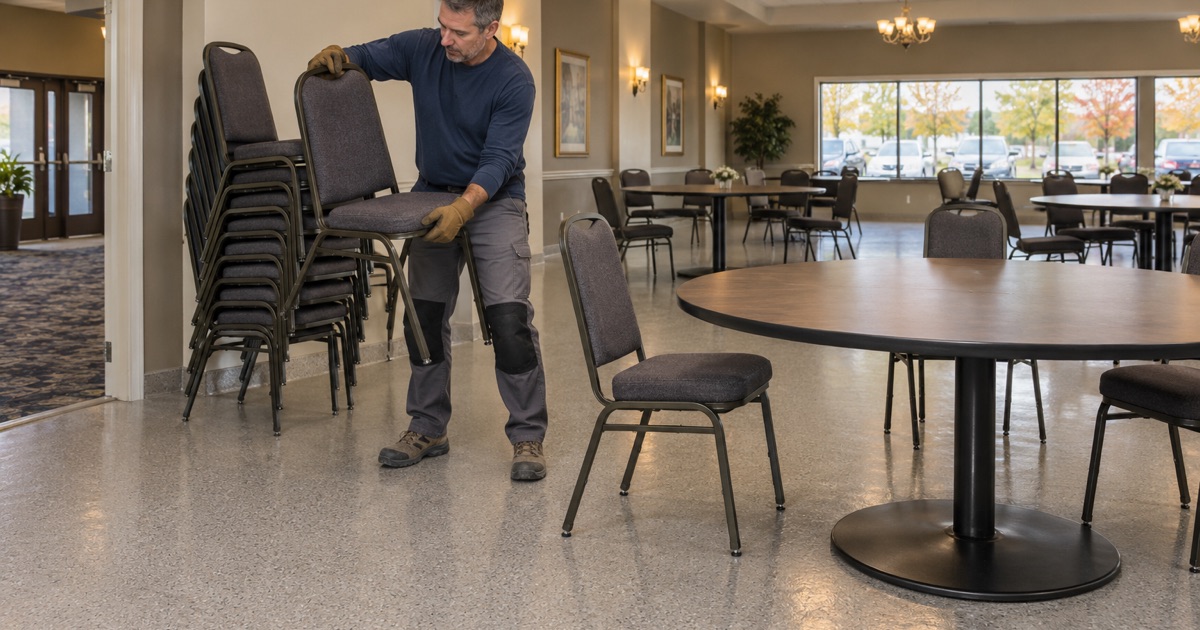
A banquet room gets set, used, cleared and swept, then set again for the next booking. Stack chairs come off the cart, get dragged into rows, slide back as guests sit and stand, and get pulled out again at cleanup. A dining room at home sees a small fraction of that movement. Over a year of weddings, meetings and parties, it adds up to a lot of chair travel across the same few square feet.
Foot traffic spreads wear across a whole floor. Dragged chairs concentrate it into short, repeated arcs behind every seat and along every aisle where chairs are hauled into position.
Why the coating alone does not settle it
A coating’s abrasion resistance matters, and we build event floors with that in mind. But the thing touching the surface thousands of times a year is the bottom of a chair leg, and what that leg is wearing decides a large share of the wear pattern.
That is why we ask about the chairs before we finalize a system, rather than after the floor starts dulling. On a coated party room, banquet floor or basement bar, the glides belong in the same conversation as the topcoat.
Smaller rooms, same mechanism
The same thing happens at home. A finished basement bar with a row of stools, or a party room where folding chairs come out for birthdays and game days, takes the same dragging on a smaller scale. Bar stools get some of the hardest use, because people shift and swivel on them while seated, working whatever is under the feet into the same small spots.
More than half of Greenfield’s housing units were built between 1950 and 1979, by Census estimates, so many of these rooms sit on slabs that have been down for decades. Those slabs get the same moisture testing as any other basement before we apply anything.
Metal, Felt and Nylon Glides on a Hard Floor
What one seating maker’s guide says
Leland International, a contract-seating manufacturer, publishes a glide guide for hard floors: concrete, ceramic or porcelain tile, traditional VCT and wood. Its guidance is direct. Nylon glides are recommended as the most versatile, and metal glides will cause scratching.
It is a furniture maker’s guidance, not a code, and it ranks glides rather than coatings. We find it useful because it describes the floor from the chair’s side, which is the side that does the damage.
Metal glides
Metal is the one the guide rules out on those surfaces, and a coated slab is no exception. If the chairs or stools in a room have bare metal feet, we raise that before the coating goes down, because a fresh topcoat does not change what a dragged metal glide does to it. Stools with bare steel bases are a common example in a basement bar.
Swapping glides is cheap next to recoating a floor. We would rather say so at the quote than explain scratch paths a year later.
Felt glides
Felt gives the easiest, quietest movement, which is why so many people choose it. The guide’s catch is cleaning: these floors almost always receive wet cleaning, and once a felt glide absorbs moisture it hardens and shrinks, even exposing the hard furniture material underneath.
So felt can start as the gentlest option and end up as a hard edge riding on the coating. The change is gradual, which is why it is easy to miss until the marks show. When felt is the choice anyway, replacing the pads before they harden is part of keeping the floor.
Nylon glides
Nylon is the guide’s general recommendation, with one condition. Dirt and grime can become embedded in the nylon over time and make it somewhat abrasive, so the guide calls diligent floor cleaning paramount.
The same guide describes its Floor Saver glide as shaped to push dirt out of its path rather than grind it into the floor. The lesson holds for any glide: grit trapped under a chair leg is what does the cutting. In a banquet room, that means sweeping before the chairs are dragged back into rows, not after.
Wet Cleaning, Coatings and Greenfield Floor Questions
Why wet cleaning changes the answer
A banquet floor gets mopped, and a room that serves food gets mopped often. In Greenfield, food businesses are inspected by the Southwest Suburban Health Department, which the city shares with West Allis. A floor that is wet-cleaned on a routine is a floor where felt glides stop behaving like felt.
That gives a practical pairing. Wet cleaning argues against felt, and skipped cleaning argues against nylon. A room mopped on schedule and fitted with clean nylon glides is the combination the guide points toward. Glides also need checking on a schedule rather than once, since a pad that looked fine at installation can wear through by the next busy season.
Building the coating for an event room
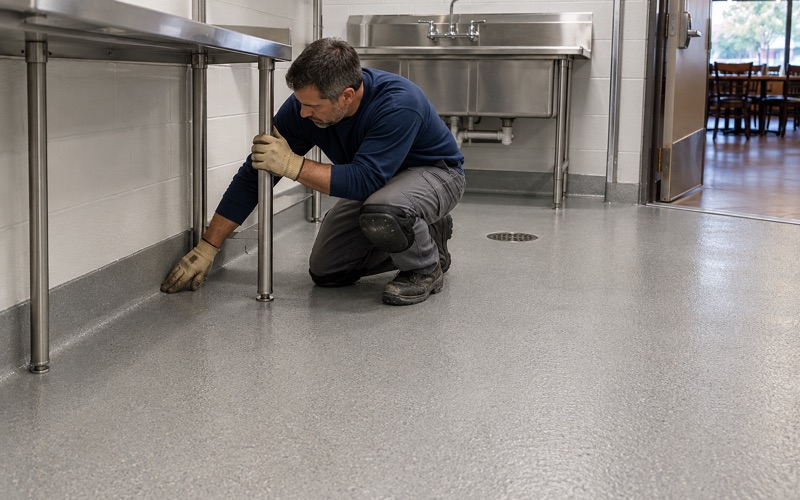
For party rooms, banquet floors and basement bars, we usually recommend a 100% solids epoxy base with a vinyl flake or quartz aggregate broadcast, finished with a polyaspartic or polyurea topcoat. Broadcast texture hides fine scuffs better than a high-gloss solid color, and the topcoat is the layer built to take the abrasion.
No coating makes a floor immune to a dragged metal leg, and we say that when we quote. What the system can do is hold up well under the right glides and a steady cleaning routine. Where a room also serves food, we plan the finish around how it will be mopped, so the topcoat and the cleaning routine work together.
Prep, moisture and paperwork
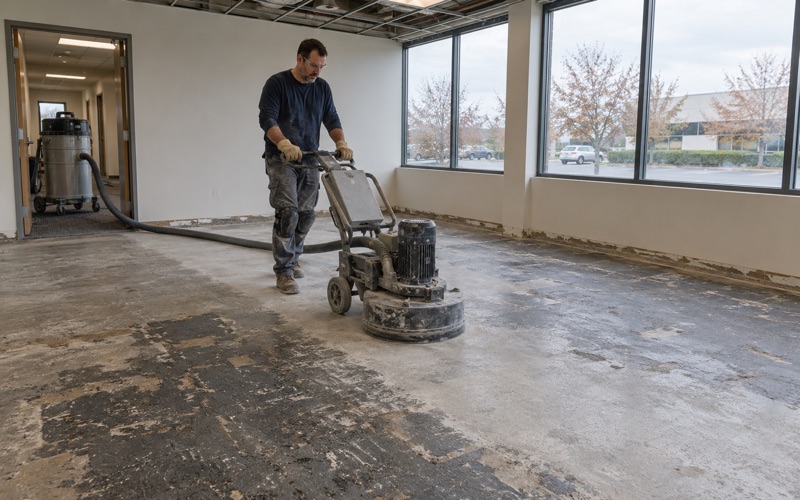
Every slab is opened by diamond grinding or shot blasting to the profile the system needs, and we never acid etch. Moisture testing sits on the proposal as its own line, because a basement bar on an older slab can carry moisture you cannot see. For commercial rooms, we ask City of Greenfield Community Development and Inspection Services whether the job needs a permit before we schedule it. Grinding dust and slurry are collected on site and never washed into a floor drain or a storm sewer.
Homeowners get a written contract before any deposit, with the products and any warranty written into it. We read the warranty exclusions out loud before the job is sold, starting with moisture from below. Curing is scheduled against slab temperature and dew point, so an event room does not reopen on a calendar date the coating has not reached.
What we ask before quoting an event floor
What chairs or stools will be used, and what are their glides made of? Do you already own the seating, or is new furniture coming? How is the floor cleaned, and how often? Is food served in the room, and does it need to reopen by a certain date?
Those answers, plus our read of the slab’s cracks, joints and any old coating, decide the system. If a slab needs repair before it can take a coating, we tell you that first, before anything is scheduled.
- 20+ Years Experience
- Moisture Testing in Every Scope
- Written Proposals and Contracts