Brookfield Epoxy Flooring has spent more than 20 years putting down epoxy flooring in Grafton and across the region, and the jobs that teach the most are the ones where somebody else is working on the other side of the floor. A coating on an upper level is never just a floor project. It is a project for every tenant whose ceiling that floor happens to be.
We plan that kind of work from the bottom up. Before we price a second- or third-floor space, we want to know who is underneath it, what hours they keep and how materials will reach the room without crowding their customers. That plan shapes the tools we bring, the products we choose and the days we work.
The proposal you get names the product, the system build and the finished thickness, so you can check what went down against what was quoted. It also lists the steps we take to protect the rooms below, because on a stacked building that part of the scope matters as much as the finish itself.
The Grafton Flour Mill on 14th Avenue
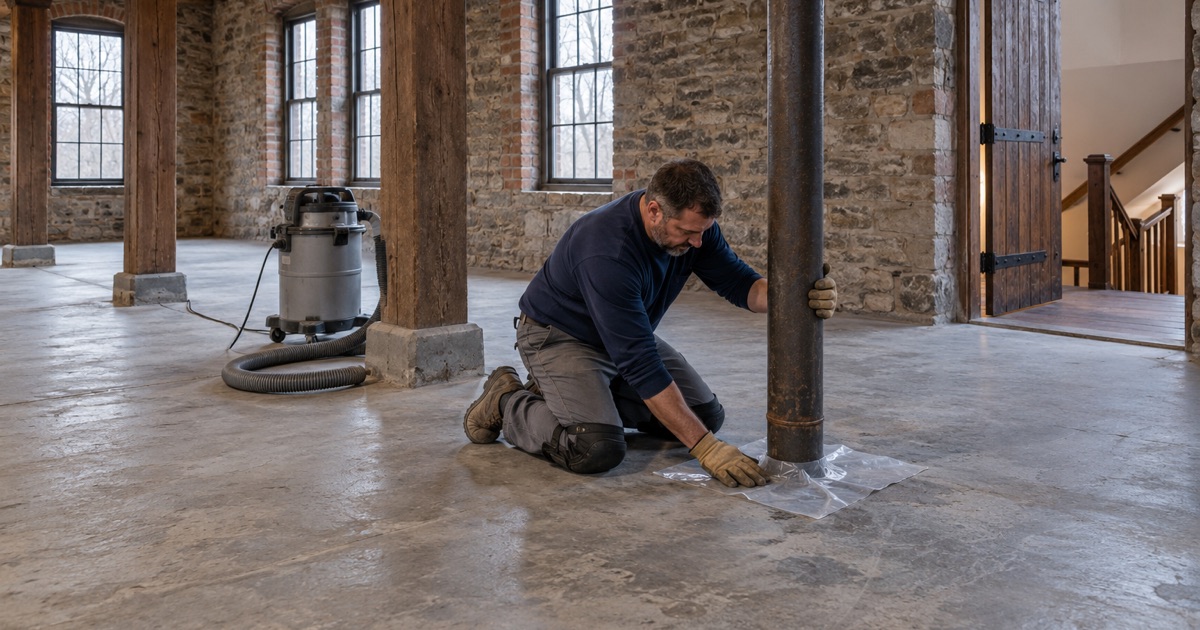
Grafton is a village in Ozaukee County, about 20 miles north of Milwaukee near Interstate 43, and its oldest commerce grew up along the Milwaukee River. The Grafton Flour Mill at 1300 14th Avenue sits on the west bank of that river, and it is the clearest example in the village of the kind of building this page is about.
A mill with a long working life
The mill’s original section dates to the 1840s, and parts of it were rebuilt after an 1884 fire. It later produced White Lily Flour, then was bought during the Depression by the neighboring Badger Worsted Mill and converted to worsted yarn before the company left Grafton in 1980. The neighboring worsted mill building stands next door at 1350 14th Avenue.
The Grafton Flour Mill has been on the National Register of Historic Places since June 30, 1983. Today it houses a yarn store, a coffee shop, offices and studios rather than machinery, which is exactly why floor work there would be a question of neighbors.
Why a mill like this changes the plan
The mill is a place we use to explain the problem, not a job we are claiming. We have not read how each of its floors is built, and nobody should assume a single answer for every level of a building with that history.
What the building does show is a pattern Grafton shares with plenty of older commercial space: occupied rooms stacked on top of one another. In that arrangement every floor except the lowest one is somebody’s ceiling, and the work has to be organized around that fact from the first site visit.
Looking for epoxy-flooring closer to Hartford? See Hartford Epoxy-Flooring.
Four Levels, Many Tenants Below the Floor
A 2019 Ozaukee Press report described the mill tenant by tenant and level by level. A coffee roastery had been on the first level since 2014, and the Grafton Yarn Store, open since 1961, was the building’s longest-running business.
Who sits on each level
That same report placed the Arts Mill gallery and studios on the second and third levels, a yoga studio holding classes in the third-floor gallery, and a basement below everything. The tenant mix in any building changes over time, so we treat a list like that as a starting point and confirm who is actually there before we schedule anything.
The current Arts Mill listing puts its 22 artists’ studios and a boutique on the second floor, open Tuesday through Saturday from 11 a.m. to 5 p.m. Those hours are the kind of detail that decides when grinding can happen and when it cannot.
Working above a coffee roastery and a yarn store
If the floor being coated sits over a first level like the mill’s, the people affected are a coffee business serving customers and a yarn store holding classes. Neither wants dust settling on counters or yarn, and neither can close for a week while a floor upstairs cures.
So the first conversation is with the building owner about those tenants. We ask which hours are busiest, whether the work can run when the lower shops are closed, and who needs a heads-up before a loud day of surface prep.
Moving materials through shared stairs and an elevator
In a stacked building the stairs and elevator belong to everyone. Our grinders, vacuums, resin kits and aggregate have to travel through those shared routes while the tenants underneath are open for business.
We stage deliveries in small loads, protect the path and keep the elevator free during the hours customers use it most. A floor job should not turn a shared hallway into a storage room.
Dust Stays at the Tool, Water Stays on the Slab
On a ground-floor slab, a little stray dust is a cleanup problem. Over an occupied room it is a complaint from a tenant who never hired us, so containment is built into the method rather than added at the end. No village rule or code we know of sets these steps; they are simply how we work above other people.
Opening the surface without sending dust downstairs
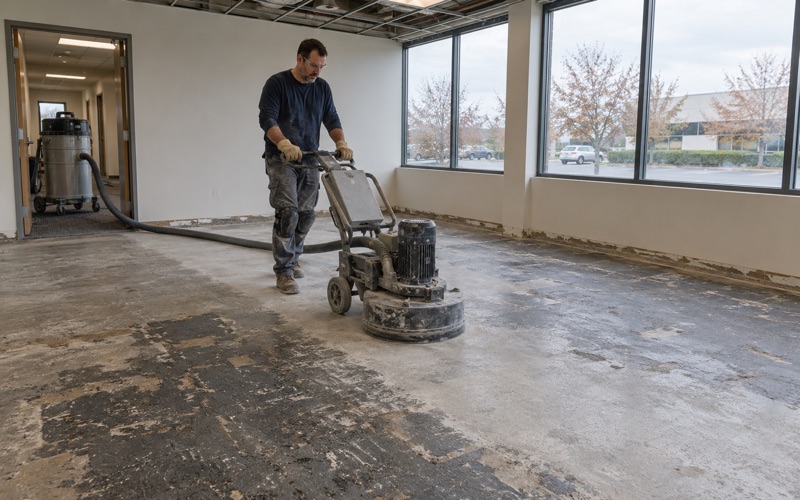
Every surface we coat is opened mechanically with diamond grinding or shot blasting, never with acid etching. That gives the coating a profile it can grip, measured against the ICRI CSP scale, without pouring acid onto a floor that may have gaps and penetrations leading to the room below.
Our grinders run attached to vacuums so the dust is captured at the tool as it is made. We do not sweep the ground surface into piles and push the fine powder around, because sweeping is how dust finds a seam and drifts onto a tenant’s shelves.
Keeping water and slurry on our side of the floor
Wet methods are where a floor job above occupied space can go badly wrong. Water or slurry that reaches a plank seam, a pipe penetration or an old opening in the floor can show up as a stain on somebody else’s ceiling.
We keep liquids to a minimum, block and seal penetrations before work starts, and collect grinding slurry on site rather than rinsing it toward a drain. If a floor’s condition makes that control doubtful, we say so before quoting rather than discovering it with a tenant underneath.
Reading the floor before we promise anything
We look at cracks, joints and any old coating before we put a price on the job, and we tell you plainly if the surface needs repair before it can be coated. In an older building that inspection also tells us where liquids could travel and where the protection has to be heaviest.
Where the floor is concrete, moisture testing is a line item in the scope, using methods such as ASTM F2170 relative humidity probes or the ASTM F1869 calcium chloride test. Warranty exclusions are read out before the job is sold, and moisture from below is the first one we name.
Studio, Gallery and Retail Floors on Upper Levels
The mill’s upper floors show what this work is usually for. Artists’ studios, a gallery, a boutique and a room that has held yoga classes each ask something different of a floor, and each sits above somebody else.
Studios and gallery floors
A working studio sees dropped tools, spilled paint and constant foot traffic, while a gallery needs a calm, even surface that sets off the work on the walls. A 100% solids epoxy with a polyaspartic topcoat, or a quartz aggregate broadcast where grip matters, can serve both, and we match the build to the room rather than selling one system to every tenant.
On a floor where people stand and work all day, we also talk about texture and cleanup. A smooth finish looks clean but can be slippery when wet, so we discuss a light broadcast before the topcoat goes down.
Odors and cure around the tenants below
Curing resin carries an odor, and in a stacked building that odor does not stay on one floor. We schedule the coating days, ventilation and cure time around the hours the tenants underneath are open, including evenings or the days the shops below are closed.
Curing is also timed to slab temperature and the dew point at the surface rather than the calendar. Coating too close to the dew point invites amine blush and adhesion trouble, and fixing that later would mean a second round of disruption for everyone downstairs.
Retail and boutique spaces that stay open
A boutique or retail floor usually cannot close for long. We stage the work in sections where the layout allows it, so part of a space can stay in use while another part is being prepared or coated.
Before any of that is scheduled, we ask the village inspector whether the job needs a permit, because coating a floor and changing how a space is used are different questions. Every home job also gets a written contract before a deposit is taken, with the products and any warranty written into it.
What we need from you before a site visit
Tell us which level the floor is on, what sits directly below it and what hours those tenants keep. If you know whether the floor is concrete, wood or something else, that helps, though we will confirm it on site.
With that, we can walk the space, look at the floor and the rooms below, and hand you a proposal that covers the finish and the protection together. That is how a floor job in a building like the Grafton Flour Mill gets done without anyone underneath noticing more than they should.
- 20+ Years Experience
- Moisture Testing in Every Scope
- Written Proposals and Contracts