Brookfield Epoxy Flooring has spent more than 20 years on epoxy flooring in Glendale and the rest of the north shore, coating garages, basements, shops and commercial floors. Our work starts with the slab itself, because what a coating can do depends on how open, dry and sound the concrete underneath it is.
On this page we focus on one problem that bare concrete handles badly: color that soaks in. Anything carried onto a raw slab in liquid form, from dyed landscape products to tinted runoff off a wet bag, can travel into the pores and stay there. A properly built coating changes where that liquid ends up, and that difference is what most Glendale garage and warehouse owners are really paying for.
We will walk through how that works, what we do to the slab before anything is applied, and what a homeowner or facility manager should expect from the quote, the schedule and the finished floor. The permit and contract questions we hear most come at the end.
Garden goods, warehouse aisles and a slab that drinks color
Plenty of Glendale floors spend part of the year under bags of landscape material. That is true of commercial storage along the city’s industrial strip and of ordinary attached garages, and the concrete reacts the same way in both.
A garden-center warehouse on Port Washington Road
Stein’s Garden & Home stocks its retail stores from a 100,000-square-foot warehouse at 4545 N. Port Washington Road. The building carries a Milwaukee mailing address, but it sits inside the City of Glendale, which surprises people who assume the address tells them which city they are in.
The building was described at its sale as a Class B industrial property fully leased to Stein Garden Centers for warehousing and distribution to its stores. We have not seen its floor, and we do not know which products move through it. What it shows is that seasonal garden goods are a real part of what Glendale buildings hold.
Dyed mulch is colored to stay colored
Stein’s sells dyed bagged mulch, including brown, red and black 2-cubic-foot bags and color-enhanced lines from other brands. Those colors come from colorants that are meant to last outdoors through sun and rain.
One colorant maker, Becker Underwood, describes its mulch product as a blend of permanent colorants. Its bulletin tells applicators to keep it off concrete, wood, light stones and other porous surfaces to avoid permanent staining. That warning comes from the colorant maker itself, and concrete is named in it.
What a torn bag does to bare concrete
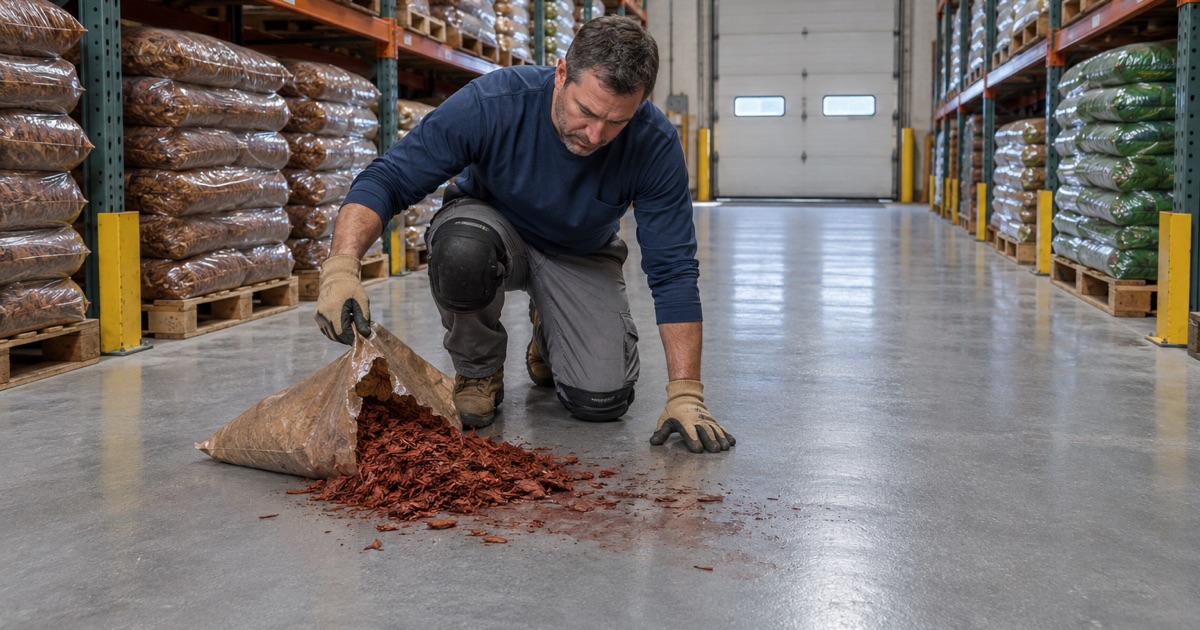
A bag that splits on a pallet, or one that sits in rain before it comes inside, sheds chips and colored water onto whatever is under it. On raw concrete that liquid finds the open pores at the surface and wicks down into them.
Once the color is in the paste of the slab, scrubbing the top only removes what is still sitting on it. That is how a garden-goods aisle or a home garage ends up with a rust-red or dark brown shadow where a bag sat for a weekend in May.
Looking for epoxy-flooring closer to Downtown Milwaukee? See Epoxy-Flooring Services in Downtown Milwaukee.
Sealed and coated floors keep the stain on top
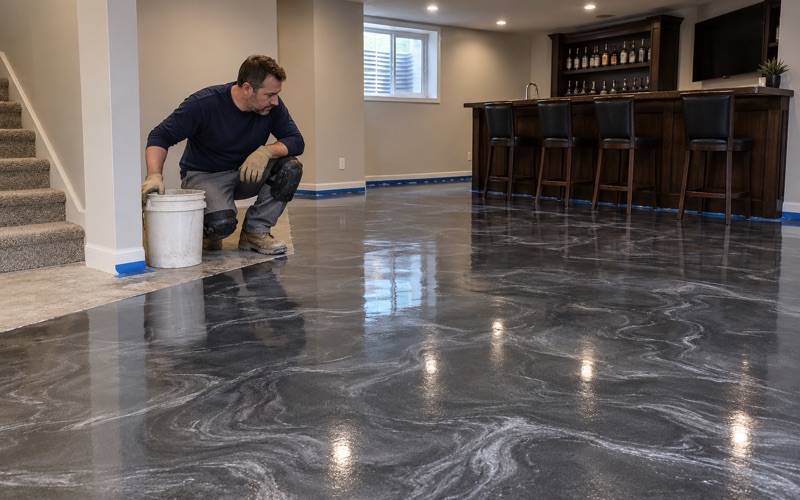
The reason a coating helps is simple: it closes the pores. The colored liquid has nowhere to go, so it sits on a film rather than inside the concrete.
Staining versus surface residue
On a sealed or coated floor, spilled colorant is residue rather than a stain in the slab. Caught while it is still wet, it usually rinses or mops away, because it never reached the concrete.
The same bulletin tells applicators to apply the colorant at least 30 minutes before irrigation or rainfall to prevent wash-off. Fresh colorant moves with water, which is why speed matters even on a coated floor.
No coating is a guarantee against every mark, and we will not describe one that way. Colorant left to dry on any surface for days is harder to remove. The practical promise is narrower and more useful: the color stays where water and a mop can reach it.
Choosing the system for the load
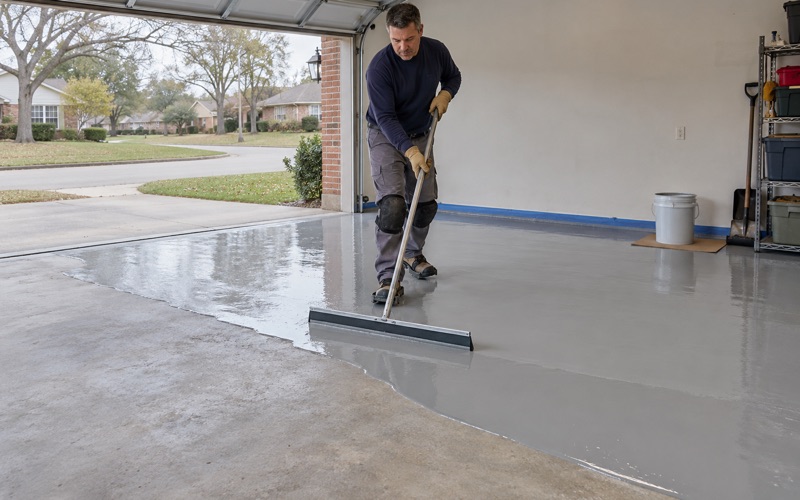
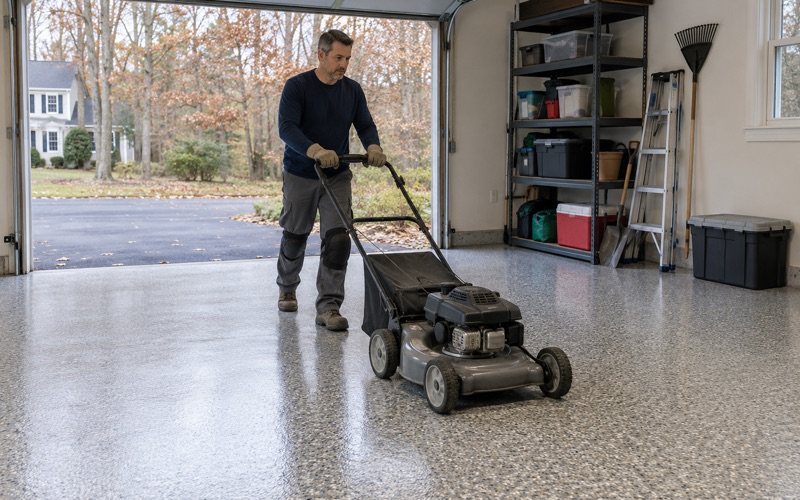
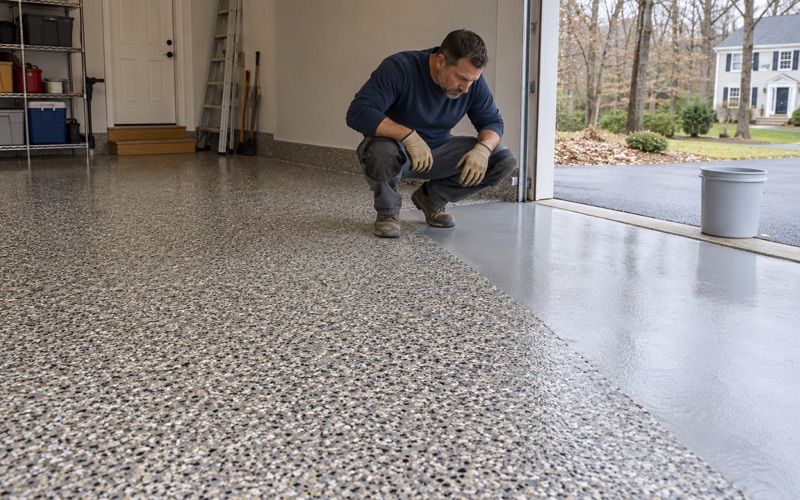
A home garage that holds a few bags each spring is usually well served by 100% solids epoxy with a vinyl flake broadcast and a polyaspartic or polyurea topcoat. The flake hides minor marks, and the topcoat resists tire wear, including hot tire pickup on a summer afternoon.
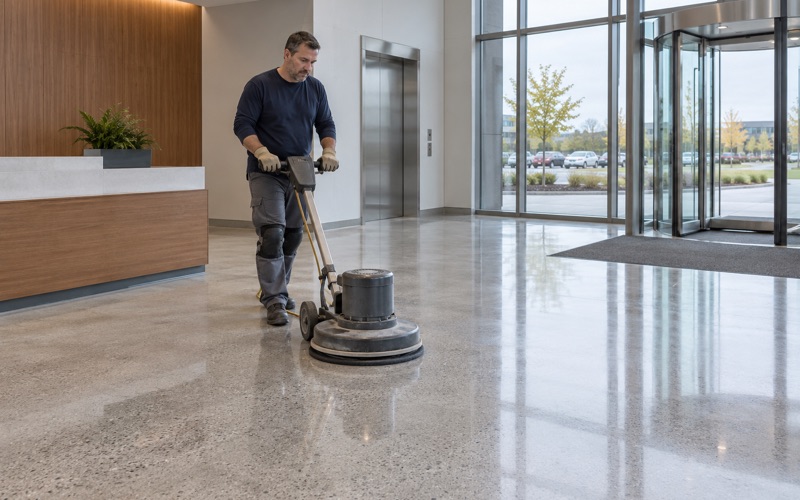
A storage or distribution floor that sees pallet jacks and forklifts is a different job. There we look at quartz aggregate broadcast systems or urethane cement, which are built for heavier traffic and frequent washing. Where a client wants bare concrete with some protection, a lithium silicate densifier hardens the surface, though it does not seal it the way a film does.
Joints and edges in working aisles
Dyed runoff tends to collect in saw-cut joints, and wheels break down unprotected joint edges over time. On shop, showroom and warehouse floors we fill joints with a semirigid filler before any coating goes over them.
That keeps cart and lift wheels from chipping the edges, and it removes the open channel where colored water would otherwise pool and sink into the slab. It also gives the coating a continuous surface to bridge.
Spring in a Glendale garage
For most households, though, the place this plays out is the home garage. The housing stock in Glendale explains why: the city has 4,047 detached single-family units, and more than 3,600 of them are owner-occupied.
Mulch, potting soil and seed bags
Each spring a lot of garages turn into a staging area for the yard. Bags of dyed mulch, potting soil and seed get stacked against a wall or near the door, and some of them leak, sweat or get rained on before they make it into the garage.
On bare concrete that season leaves its mark year after year. On a coated floor the same leak becomes a rinse job, provided someone gets to it while it is still wet.
Older slabs, more prep
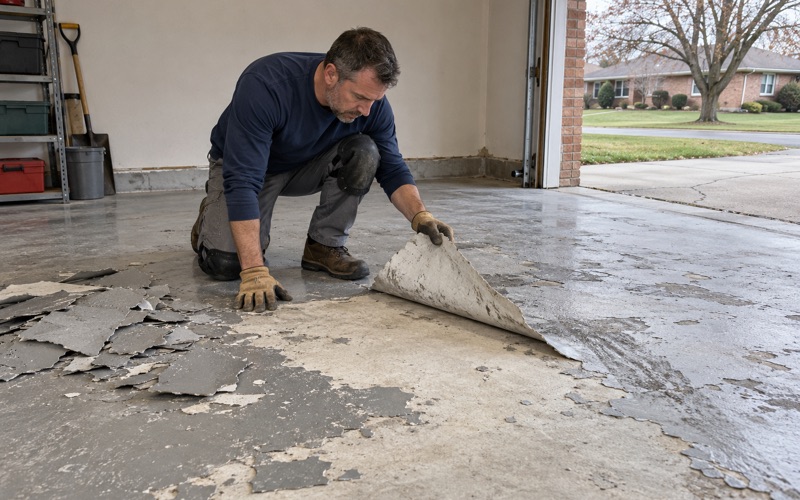
A large share of Glendale’s homes were built from the 1950s through the 1970s, so many garage slabs have decades of wear, patching and old sealers on them. Those layers have to come off before anything new will bond.
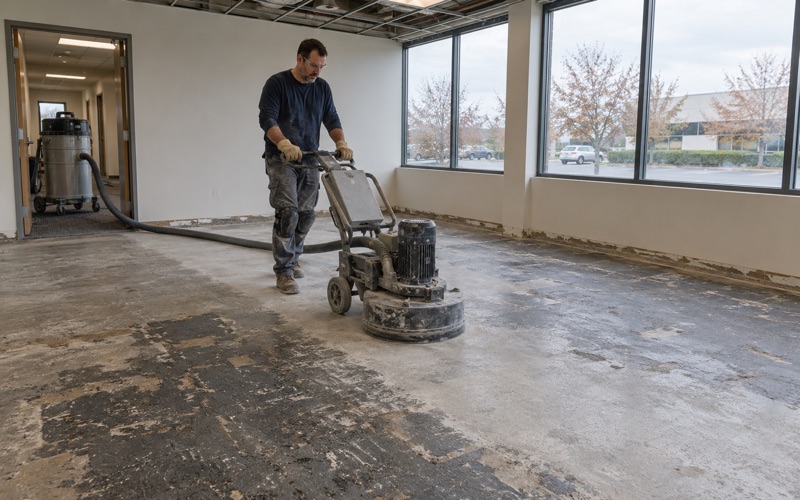
We open every slab mechanically with a diamond grinder or a shot blaster to an ICRI surface profile, and we do not acid etch. Before we quote, we read the cracks, joints and any old coating, and if a slab needs repair or replacement first, we say so plainly instead of coating over a problem.
Moisture under the bags
A garage floor that looks dry can still push vapor up from below. Wisconsin does not require a vapor retarder under an unconditioned attached garage slab, so we do not assume one is there.
Moisture testing is a line item in our scope, using methods such as the ASTM D4263 plastic sheet test, ASTM F1869 calcium chloride testing or ASTM F2170 relative humidity probes. Where readings call for it, we use a moisture-mitigation primer, and we name moisture from below first when we read the warranty exclusions to you before the job is sold.
Curing against the weather, not the calendar
Garden season is also when people want the work done, but a coating cures on slab temperature and the dew point spread at the surface, not on a date. Cure too cold or too damp and you invite amine blush on epoxy and a weak bond.
We schedule around those readings, and when an unheated garage is too cold, we tell you it has to wait for spring rather than pretend otherwise. That conversation is easier to have at the estimate than after a failed floor.
Glendale floor questions
A few practical questions apply to most Glendale floor projects, whether the floor is a two-car garage or a commercial storage space. The answers below are the ones we give at the estimate.
Does a floor coating need a city permit?
Glendale’s Building Inspection Department publishes a sheet on which common projects need permits, and a floor coating is not on its list. Other work in the same room, such as sump pumps, garage grinders or radon systems, has its own permit answers.
When there is any doubt, we ask the department at City Hall, 414-228-1708, before the job is scheduled. For one- and two-family homes, the city states that it cannot issue permits to a contractor who lacks the Wisconsin Dwelling Contractor and Dwelling Contractor Qualifier credentials.
What about a business moving into a space?
A new business in an existing Glendale building goes through the Planning & Architectural Review Board, plus City and North Shore Fire Department inspections. A commercial change of use needs a Certificate of Compliance and an Occupancy Certificate before the business occupies the space.
We schedule commercial floor work around those steps and around the hours a building has to stay open, including overnight and weekend windows. Telling us the target opening date early helps us fit the floor in.
What goes in the contract?
Every home job gets a written contract before we take a deposit, with the products and any warranty written into it. Our proposal names the product, the system build and the finished thickness, so you can check what was quoted against what went down.
Wisconsin’s ATCP 110 home improvement rules require a written contract when any payment is due before the work is complete, and Wis. Stat. 779.02(2) covers the lien notice. Both are part of our paperwork, not an afterthought.
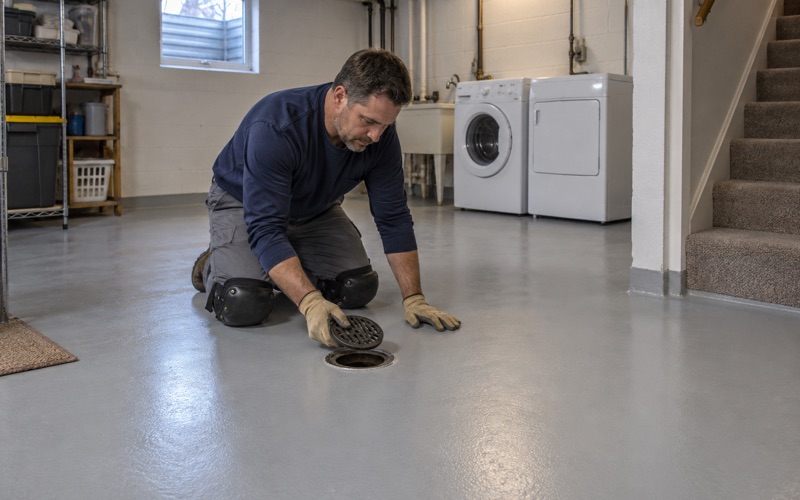
Grinding dust and slurry are collected on site, and none of it is washed into a floor drain or a storm sewer. We also do not sell a coating as a fix for water coming up through a slab.
- 20+ Years Experience
- Moisture Testing in Every Scope
- Written Proposals and Contracts