Brookfield Epoxy Flooring has spent more than 20 years putting down epoxy flooring in Germantown and across the region, and the work here leans toward shops that cut, bend and finish metal. A fabrication floor is judged less by how it looks on day one than by what it holds onto after a year of grinding, sweeping and forklift traffic. We build those floors so they give up debris instead of storing it.
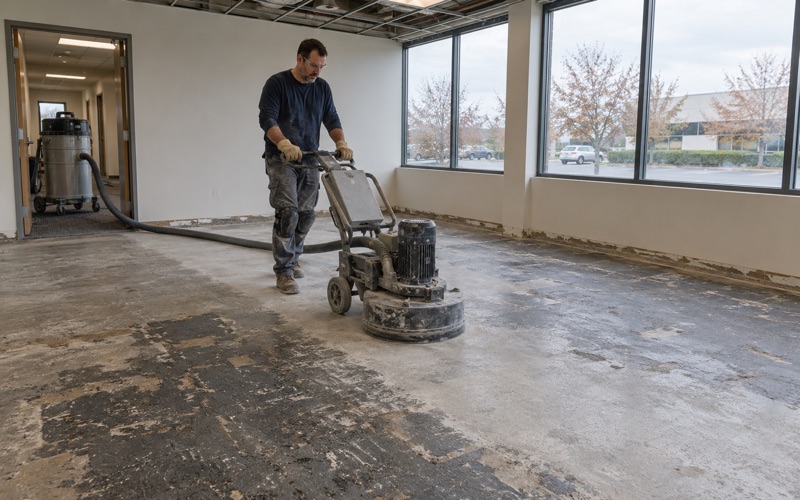
Our approach starts at the slab, not the product catalog. Every floor is opened with a diamond grinder or a shot blaster to a measured surface profile, and we never acid etch. Moisture testing goes into the written scope as its own line, because a slab that looks dry in a production bay can still push vapor up under a fresh coating.
The proposal you sign names the product, the system build and the finished thickness. That gives a plant manager something specific to hold up against the floor once it is down, and it gives us a standard we have agreed to meet in writing.
Stainless Washroom Products and Why Carbon Steel Stays Away
Germantown is home to a plant that makes stainless steel fixtures for commercial restrooms. That product line shapes how a fabrication floor in this village ought to behave, and it is a useful way to explain what we build.
The Bradley Way Plant
Bradley Corp. opened a 190,000-square-foot facility in Germantown Business Park in 2012, at N106 W13500 Bradley Way. Coverage of the opening described it as the primary plant for manufacturing the company’s commercial washroom products. It replaced an older Milwaukee plant on West Parkland Court.
We mention Bradley as a landmark of what gets made here, not as a client. We have not seen that plant floor or its bay layout, and nothing on this page describes them.
Type 304 Stainless With a Satin Finish
Bradley’s published specification for commercial toilet accessories calls for ASTM A 666 Type 304 stainless steel, the 18-8 alloy, with a satin finish on exposed surfaces. Grab bars are 18-gauge stainless tubing, sanitary product vendors are stainless cabinets, and shelves carry stainless end and intermediate brackets welded to the shelf. Mirror frames are stainless channel as well.
The same document asks for tight seams and joints and rolled exposed edges. A satin surface like that shows every stain and speck, which is exactly why stainless shops treat contamination as a production problem rather than a cleanup chore.
What Carbon-Steel Particles Do to Stainless
The Specialty Steel Industry of North America explains the risk in plain terms. When carbon steel is cut or ground nearby, or when the same tools touch both metals, tiny carbon-steel particles become embedded in the stainless surface. Those particles rust, and the rust shows up on a part that was supposed to stay bright.
SSINA warns against carbon-steel wire brushes, steel wool and grinding wheels that were previously used on carbon steel. If the same machinery handles both metals, it calls for a thorough cleaning before stainless is processed.
Looking for epoxy-flooring closer to East Side? See Epoxy-Flooring Services in East Side.
The Shop-Floor Rules for Stainless Fabrication
The guidance stainless producers give their customers reaches all the way down to the slab. Two of the rules are about the floor directly, and a third ties the whole process together.
A Separate Area Where Only Stainless Is Fabricated
SSINA says that ideally the shop should have a separate area where only stainless steel is fabricated. In a building that also handles carbon steel, that means a defined bay with its own tools, its own racks and a clear boundary on the floor.
A floor coating does not create that separation by itself. What it can do is make the boundary visible and keep each zone easy to clean on its own schedule, which supports the discipline the shop already has.
Sheets Off the Floor on Wooden Planks
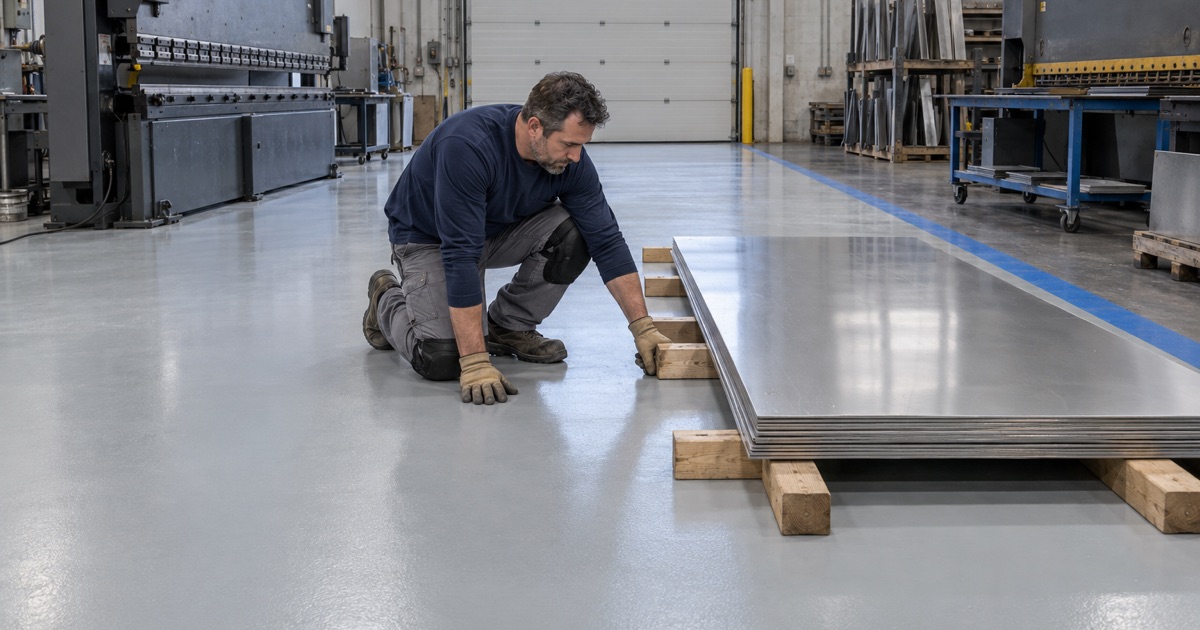
The same guidance says plates and sheets laid out for use should be off the floor and divided by wooden planks. Racks are to be protected against iron contamination, and protective wrapping is meant to stay on until processing is done.
That rule exists because a working floor collects whatever the shop produces. An ISSDA shop-practice presentation goes a step further and advises against walking on stainless that has been laid down, because shoe marks carry shop-floor contamination onto the metal.
Recontamination and ASTM A380
ASTM A380 covers cleaning, descaling and passivation of stainless steel. It ties freedom from iron and other metallic deposits to proper design, fabrication methods, cleaning and descaling, and protection against recontamination. Passivation is the removal of exogenous iron or iron compounds from the surface.
Neither SSINA nor ASTM A380 addresses floor coatings, and we make no claim that a coated floor keeps stainless from rusting or stands in for passivation. The floor’s job is narrower: not to become a reservoir of the grit that passivation exists to remove.
A Floor That Shows Grit Instead of Hiding It
Bare concrete is porous and dusts as it wears. In a metal shop that means fine carbon-steel grit settles into open pores, gets packed down by wheels and boots, and comes back up later on a cart tire or a sole. A sealed surface changes that behavior.
Sealed, Non-Dusting and Sweepable
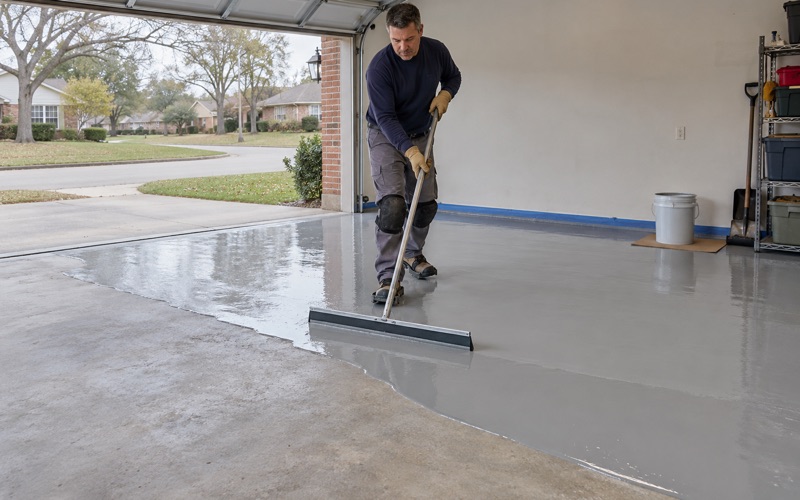
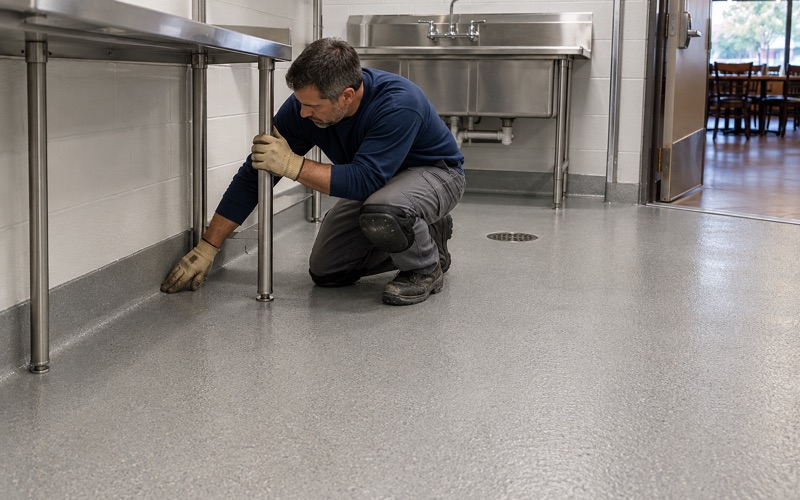
We build stainless-bay floors as a sealed, non-dusting system, typically a 100% solids epoxy body coat with a tough topcoat over it. Grit sits on top of that surface where a broom or a scrubber can lift it, instead of lodging in the slab. A lighter color makes dark metal fines easy to spot during an end-of-shift sweep.
For slip resistance we can broadcast quartz aggregate into the body coat and lock it in with the topcoat. We keep the texture moderate so the floor still sweeps clean, because a heavy profile can trap the same particles the coating was meant to release.
Grinding the Slab First, the Right Way
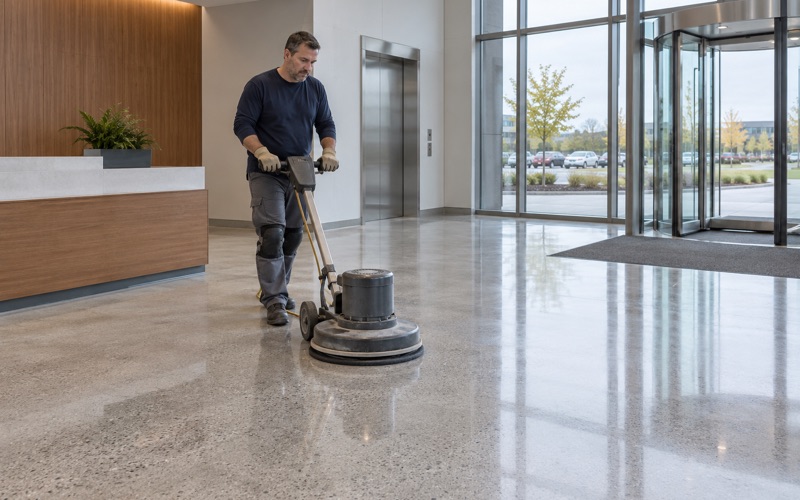
A coating is only as good as its bond, and in a working plant the bond takes a beating. We prepare every slab mechanically to the ICRI CSP profile the system calls for, using diamond grinding or shot blasting, and we skip acid etching entirely.
Preparation dust is collected on site as we go. Grinding slurry and dust never get washed into a floor drain or a storm sewer, which matters in an industrial park where those drains lead somewhere specific.
Joints, Cracks and Lift Traffic
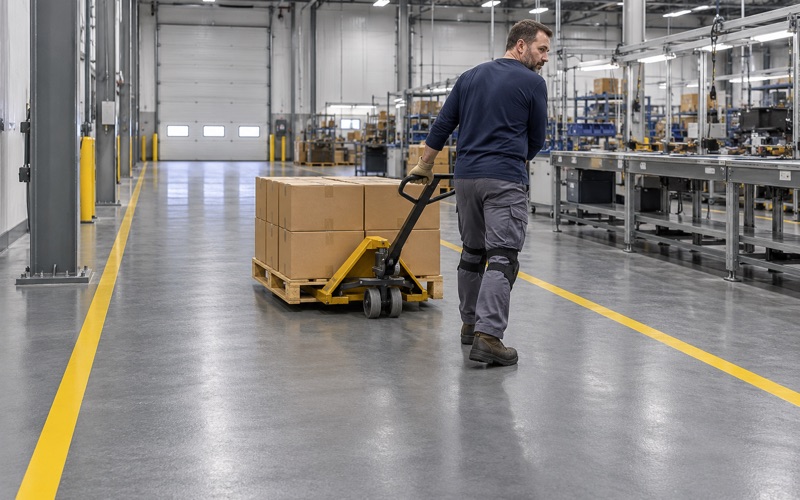
Saw-cut joints are where a fabrication floor usually fails first, because forklift and cart wheels chip the edges. We fill shop and warehouse joints with a semirigid filler before any coating goes over them, so the edges stay supported under load.
We also read the cracks, joints and any old coating before we quote. When a slab needs repair or replacement before it can carry a coating, we say so plainly rather than hide a problem under fresh resin.
Separating Bays on One Slab in Germantown
A shop that works both metals does not always have the luxury of a stainless-only building. The practical answer is usually one slab divided into zones, with the floor helping to mark and maintain the line between them.
Zoning a Mixed-Metal Building
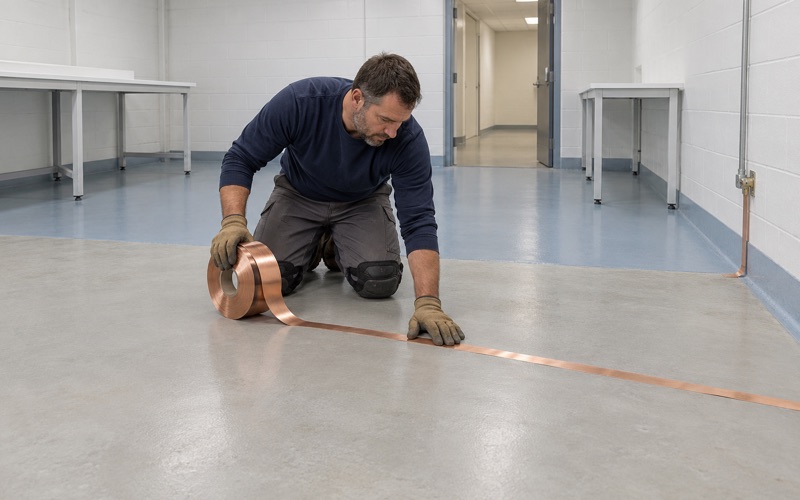
We can lay out the stainless bay in a distinct color, with a contrasting band along its edge, so the boundary is obvious to anyone pushing a cart. The carbon-steel cutting and grinding area sits on the other side of that line with its own sweep routine.
Germantown’s business parks hold other plants where this kind of planning could apply. Trans-Coil, now part of Allied Motion, planned a 66,000-square-foot manufacturing and office facility on Grant Drive, and WAGO filed in 2025 for an addition of about 18,626 square feet to its Freistadt Road production and warehouse building.
Moisture, Curing and Production Schedules
We test slab moisture before any coating goes down, using ASTM F2170 in-situ relative humidity probes or ASTM F1869 calcium chloride testing depending on the slab. Where readings run high, a moisture-mitigation primer goes into the scope before the job is sold, and warranty exclusions are read out with moisture from below named first.
Curing is scheduled against slab temperature and the dew point spread at the surface, not the calendar. For buildings that have to keep running, we plan the work in phases and use overnight and weekend windows so a production line is not idle longer than it must be.
Permits and Who Signs Off
Germantown is a village in Washington County, and building permits run through the Village of Germantown Building Inspector under Section 14 of the Municipal Code. A floor coating on its own is usually a different question from new construction, so we ask the inspector before scheduling rather than guess.
Where a coating is part of a new building, occupancy rules apply. Under Section 14.06, a new building cannot be occupied before an occupancy permit, and a temporary permit covers only part of a building or up to 30 days and requires an occupancy bond.
Germantown Fabrication-Floor Questions
Shop owners often ask whether a coated floor helps their stainless program. Our honest answer is that it supports the separation and cleaning the program already requires, and it does nothing on its own to make a part rust-free.
They also ask how soon a bay can go back into use. That depends on the system, the slab temperature and the traffic, and we put the return-to-service time in the written proposal so the production schedule can be built around it.
- 20+ Years Experience
- Moisture Testing in Every Scope
- Written Proposals and Contracts