
Brookfield Epoxy Flooring installs epoxy garage floors in Brookfield, WI, serving surrounding cities including Wauwatosa, West Allis, Pewaukee, New Berlin and Menomonee Falls. With 20+ years in floor coatings, we build garage systems from the concrete up: the slab is diamond ground, repaired and tested before a single coat of resin is mixed.
A garage floor in this part of Wisconsin works harder than most. It takes road salt, calcium chloride brine, snowmelt and road-warmed tires for months at a time, and any weakness in the prep shows up first in the tire lanes. Our garage systems are specified for exactly that use, not for a showroom photo.
You get a written proposal naming the product, the system build and the finished thickness, and on a home job, a written contract with the products and any warranty spelled out before a deposit is taken.
Preparing the Garage Slab for Epoxy
Diamond Grinding Instead of Acid Etching
We never acid etch a garage floor. Etching leaves an uneven surface, residue and moisture in the slab, and it cannot remove an old sealer at all. Diamond grinding opens the concrete to a measured ICRI concrete surface profile, usually CSP 2 to 3 for a garage coating, and pulls up curing compounds, paint and oil-soaked laitance along the way.
The grinders run with dust collection, so the fines go into a vacuum rather than into the air of your house. Any slurry from wet work is gathered and hauled away, never washed out the door or into a floor drain.
Crack, Spall and Joint Repair
Before we quote, we read the slab: hairline shrinkage cracks, spalled edges near the door, settled sections and old patches. Cracks are chased out and filled with a rigid epoxy or polyurea repair material, and spalls are rebuilt flush. Control joints are either filled or honored, depending on how the slab moves.
When a slab has heaved, sunk or broken through, we tell you it needs concrete work before coating. A coating cannot hold a broken slab together, and pretending it can is how a homeowner pays twice.
Moisture Testing the Garage Slab
Under SPS 322.38, Wisconsin’s dwelling code exempts an unconditioned attached garage from the vapor retarder required under other floors, so many garages here sit right on fill. Moisture testing is a line item in every garage scope: an ASTM D4263 plastic sheet test, and where it matters, an ASTM F1869 calcium chloride test. A high reading gets a moisture-mitigation primer, not a hopeful roll coat.
Garage Floor Epoxy Systems We Install
Full-Broadcast Vinyl Flake Garage Floors
The most common garage system we install is a 100% solids epoxy base with vinyl flake broadcast to rejection, scraped and sealed under a clear topcoat. The flake hides dust and small chips, adds texture for winter traction, and reads as one even surface. Blend and chip size are chosen from samples on your own slab.
Polyaspartic Garage Floor Coatings
Polyaspartic topcoats cure in hours rather than days, hold their color in the sun from an open garage door, and stay workable at colder slab temperatures than epoxy. We often pair an epoxy base for build and bond with a polyaspartic top for wear and UV stability, which gets you the strengths of both resins.
The fast cure has a cost: polyaspartic gives the crew a short working window, so it is mixed in small batches and rolled on a schedule. That is a job for a practiced crew on a prepared slab, and it is one reason the fastest systems are the ones most often botched by a rushed installer.
Solid Color and Metallic Garage Floors
A solid color garage system suits a workshop or a car enthusiast who wants a clean, bright floor that shows what drops on it. Metallic epoxy brings a marbled, three-dimensional finish for a showpiece garage, though it needs a smoother slab and shows scratches more readily than flake. We talk through how the garage is used before recommending either one.
Built for a Wisconsin Garage
Road Salt and Calcium Chloride Brine
Every car that pulls in from a Brookfield street in January carries rock salt and calcium chloride brine in its wheel wells. On bare concrete that brine soaks in, recrystallizes and scales the surface. A sealed, full-build coating keeps it on top, where a squeegee moves it out the door.
Texture matters here too. A very coarse broadcast can trap salt residue in the valleys, while a smooth gloss coat can be slick with brine on it. We choose the flake size and topcoat build so the floor grips under a wet boot but still rinses clean after a thaw.
Hot Tire Pickup in the Parking Lanes
Road-warm tires soften a weak coating, then grip and lift it as they cool, leaving bare patches exactly where you park. Trade sources tie it mainly to the product, the film build, the prep and the cure rather than to the tire. Ground concrete, a full-cure 100% solids base and a polyaspartic topcoat at the stated thickness are how we avoid it.
The same discipline covers amine blush, the waxy film some epoxies form when they cure in cool, damp air. A blushed coat that gets topcoated without cleaning can peel between layers, so we watch for it and wash it off before the next coat goes on.
Cold Slabs, Dew Point and Spring Scheduling
An unheated garage slab can sit near freezing for much of the winter, and resin will not cure properly on it. We measure slab temperature and the spread between the slab and the dew point before mixing. If the numbers are not there, we say plainly that the job should wait for spring rather than install a coating that cannot reach full cure.
Garage Floor Codes, Contracts and Warranty
What SPS 321.203 Says About a Garage Floor
Wisconsin’s Uniform Dwelling Code asks for a garage floor of noncombustible material, impermeable to petroleum products, sloped toward the overhead door, a drain or the outside. It does not require sealing or coating. Our system keeps the original slope intact, so meltwater still drains out once the floor is coated.
Coating a floor is not on the City of Brookfield’s list of permitted items, but garages and structural alterations are. When a job grows into slab replacement or a garage addition, we ask City of Brookfield Inspection Services, or the village inspector in a neighboring community, before anything is scheduled.
Written Contracts Under ATCP 110
Wisconsin’s ATCP 110 home improvement rules govern how home improvement work is contracted and sold. Every garage job we take on gets a written contract before any deposit, naming the products, the system and any warranty, so there is nothing about the job that lives only in a conversation.
Warranty Exclusions, Moisture First
Garage coating warranties commonly exclude failure caused by moisture coming up from below the slab. We read that exclusion out before you sign, along with any others in the product terms. Moisture testing up front is what keeps that clause from ever becoming the conversation.
Our Step-by-Step Epoxy Garage Floor Process
Step 1: Slab Assessment and Proposal
We look at cracks, spalls, old coatings, slope and drains, take a moisture reading, and write a proposal with the product, system build, finished thickness and every repair listed. Nothing is booked until you have read it.
Step 2: Grinding and Repair
The slab is diamond ground wall to wall with dust collection, then cracks and spalls are filled and ground flush so the surface is sound and evenly profiled. Edges and corners are hand ground to match.
Step 3: Base Coat and Broadcast
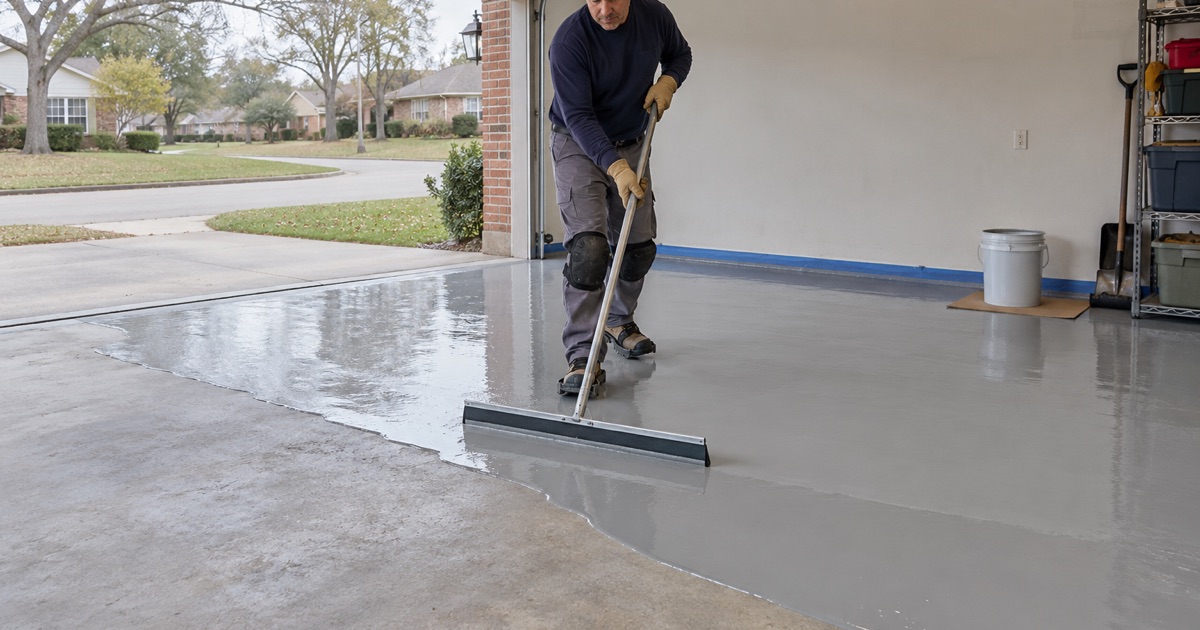
We prime where needed, roll the base coat, and broadcast flake or quartz while it is wet, all timed against the slab temperature and dew point that morning. If the readings are wrong, we wait.
Step 4: Topcoat and Cure
Excess media is scraped and vacuumed, the clear topcoat goes on, and you get written walk-on and park-on times taken from the product’s cure data. A cold slab stretches both.
- 20+ Years Experience
- Moisture Testing in Every Scope
- Written Proposals and Contracts