
Brookfield Epoxy Flooring installs ESD flooring in Brookfield, WI, serving surrounding cities including Wauwatosa, West Allis, Pewaukee, New Berlin and Menomonee Falls. Our 20+ years in resinous floors include the precise work static control demands: a slab prepared correctly, a ground path that actually connects, and a finished floor tested to a resistance range rather than judged by its looks.
Electrostatic discharge can damage sensitive electronic components without leaving visible marks, and in some settings it can ignite vapors or dust. An ESD floor gives that charge a controlled route to ground. Whether the floor is conductive or static-dissipative, it is specified by a resistance range and verified with a meter.
Brookfield is a center for office, retail and light industrial activity, with almost a dozen industrial and office parks. Electronics assembly, testing labs, server rooms and data spaces in buildings like these are the floors ESD systems are made for.
ESD Floor Types and Resistance Ranges
Static-Dissipative Flooring
Static-dissipative floors drain charge to ground at a controlled rate. Under the ANSI/ESD STM7.1 test method, they measure above 1.0 x 10^6 ohms and below 1.0 x 10^9 ohms. They suit most electronics handling areas, where charge needs to bleed off steadily rather than suddenly.
A dissipative floor is also the more forgiving choice for a space where people work in ordinary shoes for part of the day, such as an office area next to a test bench. It reduces charge buildup without the faster discharge a conductive floor allows, and it usually costs less to install.
Conductive Flooring
Conductive floors measure at or below 1.0 x 10^6 ohms and move charge to ground faster. They are used where very sensitive components are handled or where flammable or explosive materials make rapid discharge important. Choosing conductive over dissipative depends on your process and your ESD control program.
Matching the Floor to ANSI/ESD S20.20
ANSI/ESD S20.20 evaluates the person, the footwear and the floor together. One requirement is that the system resistance of a person wearing ESD footwear while standing on the floor stays below 1.0 x 10^9 ohms. Another, measured under ANSI/ESD STM97.2, limits the body voltage generated by walking to less than 100 volts peak.
The floor alone cannot meet those requirements without the right footwear, and the right footwear cannot do it on the wrong floor. We work from your program’s requirements so the floor is specified for the whole system.
How an ESD Floor Is Built
Surface Preparation
The slab is diamond ground or shot blasted to the ICRI profile the system calls for, never acid etched. Cracks and joints are repaired and filled. Any old coating, sealer or adhesive that would interfere with the bond or the conductive layers is removed.
Moisture Testing
Moisture coming up through a slab can disrupt the bond and, in some systems, the electrical performance of the floor. We test with ASTM F1869 calcium chloride or ASTM F2170 relative humidity methods. If readings exceed the system’s limits, a moisture-mitigation primer goes down before the ESD layers.
Grounding Points and Conductive Layers
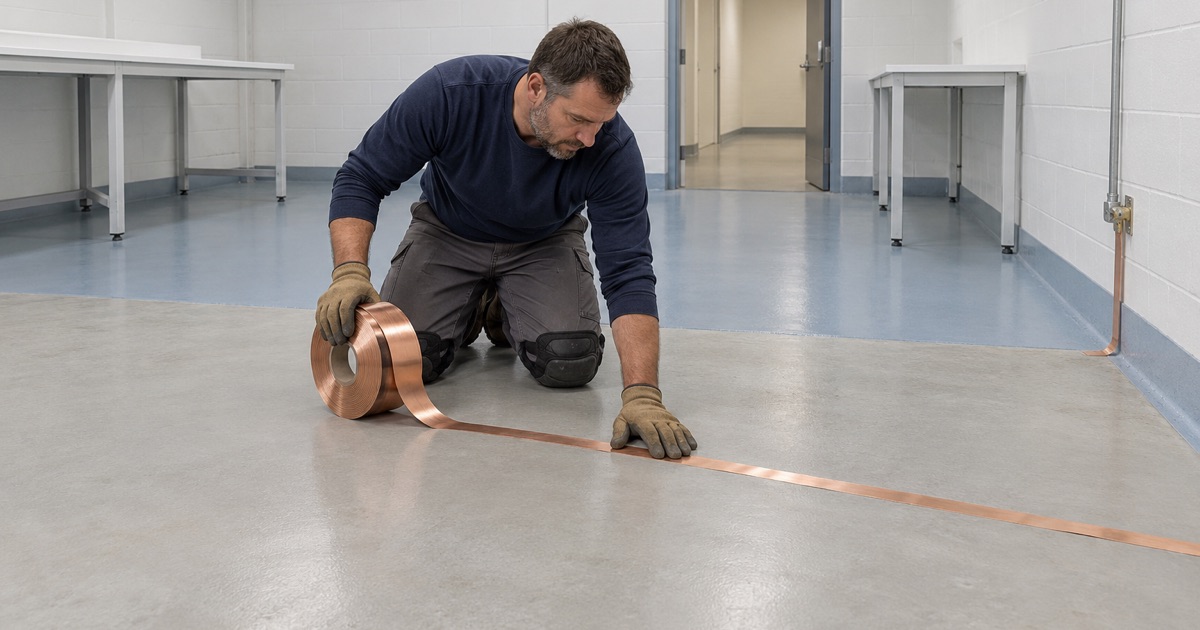
An ESD floor needs a reliable path to ground. Copper grounding strips or tabs are placed on the slab and tied to the building ground, then a conductive primer or layer links them across the floor. The topcoat contains conductive materials that carry charge down to that layer.
The number and spacing of grounding points follow the system manufacturer’s requirements and the size of the room. A floor with too few ground points can test well near a strip and poorly across the room.
Topcoat and Finish
The ESD topcoat is applied at a controlled thickness, because film build affects resistance. Colors are usually light grays or beiges, which help with visibility in assembly areas. The finished floor is seamless and cleanable, with no tiles or seams to collect dust.
Testing, Cleaning and Upkeep
Resistance Testing
After cure, we measure the floor’s resistance at multiple points using a meter and the appropriate electrodes. Readings are recorded so you have a baseline for your ESD program. If an area falls outside the range, we find the cause before the floor goes into service.
Resistance readings can drift with humidity, cleaning habits and wear. A dry Wisconsin winter is when static problems are most noticeable, so retesting after the first heating season gives a useful second baseline to compare against the readings taken at turnover.
Cleaning an ESD Floor
Waxes, polishes and many general cleaners leave insulating residue that can push a floor out of range. ESD floors need cleaners made for static control floors or neutral cleaners that rinse clean. We provide written care guidance and suggest periodic resistance checks as part of your program.
Scheduling Around Production
Electronics assembly and test areas often run on tight schedules. We phase ESD floor installation around production and use overnight and weekend windows where needed. Dust from grinding is captured by industrial extractors, and slurry is collected on site rather than washed into a drain.
Where ESD Floors Are Used
Electronics Assembly and Repair
Circuit board assembly, electronics repair benches and component storage all benefit from a static control floor that keeps charge from building as people move around. The floor works with wrist straps and grounded benches rather than replacing them.
Carts, chairs and racking used on the floor matter too. Conductive casters and drag chains let rolling equipment shed charge to the floor, and the floor in turn sends it to ground. We review the equipment that will roll over the finished floor when planning the system.
Labs, Server Rooms and Data Spaces
Testing labs, server rooms and network closets house sensitive equipment, and a dissipative floor helps protect it. In data spaces, a seamless floor also helps with dust control.
These rooms are often small and inside a larger building that stays open, so access, ventilation and odor matter. We favor low-odor systems and tight scheduling to keep the rest of the building working while the floor is installed and cured.
Clean and Controlled Environments
Some manufacturing and medical device work needs both static control and a seamless, easy-to-clean surface. A resinous ESD floor can serve both needs, with coved bases where the space requires them.
- 20+ Years Experience
- Moisture Testing in Every Scope
- Written Proposals and Contracts