Brookfield Epoxy Flooring brings more than 20 years of epoxy-flooring in Cudahy to plants, machine shops and inspection rooms where the floor is judged by one question: does it shed anything? A slab that dusts, a coating that chips and a repair that never happened all end up as loose material on the floor. In precision work, loose material is a quality problem, not a cosmetic one.
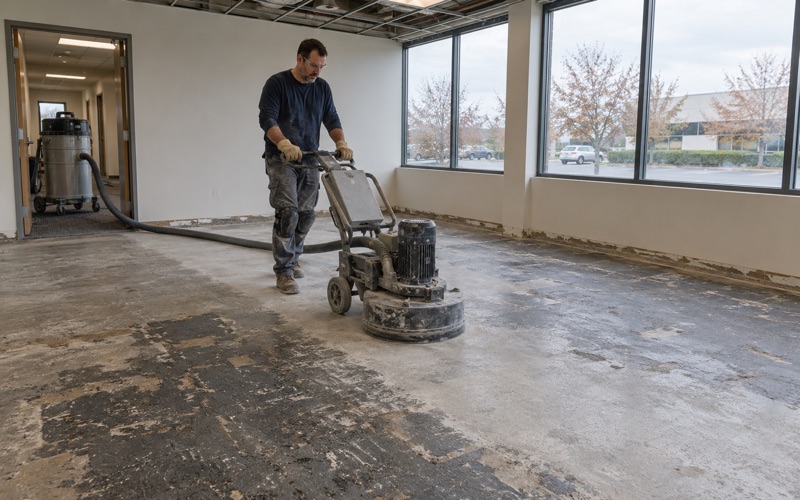
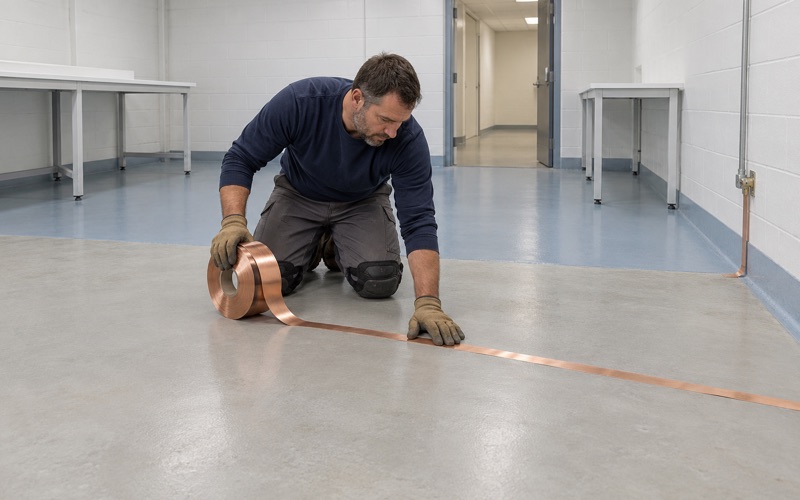
Our approach starts below the coating. Every slab is opened with a diamond grinder or a shot blaster before anything is applied, and we never acid etch. We read the cracks, the joints and any old coating first, and when a slab needs repair or replacement before it can carry a coating, we say so in plain words rather than coating over it.
The written proposal names the product, the system build and the finished thickness, so a plant engineer or a quality manager can hold what was quoted against what went down. Moisture testing is its own line item, and the warranty exclusions are read out before anything is signed, with moisture coming up from below named first.
Jet-Engine Forgings and the Foreign Object Problem
Cudahy is a city in Milwaukee County, a suburb south of Milwaukee on the shore of Lake Michigan, and it sits next to Milwaukee Mitchell International Airport. It is also a place where jet-engine parts are made. The plant at 5481 S. Packard Avenue, formerly Ladish Co. and acquired by Allegheny Technologies in 2011, is ATI’s forging plant, covering about 1.4 million square feet.
The isothermal forging center on Packard Avenue
In March 2018, ATI announced an investment of about $95 million in a fourth iso-thermal press and an associated heat-treating expansion at what the company called its iso-thermal forging center of excellence in Cudahy. The stated purpose was to meet growing demand from the aerospace jet engine market with powder-to-isothermally-forged jet engine components for engine makers.
The Cudahy operation forges titanium and nickel-base alloy parts for the hot sections of jet engines, forging in vacuum above 2,000 degrees. Once the parts are machined, they are tested for defects and measured in a temperature-controlled room on site. That chain of forging, machining and inspection is what makes the floor under it matter.
What foreign object debris means to a supplier
Foreign object debris, usually shortened to FOD, is any loose material that can end up where it does not belong in an aircraft or an engine. Aerospace suppliers work under the AS9100 quality standard, and Boeing’s supplier quality page states that AS9100 calls for provisions for the prevention, detection and removal of foreign objects.
Boeing’s page names SAE AS9146 and NAS 412 among the documents that define a FOD program. NAS 412 is a guide that becomes binding through customer requirements, and its core elements include housekeeping and a clean-as-you-go habit. Boeing’s page sets no floor or facility requirement, and we never present a coating as something a quality standard requires or certifies.
Where most debris actually comes from
A NASA presentation on the subject attributes most FOD to poor housekeeping, facilities deterioration and improper maintenance. That list is worth reading slowly, because facilities deterioration describes the building itself rather than anything a person dropped.
A floor is the largest surface in any shop, and it deteriorates in plain sight. When a facility’s FOD effort focuses on tools and fasteners, the slab underneath can quietly become a steady supplier of grit.
Looking for epoxy-flooring closer to Cedarburg? See Epoxy-Flooring in Cedarburg.
When the Floor Itself Becomes the Debris
Bare concrete is not inert. Its surface paste wears under carts, forklifts and foot traffic, and it gives off a fine gray powder that settles on benches, fixtures and parts. Coatings fail too, and when they fail in a precision area the failure is measured in fragments.
Dusting and spalling concrete
A dusting slab releases fine material every time something rolls across it. A spalling slab is worse: chips of concrete break away at joints, edges and damaged patches, leaving sharp pieces that a sweeper can miss and a wheel can carry into the next room.
Before we quote a machining or inspection area, we walk the slab and mark where it is dusting, where joints are breaking down and where earlier patches have let go. That reading tells us whether the floor needs repair first, and it goes into the written scope rather than into a conversation.
Chipped coatings shed debris too
Flooring trade guidance written for aircraft hangars puts the coating side of the problem bluntly: loose grit or chipped coating becomes a potential engine-ingestion hazard, so a coating that fails locally fails for the whole operation. The same logic holds wherever finished parts are handled.
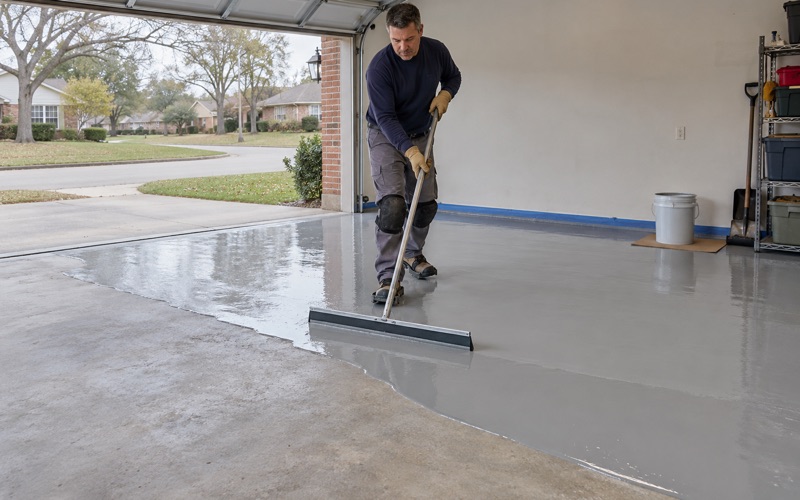
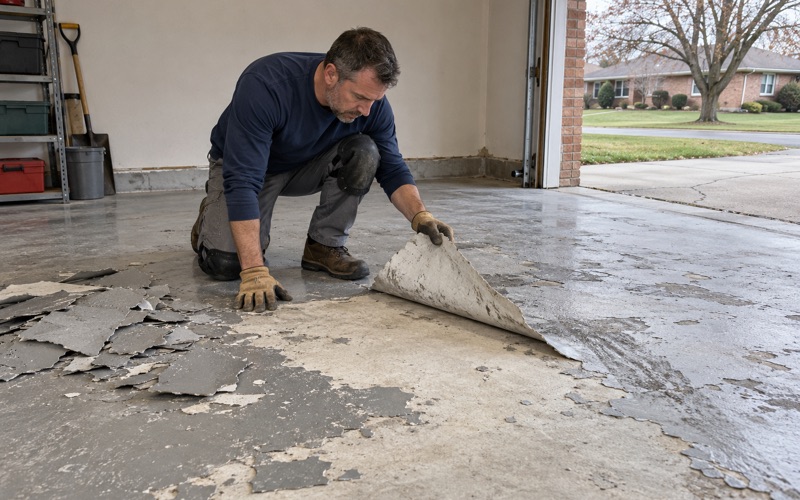
A coating that peels at a joint or flakes under a pallet jack is a source of debris, not a defense against it. Many of those failures trace back to poor preparation or to moisture under the film, which is why we grind or shot blast to a measured ICRI surface profile instead of trusting a quick scuff or an acid wash.
Moisture under a coated slab
Moisture moving up through concrete can push a coating off from below, producing blisters that eventually break open into loose flakes. We test before we coat, using ASTM F2170 in-situ relative humidity probes or ASTM F1869 calcium chloride testing, and read the results against the product’s limits.
When readings run high, a moisture-mitigation primer goes into the system rather than hoping the slab stays dry. We also schedule curing against slab temperature and the dew point spread at the surface, not against a calendar date, because a coating cured in the wrong conditions can develop amine blush and lose its grip.
Building a Floor That Does Not Shed
The goal in an aerospace machining or inspection area is a surface that is non-dusting, resists chipping and stays sealed at its edges. Each layer of the system is chosen with that outcome in mind, and the proposal spells out every one of them.
Non-dusting systems that seal the slab
A 100% solids epoxy over a properly profiled slab locks the concrete surface under a continuous film, so the paste can no longer powder off. Where a client wants a bare look, a lithium silicate densifier hardens the surface, though it is a different tool with different limits, and we explain the tradeoff before anyone chooses.
For heavier wear, a polyaspartic or polyurea topcoat adds abrasion resistance, and urethane cement suits areas that see hot water or harsh cleaning. Quartz aggregate broadcast can add texture where footing matters, but in a clean inspection room we usually keep the finish smooth so nothing has a place to lodge.
Joints and edges that stay intact
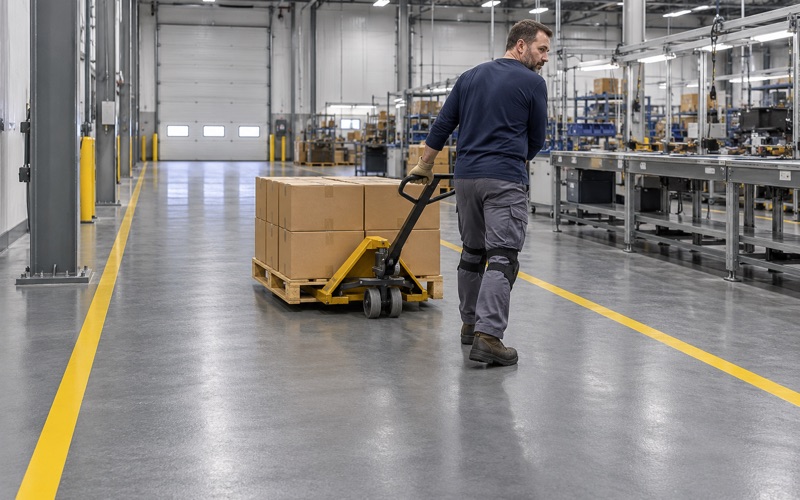
Joints are where chipping usually begins. In shops and plants we fill control joints with a semirigid filler before any coating goes over them, so cart and lift wheels ride across a supported edge rather than breaking a thin film at the joint line.
Coating terminations get the same attention. A coating that simply stops at a door or a column edge invites lifting, so we cut a key into the slab at those edges and anchor the film into it. That small detail removes one of the most common starting points for flaking.
Repaired, not left flaking
A worn or chipped area in a coated floor does not have to wait for a full replacement. Because the proposal records the product and the system build, a damaged section can be ground out and rebuilt with a matching system, keeping the rest of the floor in service.
Left alone, a flaking patch keeps feeding debris into the area around it and spreads as wheels catch its edges. A repair that lasts a year and then sheds is worse than an honest recommendation to replace a section of concrete first.
Floors That Make a FOD Walk Easy
A FOD walk is a routine sweep of a work area to find and remove loose material before it reaches a part. The floor either helps that walk or fights it, and the difference shows up in how quickly a crew can confirm an area is clean.
Sweepable surfaces and visible debris
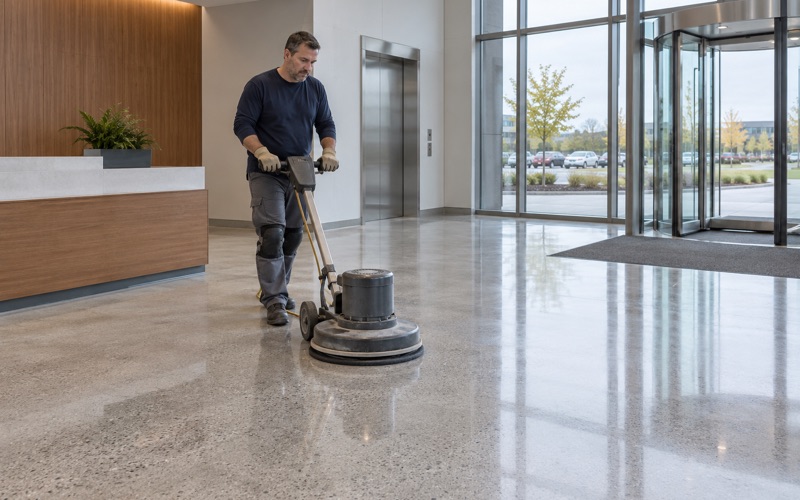
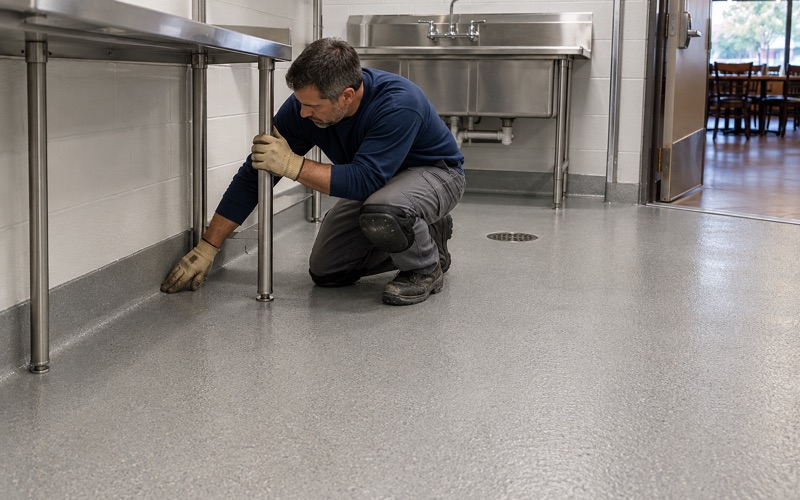
A smooth, sealed floor lets a broom or a scrubber pick up everything in one pass, without grit catching in open pores or spalled pockets. A uniform light color also makes a dropped washer, a burr or a fleck of coating easier to see against the background.
We talk through the finish with the people who will actually walk the floor. A heavy texture may suit a wet process room, but in a machining bay or an inspection area a crew often prefers a finish that shows debris clearly and sweeps clean, and we build to that preference.
Scheduling work around production
Plants that run on tight schedules cannot hand over a bay for weeks. We plan installation around the hours a building has to stay in operation, including overnight and weekend windows, and we phase larger areas so production can move around the work.
Grinding dust and slurry are collected on site and never washed into a floor drain or a storm sewer. In a facility that already watches for debris, a coating crew that leaves dust behind would be undoing the point of the job.
Machine shops and suppliers across the city
The forging plant is not the only manufacturer in town. Lucas-Milhaupt, a maker of brazing alloys, fluxes and pastes, was set to move in November 2023 into a $10 million, 105,000 square-foot world headquarters at 4850 S. Pennsylvania Avenue in Cudahy.
Smaller machine shops and fabricators face the same floor question at a smaller scale. Whether a shop runs one CNC cell or an entire inspection department, we test the slab, write the full system into the proposal and build a floor meant to stay intact rather than add to the sweep.
Building permits in Cudahy run through the City of Cudahy Inspection Department at City Hall, and we confirm with the department whether a job needs a permit before it is scheduled. Contractor and property-owner registration forms go on file before any permit is issued.
- 20+ Years Experience
- Moisture Testing in Every Scope
- Written Proposals and Contracts