Brookfield Epoxy Flooring has spent more than 20 years on epoxy-flooring in Bay View and across the Milwaukee area, and the floors we think hardest about here are the ones that take fluids people do not expect. A garage where someone services a bike, a back room with a work stand, a basement corner with a tool board: each one puts liquid on concrete, and the finish under it decides whether a drip is a nuisance or a stain that never comes out.
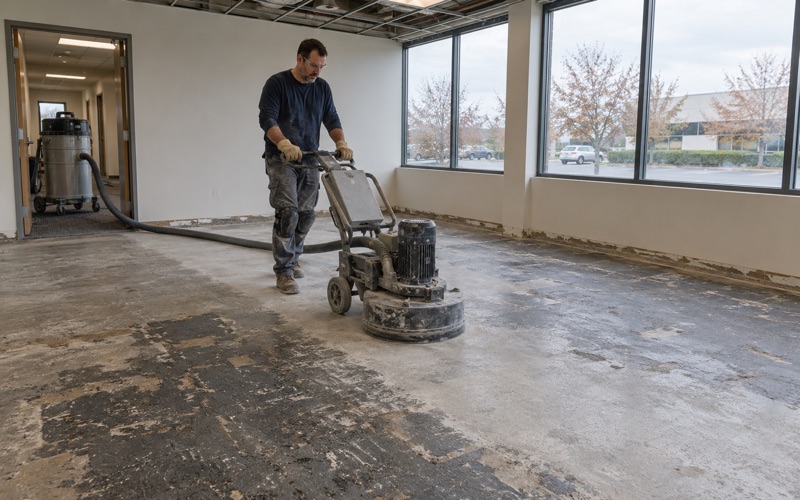
Every floor we coat starts the same way. We open the slab with a diamond grinder or a shot blaster, never acid, and we put a moisture test on the written scope as its own line rather than waiting to find out after the coating lifts. The proposal names the product, the system build and the finished thickness, so you can hold what we quoted against what went down.
We also look before we price. Cracks, joints and any old coating get read first, and if a slab needs repair or replacement before it can carry a coating, we say so plainly instead of coating over the problem.
A Bike Shop in an Old Becher Street Foundry
Bay View is a neighborhood of the City of Milwaukee on the Lake Michigan shore, south of downtown, and for eight years, from 1879 to 1887, it was an independent village. Its northwest corner still carries the bones of heavy industry, and one of those buildings now holds a bike shop.
The Filer and Stowell building
Wheel & Sprocket put its flagship store, headquarters and service hub into 187 E. Becher Street. The building was part of the Filer and Stowell complex, built in 1919 as a foundry making logging-industry equipment, and it turned out engines and cast fire hydrants during World War II.
The chain bought it in 2017, converted it from one story to two and removed the old rail spur. It opened in December 2020, moving the corporate office over from Hales Corners.
What happens inside now
The store sells new and used bikes and runs a repair shop. The Joy Ride Cafe shares the building, along with the offices of the Bicycle Federation of Wisconsin and the Rails-to-Trails Conservancy.
We mention it because it is a landmark, not a job of ours. We have not seen its floor, and we do not know which brake brands its mechanics service; what it does is put bike service at the center of the neighborhood.
Why a bike shop points at a floor question
A shop that services hydraulic disc brakes handles brake fluid. Riders who learn to bleed their own brakes bring the same fluid home, often to a garage floor that was painted or never finished at all. That is where our part of the story starts.
Looking for epoxy-flooring closer to Richfield? See Epoxy-Flooring Services in Richfield.
Brake Bleeds Are Fluid Work
A hydraulic disc brake is a sealed system of fluid, and bleeding it means pushing fresh fluid through the line and catching the old fluid as it comes out. Even a careful bleed puts a few drops somewhere other than the catch bottle, and gravity sends them to the floor under the stand.
What SRAM’s manual says about paint
SRAM’s bleed manual for its HydroR hydraulic rim brakes is blunt on the point. It warns that “DOT fluids will damage painted surfaces,” and it says that if any fluid contacts a painted surface, you should wipe it off immediately and clean the spot with water.
That warning does not rate any floor coating, and it was not written about floors. It does tell you something about the floor, though: a painted floor is a painted surface, and nothing in the warning exempts it.
DOT fluid versus mineral oil
The same manual says to use only DOT 4 or DOT 5.1 fluid in SRAM hydraulic brakes and never mineral oil. Mineral-oil brakes are a different system with a different fluid, so a rider who owns both kinds is handling two liquids that should never be mixed. For the floor, the point is simpler: know which one is dripping, and treat DOT fluid as the one the maker warns about. Either way, used fluid goes to recycling, never down a drain.
Painted Floors Versus Cured Coatings Under a Work Stand
Plenty of garage floors that look finished are painted. A one-part “garage floor paint” goes on from a can, dries to a sheen and feels like a coating, but it is a film of paint, and that puts it on the wrong side of the SRAM warning.
Why one-part paint is the weak spot
A one-part floor paint dries rather than cures; it never forms the dense, cross-linked film a two-part system does. Under a bleed stand, the same few square feet take drip after drip, and each one lands on a surface the maker’s warning already covers.
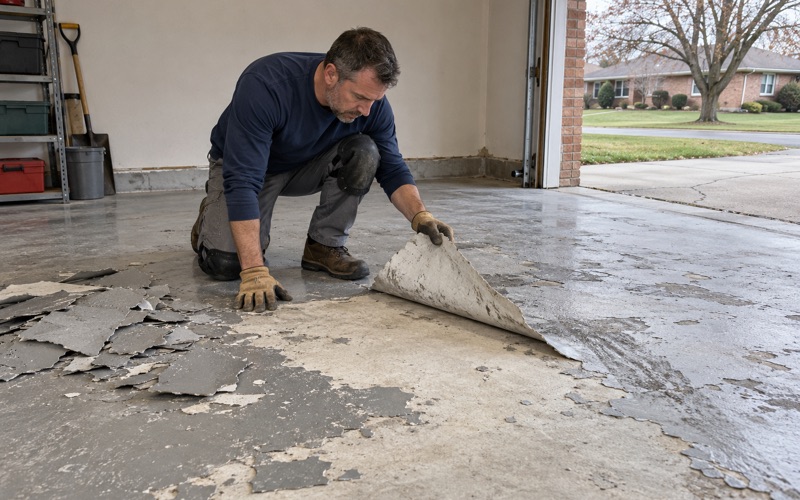
Paint also tends to go down on a slab that was never ground. Without a profile to grip, a damaged spot can lift as a flake, and every flake is a new edge for the next drip to get under.
What a cross-linked system changes
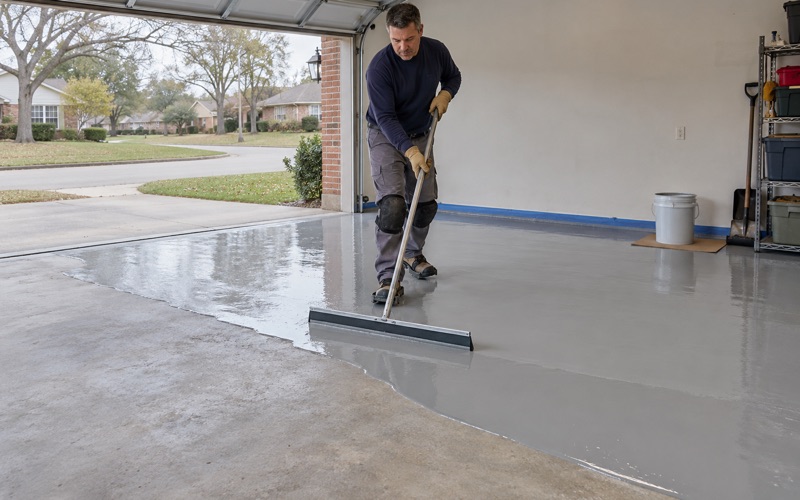
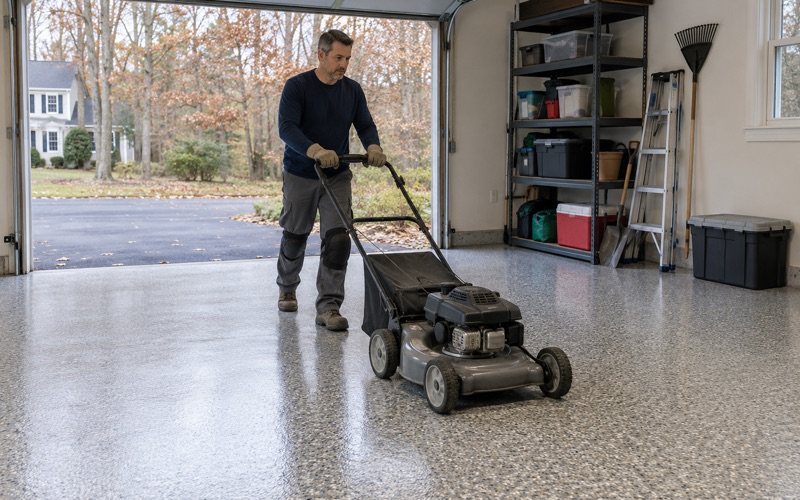
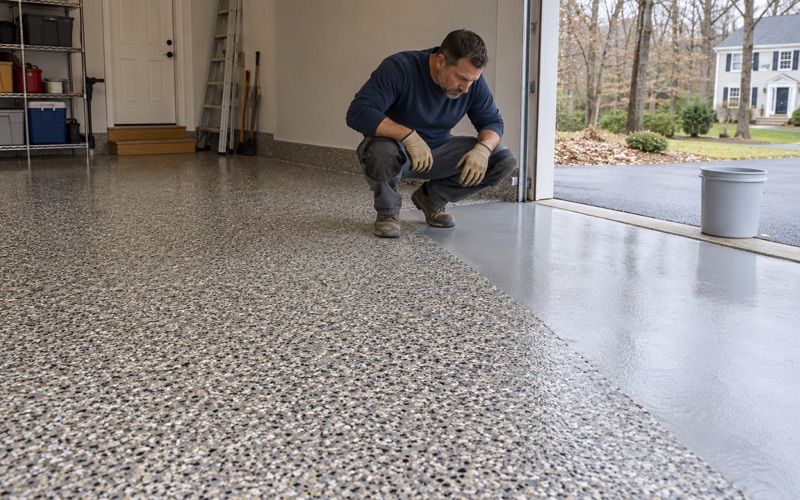
We build bike-service floors with a two-part system that cures into a cross-linked film: 100% solids epoxy over a ground slab, often with a vinyl flake or quartz aggregate broadcast, and a polyaspartic or polyurea topcoat over it. A fully cured film of that kind is a different material from paint, and it gives a drip far less to work on.
In a shop, joints get a semirigid filler before the coating goes over them, so the wheels of a work stand or parts cart do not break the edges. A rolling stand that crosses a chipped joint every day is how a good coating starts to fail at its seams.
We do not sell any floor as immune to brake fluid, and no maker’s warning backs that kind of claim. What we say is that a cured coating gives you time to clean up, which a painted floor does not.
Cure before the first bleed
A coating is only cross-linked once it has cured, and that depends on the slab, not the date. We schedule curing against slab temperature and the dew point spread at the surface, and in an unheated Bay View garage we will tell you plainly when the job has to wait for spring.
A floor driven on before it has cured invites hot tire pickup, and a cure in damp, cold air invites amine blush on the surface. We would rather keep a garage closed a few more days than hand back a floor that is not ready for the stand.
Trays, mats and wiping it up
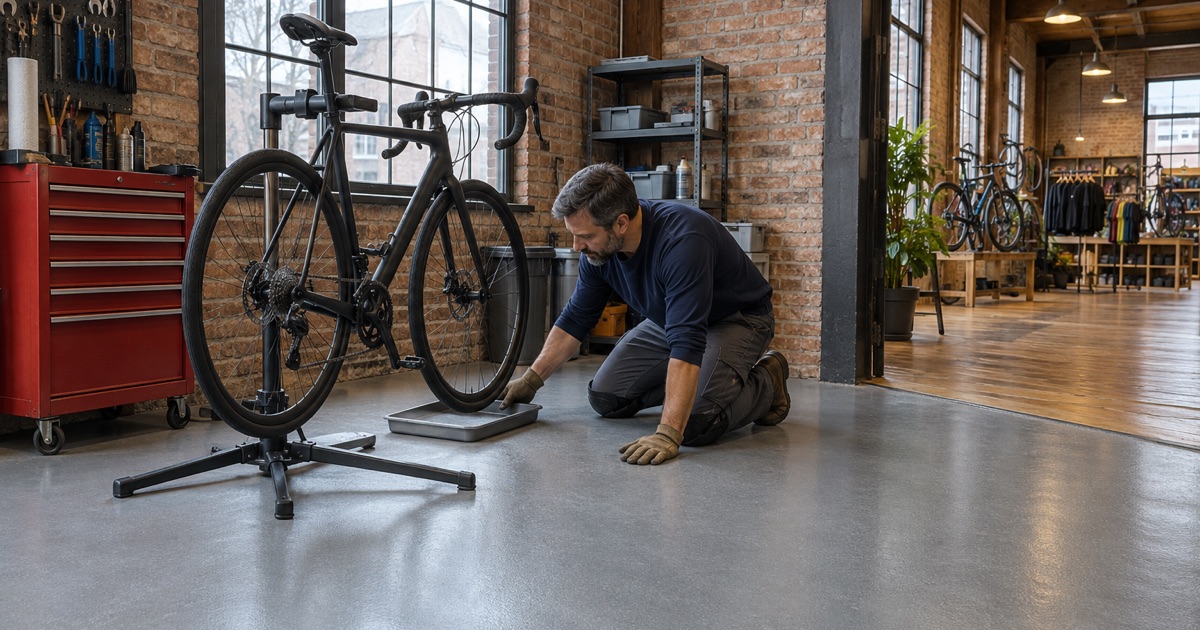
The coating is the second line of defense. The first is a drip tray or mat under the bleed stand, so most fluid never reaches the floor at all.
Whatever does land should be handled the way SRAM tells you to handle paint: wipe it off immediately and clean the spot with water. A cured floor makes that easy, and the habit matters more than any product we install.
Put the stand where you can reach around it with a rag, not tucked against a wall or a shelf. A drip you can see and wipe in a minute is a drip that never has time to work on any surface.
Bay View Garage and Shop Floor Questions
The questions below are the ones that change a quote in Bay View, where the authority is the City of Milwaukee and not a village hall. That matters for permits and for any shop, cafe or kitchen floor.
Do I need a permit to coat my garage floor?
Coating a floor and finishing a basement are different questions, and we ask before we schedule. One- and two-family dwellings fall under the Wisconsin Uniform Dwelling Code, administered here by the City of Milwaukee, and building, plumbing and electrical review runs through the Department of Neighborhood Services and the Milwaukee Development Center.
What about a shop or a cafe floor?
Commercial and food work in Bay View goes through two separate City of Milwaukee reviews. DNS handles construction plan review and does not accept hand-drawn plans for any project that needs it, while the Health Department’s food plan review is the required first step toward a food license.
We plan a food floor around that plan review rather than after it. The plans have to show kitchen and prep areas, equipment, plumbing fixtures and hoods, and the floor detail belongs in them.
For a store or other business that has to stay open, we schedule around its hours, including overnight and weekend windows. Curing time is part of that schedule, so the floor is ready when the doors open.
Will my slab hold a coating?
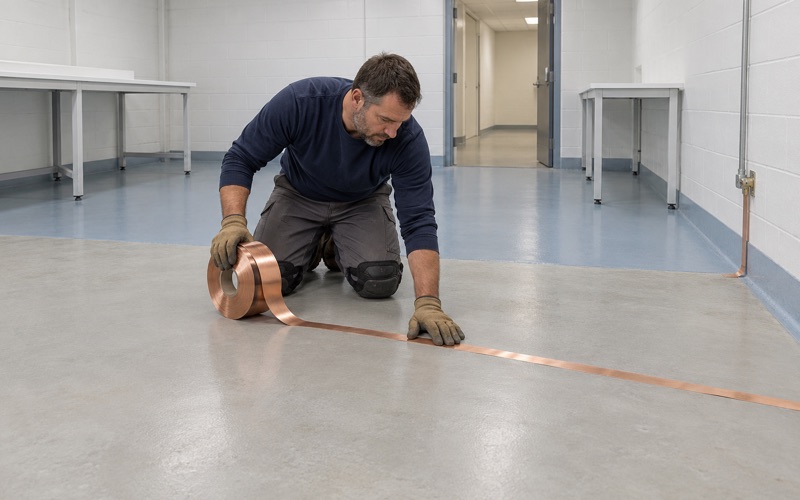
A dry-looking garage slab is not proof of a dry one, so we test before we coat. That can mean an ASTM F1869 calcium chloride test, ASTM F2170 in-situ relative humidity probes or an ASTM D4263 plastic sheet test, depending on the slab.
Wisconsin does not require a vapor retarder under an unconditioned attached garage slab; SPS 322.38 carries that attached garage exception. So a garage slab may have nothing under it to slow moisture, and the test result, not the look of the surface, decides whether a moisture-mitigation primer belongs in the system.
Before you sign, we read the warranty exclusions out loud, with moisture from below named first. We also do not sell a floor coating as a fix for water coming up through a slab.
What about winter salt on the same floor?
We build garage floors for the road salt and calcium chloride brine that winter tires track in. The same cured system that sits under a bleed stand takes that brine near the door, and both reward the same habit of cleaning up rather than letting it sit.
What do I get in writing?
Every home job gets a written contract before we take a deposit, with the products and any warranty written into it. If you bleed brakes in that garage, tell us, and we will build the floor and plan the stand area around it.
- 20+ Years Experience
- Moisture Testing in Every Scope
- Written Proposals and Contracts