Brookfield Epoxy Flooring installs basement floor epoxy in Brookfield, WI, serving surrounding cities including Wauwatosa, West Allis, Pewaukee, New Berlin and Menomonee Falls. In 20+ years of coating floors, the basement is where we have seen the most failures caused by skipping one step: testing the slab for moisture before anything is rolled onto it.
A basement slab sits in the ground, and the ground is wet. Vapor moves up through the concrete, groundwater can press on it from below, and summer humidity condenses on its cool surface. None of that shows on a floor that looks dry, which is why moisture testing is a line item in every basement scope we write.
Every proposal names the product, the system build and the finished thickness, and every home job gets a written contract with the products and any warranty spelled out before a deposit is taken.
Moisture Comes First on a Basement Floor
Testing the Slab Before Choosing a Color
We start with an ASTM D4263 plastic sheet test to see whether moisture is collecting under a taped sheet. Where the floor will carry a full system, we add an ASTM F1869 calcium chloride test or ASTM F2170 in-situ relative humidity probes for a number. ASTM F710 sets common limits at 3 pounds per 1,000 square feet in 24 hours or 75% relative humidity.
If the slab tests above what the chosen system tolerates, a moisture-mitigation primer goes down first. If it tests far beyond any primer’s rating, or is actively taking water, we say plainly that the floor is not ready to coat.
Hydrostatic Pressure Under a Basement Slab
When the water table rises after a wet spring, groundwater can press up against the underside of a slab. That pressure drives moisture and dissolved salts through concrete that looks perfectly dry at the surface. Under a coating, that moisture builds at the bond line and lifts the film in blisters.
We ask about seasonal water, look for tide lines and staining along the walls, and check the sump. A basement that takes water needs drainage work first, and we do not coat over that problem to make a sale.
Efflorescence on the Slab
Efflorescence is the white, chalky powder that collects on basement floors and walls. It is mineral salt carried up by moisture and left behind as the water evaporates. A coating applied over it has nothing solid to hold onto, and new salts keep arriving under the film.
We grind efflorescence off, test the slab, and choose a mitigation primer where readings show vapor is still moving. Where efflorescence is heavy and constant, the water source needs attention before the floor does.
Summer Condensation and Dew Point
In a humid Wisconsin summer, warm air hits a slab kept cool by the ground and water condenses right on it. Basement floors sweat for this reason even when no water is coming through. Coating a slab near its dew point traps a film of moisture under the resin.
We measure slab temperature and the dew point spread at the surface before mixing, and run dehumidifiers when the margin is too thin. Some summer days, the right call is to wait until the air dries out.
Basement Floor Epoxy Systems
100% Solids Epoxy With a Flake Broadcast
For most basements, we install a 100% solids epoxy base with a vinyl flake broadcast and a clear topcoat. The flake adds texture and hides dust and small marks, and the system cleans with a damp mop. Chip size and blend are chosen from samples laid on your floor.
Moisture-Mitigation Primers
A moisture-mitigation primer is a dense epoxy formulated to hold back vapor emissions up to a stated limit, so the rest of the system can bond. It is not waterproofing and it cannot handle running water. It is the right tool when testing shows elevated vapor in a slab that is otherwise sound and dry to the eye.
Metallic and Solid Color Finishes for Finished Basements
In a finished basement used as a family room or bar area, a metallic epoxy floor gives a marbled, polished-stone look that pairs well with rugs and furniture. A solid color coat suits laundry and utility rooms where the job is to be bright and easy to clean. Both start with the same grinding and moisture testing.
How the Room Is Used Shapes the Floor
Home Gyms and Weight Areas
A basement gym takes dropped dumbbells and sliding equipment. We build a thicker system in lifting zones and recommend rubber mats where heavy weights are dropped, since no coating is meant to take repeated impact from a loaded bar. The coated floor around the mats stays easy to wipe clean.
Playrooms, Rec Rooms and Laundry Areas
Playrooms and laundry rooms see spills, toys and water. A textured topcoat keeps the floor safer when it is wet, and a seamless surface means spills do not soak into grout or carpet padding. Around washers and utility sinks, we detail the coating to shed water toward the floor drain.
Workshops and Storage
A basement workshop sees oils, solvents, paint and rolling tool chests. We choose chemical-resistant topcoats for these rooms and build up the film where carts and heavy benches move. Storage areas get a simpler system that brightens the room and keeps dust down.
Finishing a Basement in Brookfield
The Rec-Room Permit
The City of Brookfield requires a building permit to finish a recreation room, at $0.45 per square foot with a $70 minimum and a $125 non-refundable plan exam fee. The city handout covers walls, ceilings and electrical, not the floor. When a coating is part of a finish, we schedule around the permit and its inspections.
Because finishing a basement and coating a floor are different questions, we ask City of Brookfield Inspection Services, or the village inspector in a neighboring community, before scheduling when a job’s scope sits between the two.
Sump Pits, Floor Drains and Wall Edges
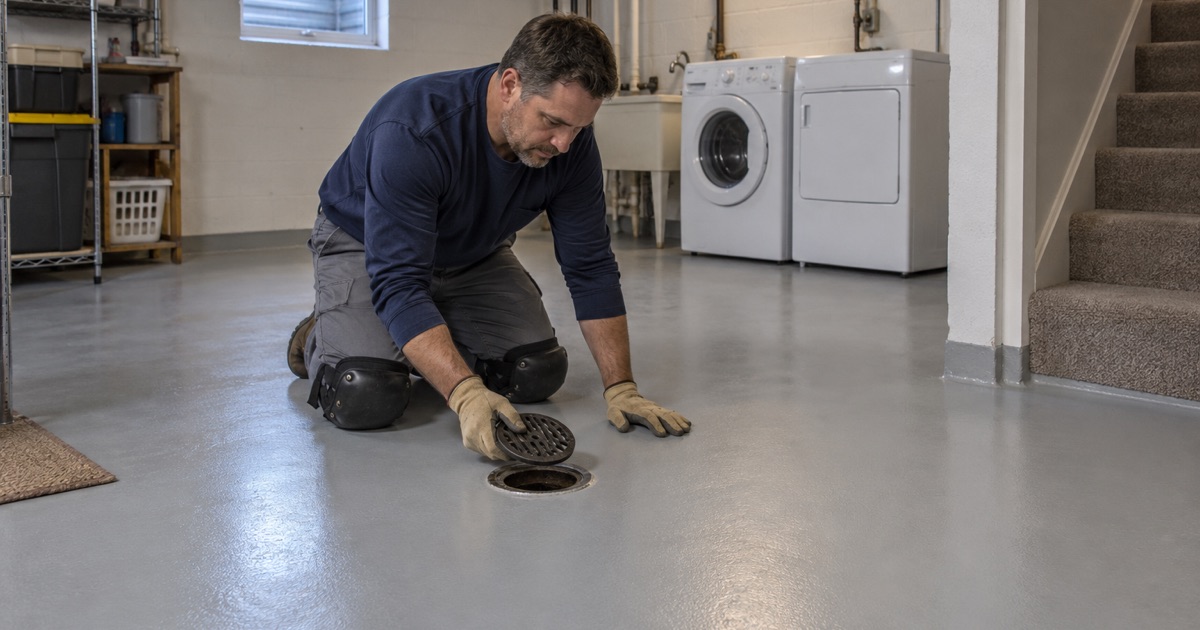
Basement coatings tend to fail first at the edges: around the sump pit, at floor drains and along the cove joint where floor meets wall. We grind right to the wall, detail around drains, and finish neatly at the sump basin. Water reaching an edge should run across the coating, not under it.
Radon and Basement Coatings
We do not sell a basement floor coating as radon reduction. A coated floor is not a mitigation system, and if a radon test calls for mitigation, that is work for a radon specialist. If a mitigation system is planned, we coordinate so the floor is coated around its penetration.
Warranty Exclusions, Read Out Loud
Nearly every coating warranty excludes failure caused by moisture or hydrostatic pressure from below the slab. We read that exclusion to you before the job is sold, along with any other terms. The testing at the start of every job is what keeps that clause from ever being used.
Our Step-by-Step Basement Floor Epoxy Process
Step 1: Inspection and Moisture Test
We look at the slab, walls, sump and drains, ask about water history and run moisture tests. The proposal lists the system, thickness and any mitigation primer.
Step 2: Grinding and Repair
The floor is diamond ground with dust extraction, and cracks and pits are filled and ground flush. Efflorescence and old paint come off in this step.
Step 3: Primer and Base Coat
We apply the mitigation primer or standard primer, then the epoxy base coat and broadcast, timed against the slab temperature and dew point that day. Dehumidifiers run when the margin is thin.
Step 4: Topcoat and Cure
The clear topcoat goes on, and you get written times for light foot traffic and for moving furniture back in. Both come from the product’s cure data, not a guess.
- 20+ Years Experience
- Moisture Testing in Every Scope
- Written Proposals and Contracts